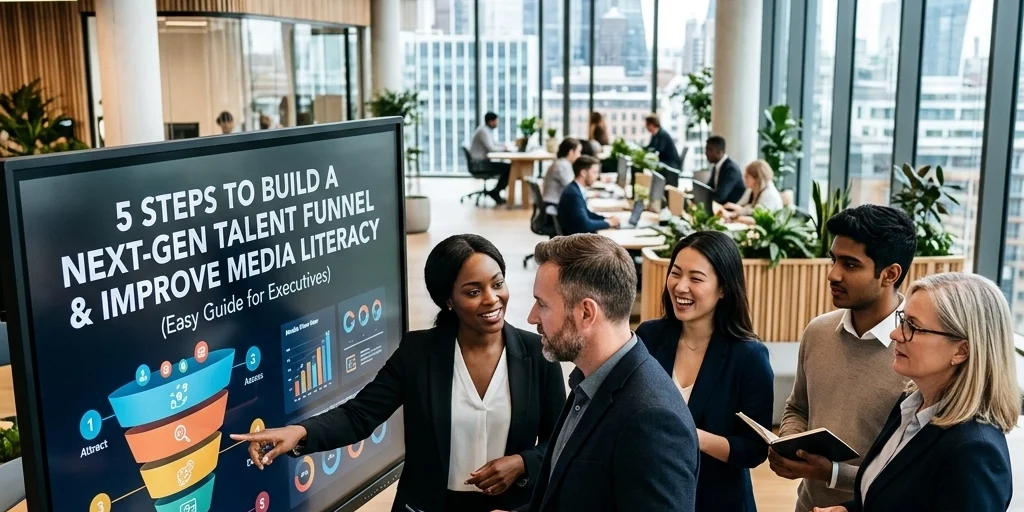
In the rapidly evolving landscape of 2026, the traditional methods of talent acquisition are no longer sufficient to maintain a competitive edge. As technology advances and the digital economy expands, the gap between what is taught in schools and the skills required in the boardroom is widening. For executives at the helm of modern enterprises, the challenge is two-fold: building a sustainable pipeline of high-caliber talent and ensuring that this talent possesses the media literacy required to navigate a world saturated with information.
The solution lies in shifting from a reactive "hiring" mindset to a proactive "talent cultivation" strategy. By positioning your organization as an anchor for "Future Ready" schools, you can create a reciprocal ecosystem that benefits the business, the students, and the community at large. This guide outlines five essential steps to building a next-gen talent funnel while prioritizing media literacy and data-driven outcomes.
1. Shift from Job Postings to Role and Skill Mapping
The first step in modernizing your talent funnel is to stop looking for "employees" and start looking for "capabilities." Traditional job postings are often static and outdated by the time they are published. Instead, executives should focus on role mapping and skill mapping.
Identify 3–5 roles within your organization that are critical for growth over the next decade. Rather than listing years of experience, break these roles down into three distinct categories:
- Foundational Skills: Entry-level technical requirements (e.g., data interpretation, basic coding, or digital project management).
- Trainable Skills: Industry-specific knowledge that can be taught internally.
- Core Behaviors: Non-technical attributes such as learning agility, reliability, and emotional intelligence.
By utilizing data analytics dashboards, executives can gain a high-level view of where these skills currently exist in the market and where the gaps are. These dashboards allow leadership to visualize the "health" of their future pipeline, moving talent strategy from guesswork to a data-backed science.

2. Anchor "Future Ready" Schools through Deep Partnerships
A next-gen funnel requires going to the source. However, the old model of attending a single "Career Day" per year is ineffective. To truly influence the quality of your future workforce, your organization must become an anchor for local schools and districts.
Building deep relationships with 2–4 "Future Ready" school partners allows for a more integrated approach. This means moving beyond occasional visits and engaging directly with principals, counselors, and Career and Technical Education (CTE) coordinators.
The primary goal of these partnerships should be the integration of media literacy into the curriculum. In an era of deepfakes and algorithmic bias, media literacy is no longer just a soft skill: it is a business necessity. Employees who can discern fact from fiction and understand the nuances of digital communication are less likely to fall for phishing schemes and more likely to represent your brand accurately online. Promoting these outcomes ensures that the students entering your funnel are not just technically capable, but digitally resilient.
For more insights into how these partnerships drive business growth, you can explore our business category.
3. Implement NIL Education and Personal Branding
The landscape of student engagement changed significantly with the rise of Name, Image, and Likeness (NIL) opportunities. While originally focused on collegiate athletes, the principles of NIL are now filtering down into high schools and general vocational training.
Executives who incorporate NIL education into their talent funnels provide immense value to students. Teaching young people how to manage their personal brand, understand basic contracts, and maintain professional digital footprints creates a more mature pool of candidates.
NIL education serves as a practical application of media literacy. It teaches students that every post, comment, and interaction is a piece of media that reflects on their professional identity. When a company provides this education, it positions itself as a mentor rather than just a recruiter. This builds brand loyalty before the student has even graduated.

4. Launch a 90-Day "Micro-Work" Execution Plan
Complexity is the enemy of execution. To build a talent funnel that actually works, executives should implement a simple, repeatable 90-day program calendar. This pilot program should focus on "micro-work": small, meaningful tasks that provide real skill signals.
- Month 1: Awareness and Alignment. Host awareness sessions at partner schools. Use this time to explain the industry and the specific skills your company values.
- Month 2: The Challenge Phase. Introduce micro-work projects. These are low-stakes deliverables, such as cleaning a small dataset, creating a social media mock-up, or drafting a project summary.
- Month 3: Evaluation and Selection. Use the outcomes of the micro-work to identify high-potential students for further engagement, such as internships or mentorship circles.
Micro-work provides "evidence of work" that a traditional resume cannot. It allows hiring managers to see how a student approaches a problem, follows instructions, and handles feedback. This data is then fed back into the data analytics dashboards to refine the funnel further.
5. Track Relationships via Talent Relationship Management (TRM)
The final step is to treat your talent funnel like a long-term sales pipeline. Most companies make the mistake of putting student contacts into an Applicant Tracking System (ATS). An ATS is designed to filter people out; a Talent Relationship Management (TRM) system is designed to keep them engaged over time.
A TRM allows you to track a student’s progress from their first interaction in 10th grade through their college years or vocational training. You can monitor:
- Attendance at touchpoints and workshops.
- Performance on micro-work challenges.
- Mentor notes on soft skills and learning agility.
- Readiness levels for full-time employment.
This long-term tracking ensures that when a role opens up, you aren't starting your search from scratch. You are simply reaching out to a warm lead who has been part of your ecosystem for years. This drastically reduces the "Time to Hire" and improves the quality of the "Cost per Hire."
The Strategic Advantage of Media Literacy Outcomes
As we look toward the future, the integration of media literacy into talent development is not just an educational goal: it is a risk management strategy. According to recent industry observations, companies that prioritize media literacy in their training programs see a marked decrease in internal security breaches and an increase in creative problem-solving.
"Media literacy is the new 'reading and writing' for the digital age," says Dan Kost, CEO of USA Entertainment Ventures LLC. "If your talent can't navigate a complex information environment, they can't effectively lead your business into the future."
By focusing on these outcomes, your organization doesn't just hire workers; it fosters citizens who are equipped to handle the complexities of the modern world. This is the hallmark of a "Future Ready" anchor institution.
Conclusion: Future-Proofing the Enterprise
Building a next-gen talent funnel is an investment in the most valuable asset any company possesses: its people. By moving away from transactional hiring and toward a skills-based, data-driven partnership model, executives can secure their organization's future.
Integrating NIL education and media literacy ensures that the next generation of workers is professional, discerning, and ready to contribute from day one. As you look at your strategy for the coming years, ask yourself if your current funnel is simply filling seats, or if it is building a foundation for long-term excellence.
For those ready to take the first step, focusing on school partnerships and data transparency is the most effective way to start. The future belongs to those who prepare for it today.
To learn more about our work in various sectors, visit our portfolio category page or check out our latest updates in technology.