
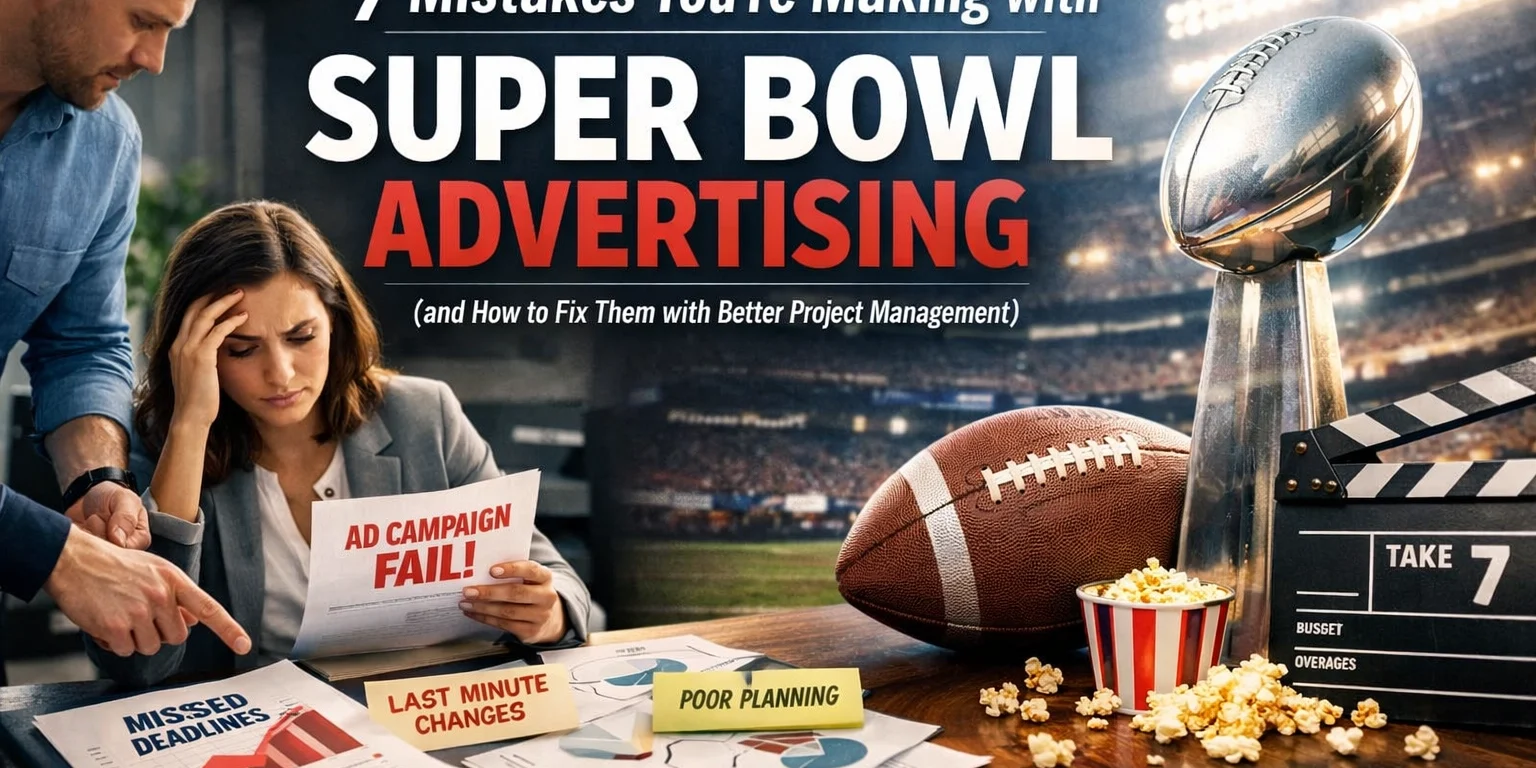
In the world of sports media, there is no bigger stage than the Super Bowl. As we reflect on the 2026 season, the stakes have never been higher. With 30-second spots commanding upwards of $7 million, the margin for error is non-existent. Yet, year after year, multi-billion dollar brands fall into the same traps.
At USA Entertainment Ventures LLC, we’ve observed that the difference between a viral success and a multi-million dollar flop often isn't the creative idea itself: it’s the project management behind it. Whether you are navigating sports advertising or a broad media rollout, execution is everything.
In this edition of our newsletter, The Super Bowl Playbook – Sports Media's Advertising Strategy, we’re breaking down the seven most common mistakes brands made this year and how a more disciplined approach to project management can save your ROI.
https://www.youtube.com/watch?v=l6J-0zileKE
1. Prioritizing Celebrity Over Substance
The 2026 Super Bowl landscape was crowded with A-listers, but many brands learned the hard way that a famous face cannot save a weak concept. Ads like Ro, featuring Serena Williams, and Uber Eats, with Bradley Cooper and Matthew McConaughey, suffered from what industry analysts call "celebrity reliance."
The Mistake: Casting stars without giving them meaningful material. When the audience feels the ad is just a "celebrity for celebrity's sake" play, they disengage.
The Fix: Use celebrities in service of an idea, not as a substitute for one. From a project management perspective, this requires a rigorous vetting process during the pre-production phase. Your project manager should ensure that the creative brief explicitly links the celebrity’s persona to a core product truth. If you can swap the celebrity for a different one and the ad still "works" (or still doesn't), your strategy is flawed.
2. Failing to Communicate a Clear Product Message
It sounds elementary, but several high-profile spots in 2026 left viewers asking, "Wait, what was that actually for?" Instacart's spot was described by viewers as so "loud and over-the-top" that the actual service was drowned out by the noise. Similarly, Wegovy’s GLP-1 advertisement lacked a clear emotional anchor or value proposition.
The Mistake: Letting the spectacle overshadow the product.
The Fix: Implement a "Product Truth" milestone in your project timeline. Before a single frame is shot, the project lead must confirm that the benefit is tangible. For more on how to create these connections, check out our Ultimate Guide to Super Bowl 2026 Fan Engagement. Ground your spectacle in differentiation.

3. Mismatching Emotional Appeal with Brand Identity
Emotional storytelling is a powerful tool, but it must be authentic to the category. This year, Rocket Mortgage attempted to sell financial products by highlighting "good neighbors." While the sentiment was nice, it felt disconnected from the reality of mortgages. Wells Fargo faced similar criticism for showing intrusive "celebrations" that contradicted their promise of being "there for customers."
The Mistake: Using "borrowed interest" or emotional themes that don't align with the brand’s actual utility.
The Fix: This is where consulting and brand auditing become vital. Project management isn't just about deadlines; it’s about brand stewardship. Use data-driven research to ensure your emotional hook aligns with customer expectations for your specific industry.
4. Using Confusing or Ironic Creative Executions
As technology evolves, brands are tempted to use the "latest thing" just because it’s there. Svedka’s use of AI-generated robots created a "creepy" feeling that alienated audiences. OpenAI ironically used heavily analogue media to promote its AI services, leaving viewers puzzled by the disconnect.
The Mistake: Chasing tech trends without considering the psychological impact on the viewer.
The Fix: Better user testing and quality control. A robust project management framework includes a feedback loop where the creative execution is tested against a sample audience before finalizing the buy. At USA Entertainment Ventures LLC, we believe technology should enhance the human experience, not distract from it.

5. Making Persuasive Intent Too Transparent
Dunkin’s "Good Will Hunting" themed ad struggled because it felt like it was trying too hard. Between the heavy reliance on inside jokes and a constant stream of cameos, the "persuasive intent" was too obvious. When viewers feel they are being "sold to," their skepticism activates, and emotional engagement drops.
The Mistake: Signaling "this is an ad" too early and too often.
The Fix: Focus on narrative integration. Project managers should oversee the "pacing" of the script to ensure the brand message is woven into the story naturally. If the ad feels like a commercial for the celebrity's brand rather than yours, you’ve lost the plot.
6. Chasing Novelty Without Strategic Purpose
Liquid I.V. featured a spot with someone singing in a bathroom. It was certainly "quirky," but it felt like the creative brief got lost somewhere between strategy and execution. When everyone is trying to be "unexpected," nothing is unexpected anymore.
The Mistake: Aiming for "weird" at the expense of "relevant."
The Fix: Strict adherence to the strategic brief. A project manager’s job is to keep the creative team on the rails. If a creative choice doesn't serve the primary objective established in the research phase, it shouldn't make the final cut.

7. Building Hype That Doesn’t Pay Off
The teaser campaign has become a staple of Super Bowl marketing, but it’s a double-edged sword. Many brands invested millions in elaborate teasers that built a mystery the final 30-second spot couldn't possibly satisfy.
The Mistake: Over-promising in the pre-game and under-delivering during the kickoff.
The Fix: Integrated campaign management. Your project roadmap must treat the teaser and the main spot as a single cohesive journey. Ensure the "payoff" is worth the build-up. If your teaser is more interesting than your commercial, you need to revisit your editing room.
How Better Project Management Fixes Everything
At USA Entertainment Ventures LLC, led by our CEO Dan Kost, we understand that a Super Bowl ad isn't just a video; it's a massive logistical and strategic undertaking. Whether we are working on distribution or digital strategy, we apply a few core principles to avoid the mistakes listed above:
- Clear Accountability: Every creative decision must be tied back to a specific business goal.
- Strategic Guardrails: We ensure that "novelty" never replaces "utility."
- Holistic Oversight: From the initial consulting phase to the final airtime, we maintain a singular focus on the product truth.
Advertising during the Big Game is a gamble, but it doesn't have to be a blind one. By tightening your project management processes and focusing on substance over flash, your brand can stand out for all the right reasons.

As we look toward the future of media and entertainment, the brands that succeed will be the ones that ground their spectacle in meaningful differentiation. If you're looking for a partner to help navigate your next big rollout: whether it's a national campaign or a national infrastructure rollout: we’re here to help.
The Super Bowl is just the beginning. The real work happens in the planning. Let’s make sure your next project is a touchdown.





