
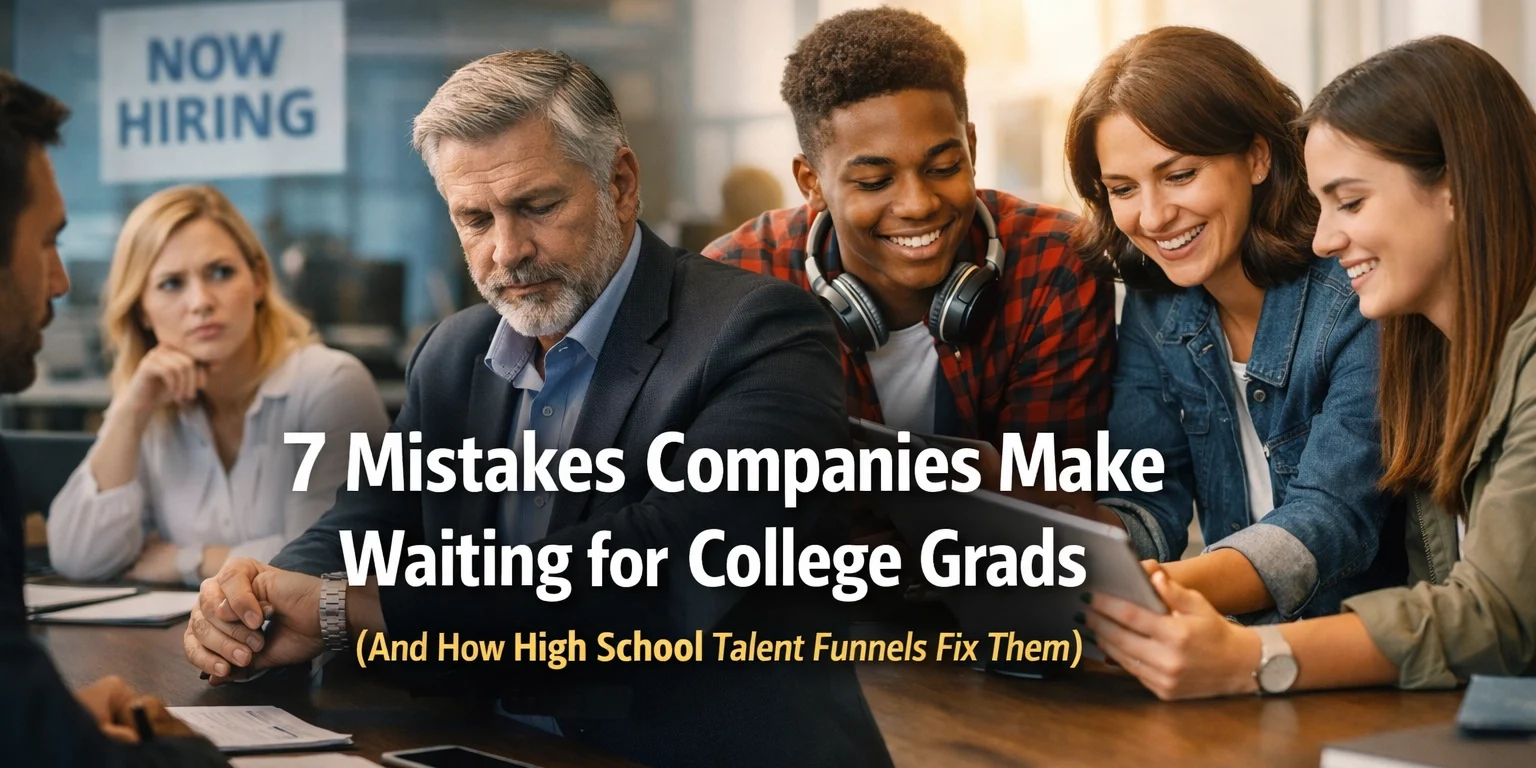
The talent acquisition landscape has fundamentally shifted. While most companies continue operating under traditional recruitment models: posting job openings and waiting for college graduates to apply: a growing gap has emerged between workforce demand and supply, particularly in specialized fields like Cloud computing, AI, and Data Analytics. Current projections indicate that the technology sector alone will face a shortage of over 85 million skilled workers by 2030, representing approximately $8.5 trillion in unrealized annual revenues globally.
This scarcity has prompted forward-thinking organizations to reconsider when and how they engage future talent. The conventional approach of recruiting fresh college graduates has become increasingly problematic, revealing systemic inefficiencies that impact both hiring costs and long-term retention. Understanding these pitfalls illuminates why high school talent funnels represent not merely an alternative strategy, but a necessary evolution in workforce development.

Mistake #1: Missing the Critical Development Window
Companies that wait until college graduation forfeit four to six years of potential skill development and relationship building. During high school years, students demonstrate heightened neuroplasticity and adaptability: qualities that facilitate rapid technical learning and cultural assimilation. Research in cognitive development consistently shows that adolescents who receive structured exposure to technical fields during their formative years develop stronger foundational competencies than those who begin training later.
High school talent funnels capitalize on this developmental window by introducing students to Cloud platforms, AI concepts, and Data Analytics methodologies before they commit to traditional educational paths. This early engagement allows companies to shape talent according to specific technical requirements rather than inheriting graduates with generalized, potentially misaligned skill sets.
Mistake #2: Competing in an Oversaturated Market
The competition for qualified college graduates in technical fields has intensified exponentially. Major technology corporations, startups, and established enterprises all converge on the same limited talent pool each recruitment cycle. This creates bidding wars that inflate entry-level salaries and benefits packages while simultaneously reducing the likelihood of securing top candidates.
By establishing relationships with high school students, companies effectively remove themselves from this hypercompetitive environment. They cultivate exclusive pipelines that yield committed candidates who have grown alongside the organization, understanding its culture and expectations long before formal employment begins. This strategic repositioning transforms recruitment from a reactive scramble into a proactive cultivation process.

Mistake #3: Paying Premium Prices for Untrained Talent
Current market conditions demand that companies offer competitive compensation packages to attract recent graduates, despite these candidates typically requiring six to twelve months of intensive onboarding and training before reaching full productivity. According to industry analyses, the average cost of hiring and training a new college graduate in technical roles ranges between $50,000 and $75,000 when accounting for recruitment expenses, onboarding resources, and lost productivity during the learning curve.
High school talent funnels invert this model. Through internships, mentorship programs, and structured learning opportunities during secondary education, students develop practical competencies and company-specific knowledge gradually and cost-effectively. By the time these individuals reach employment age, they require minimal additional training, allowing companies to allocate resources more efficiently while offering competitive entry-level positions to candidates who already demonstrate proven capabilities.
Mistake #4: Dealing with Misaligned Expectations
Many college graduates enter the workforce with expectations shaped by academic environments that differ significantly from corporate realities. This misalignment frequently manifests in unrealistic compensation demands, inflexibility regarding role responsibilities, or insufficient understanding of professional workplace dynamics. These disconnects contribute to early-career dissatisfaction and elevated turnover rates, with studies indicating that approximately 30% of new hires leave their positions within the first 90 days.
Students who participate in high school talent funnels gain realistic exposure to workplace environments, project demands, and career trajectories well before making employment commitments. This extended preview period allows both parties to assess compatibility, adjust expectations, and build relationships based on accurate understanding rather than idealized assumptions. The result is significantly improved retention rates and mutual satisfaction.

Mistake #5: Losing Talent to Competitors with Earlier Relationships
As awareness grows regarding the benefits of early talent engagement, pioneering companies have begun establishing strong presences in high schools, particularly within STEM programs. These organizations cultivate relationships with promising students years before graduation, offering mentorship, project opportunities, and clear pathways to employment. Students who develop these early connections naturally gravitate toward companies that invested in their development, creating competitive advantages that traditional recruitment methods cannot overcome.
Companies that delay engagement until college graduation increasingly find themselves excluded from conversations with the most promising candidates. By the time traditional recruiters make contact, many top students have already committed to organizations that supported their development throughout their educational journey. This temporal disadvantage places late-adopting companies at permanent competitive disadvantage within rapidly evolving technical fields.
Mistake #6: Accepting Generic Skill Sets Instead of Company-Specific Training
College curricula, by necessity, provide broad foundational knowledge across various technologies, methodologies, and platforms. While this generalist approach serves educational purposes, it produces graduates whose competencies may not align precisely with specific organizational needs. Companies that hire these graduates must then invest substantial resources in retraining or supplementary education to bridge gaps between academic preparation and practical requirements.
High school talent funnels allow organizations to introduce students to proprietary systems, preferred platforms, and company-specific workflows progressively over several years. This extended training period produces candidates whose technical abilities map directly onto organizational needs from day one. Rather than spending months translating generic skills into practical applications, companies can immediately deploy these individuals in productive roles, accelerating both individual career progression and organizational return on investment.

Mistake #7: Starting from Zero with Culture Fit
Organizational culture represents one of the most significant predictors of employee satisfaction, performance, and retention. Yet traditional hiring processes allocate minimal time to evaluating cultural compatibility, relying instead on brief interviews and reference checks to assess whether candidates will thrive within existing team dynamics. This inadequate evaluation process contributes to poor hiring decisions, team conflicts, and premature departures that cost organizations both financially and operationally.
High school talent funnels transform cultural assessment from a speculative exercise into an extended observation period. Students who interact with organizations over multiple years through internships, project collaborations, and mentorship relationships reveal their authentic work styles, communication preferences, and values alignment gradually and reliably. Companies gain comprehensive understanding of each candidate's cultural compatibility long before making hiring commitments, virtually eliminating the risk of cultural mismatch that plagues conventional recruitment approaches.
Building Sustainable Talent Infrastructure
The shift from reactive college recruitment to proactive high school engagement represents more than tactical adjustment: it constitutes strategic repositioning that addresses fundamental weaknesses in traditional talent acquisition models. Companies that recognize these seven mistakes and implement high school talent funnels establish sustainable competitive advantages in securing Cloud, AI, and Data Analytics expertise.
This approach requires initial investment in program development, educational partnerships, and mentorship infrastructure. However, organizations that commit to these early-stage relationships consistently report superior outcomes: reduced hiring costs, improved retention rates, faster productivity timelines, and access to talent pools that competitors cannot reach.
The question facing business leaders is not whether to engage with high school talent, but whether they can afford to continue operating without these strategic pipelines as competition for technical expertise intensifies. The companies that recognize this reality and act accordingly will define the competitive landscape for the next decade, while those that cling to outdated recruitment models will find themselves perpetually disadvantaged in the war for talent.





