
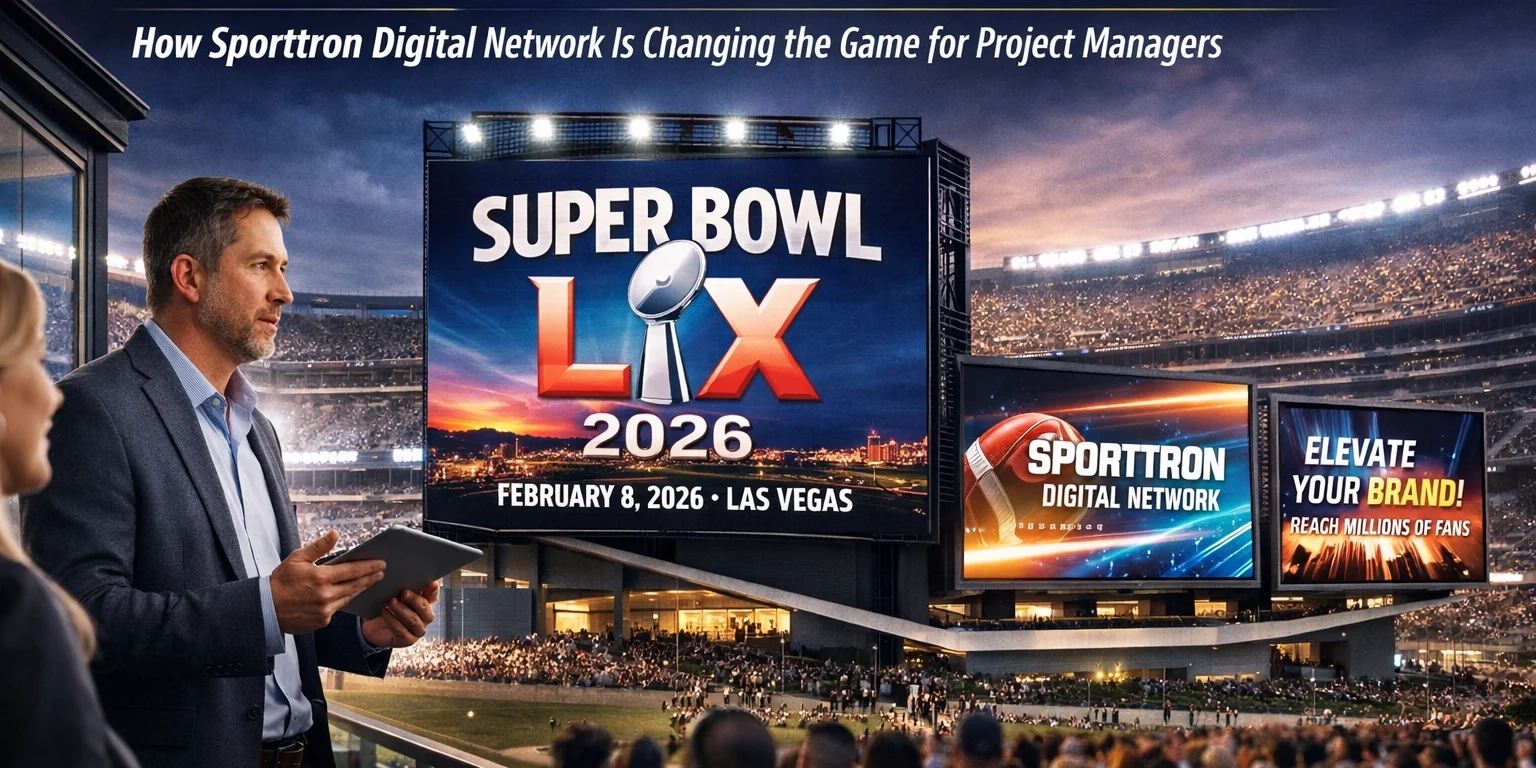
The Super Bowl remains advertising's most coveted stage, but the game itself represents only a fraction of the total advertising opportunity. For project managers orchestrating campaigns around Super Bowl 2026, the real challenge: and opportunity: exists in the physical environments surrounding the event. Out-of-home (OOH) advertising at sporting venues has traditionally demanded fragmented coordination across dozens of vendors, venues, and technical specifications. That complexity is now being systematically eliminated.
The Sporttron Digital Network: Centralizing Venue Access
The Sporttron Digital Network represents a fundamental shift in how large-scale sporting event campaigns are executed. Developed by Sports Media Inc., this proprietary system provides centralized access to ribbon boards and jumbotrons across more than 780 venues nationwide. For context, consider what this consolidation means: a project manager can now coordinate messaging across hundreds of high-traffic sporting environments through a single platform rather than negotiating separate agreements with individual venue operators.

This centralization addresses a persistent operational bottleneck. Traditional venue advertising required marketing teams to maintain relationships with multiple vendors, navigate varying technical requirements, and coordinate timing across disparate systems. Each venue operated as its own silo, with unique specifications for content delivery, approval processes, and scheduling protocols. The administrative overhead consumed resources that could otherwise focus on campaign strategy and creative development.
The Project Manager's Operational Reality
Before platforms like Sporttron emerged, project managers faced a predictable cascade of challenges. Brand guidelines: carefully developed to ensure consistency across all customer touchpoints: frequently degraded during implementation. When a campaign spanned 50 venues, slight variations in how each venue interpreted and displayed content compounded into significant inconsistencies. A brand's visual identity, messaging hierarchy, or call-to-action placement might vary substantially depending on which regional vendor handled the installation.
The logistical coordination alone demanded dedicated personnel. Scheduling content rotations, managing version control as campaigns evolved, and troubleshooting technical issues across multiple platforms required constant vigilance. For time-sensitive campaigns like Super Bowl activations, where messaging needs to shift rapidly in response to game developments or social media trends, this fragmentation introduced unacceptable delays.
How Sporttron Changes Campaign Execution
The operational efficiency gains extend beyond simple convenience. By consolidating venue access, Sporttron enables project managers to enforce brand guidelines uniformly across hundreds of locations simultaneously. When a creative team finalizes an updated message or visual element, that change can propagate across the entire network without requiring individual coordination with each venue. This consistency protects brand equity and ensures that every customer interaction reinforces the same strategic message.
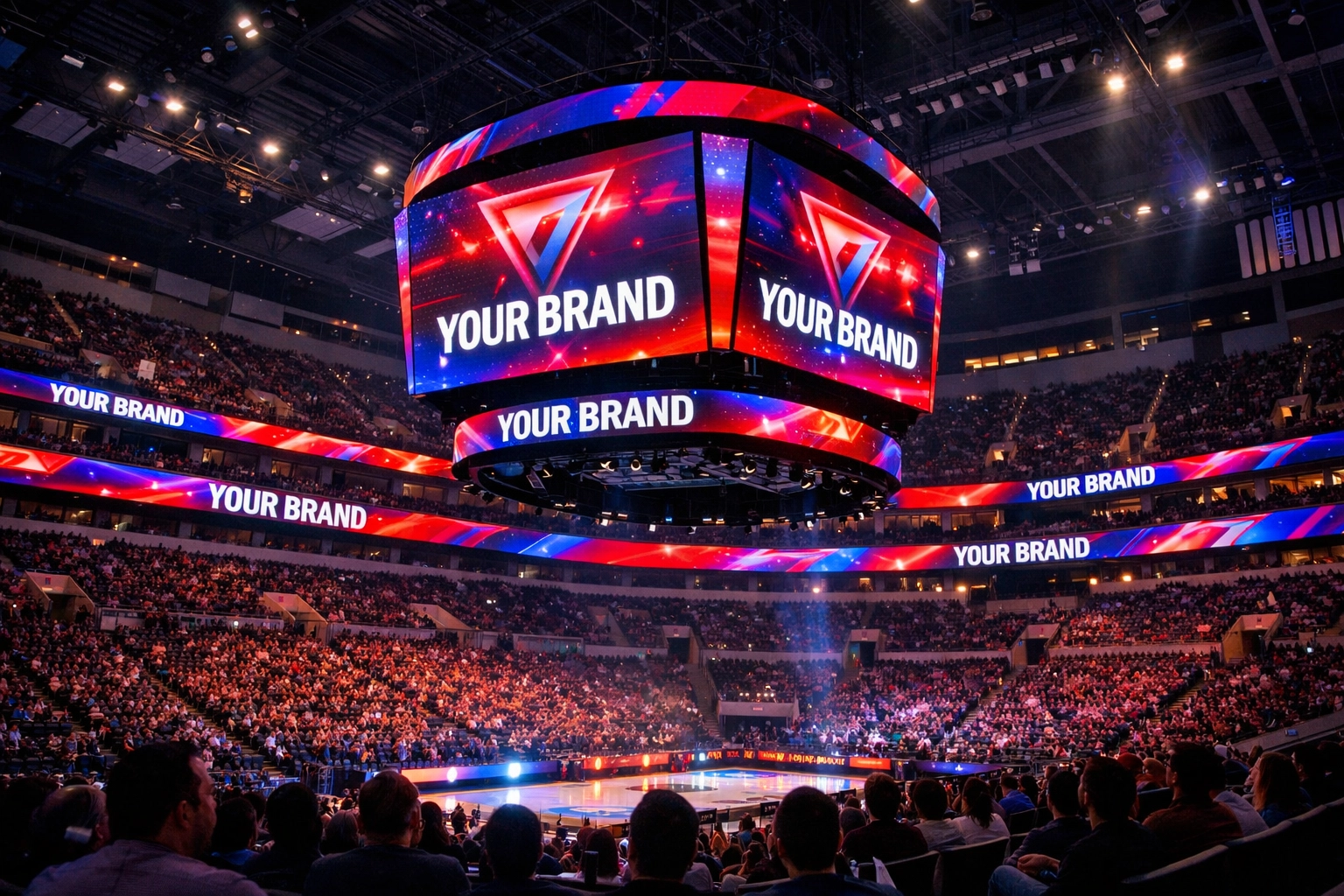
The platform's architecture also supports more sophisticated campaign structures. Project managers can segment venues by geography, audience demographics, or game timing to deliver targeted messages that resonate with specific fan segments. A campaign might display one message set in venues hosting college games while simultaneously deploying alternative creative in professional arenas, all managed through unified controls.
Beyond Digital Displays: Multi-Format Integration
The strategic value of OOH advertising during major sporting events extends well beyond jumbotrons and ribbon boards. Effective campaigns recognize that venue environments offer multiple engagement opportunities, each serving distinct functions in the customer journey. Times Square billboards build pre-event awareness weeks before game day, establishing brand presence in the cultural conversation surrounding the Super Bowl. These high-visibility placements capture attention from audiences who may not attend games but participate in the broader event experience.
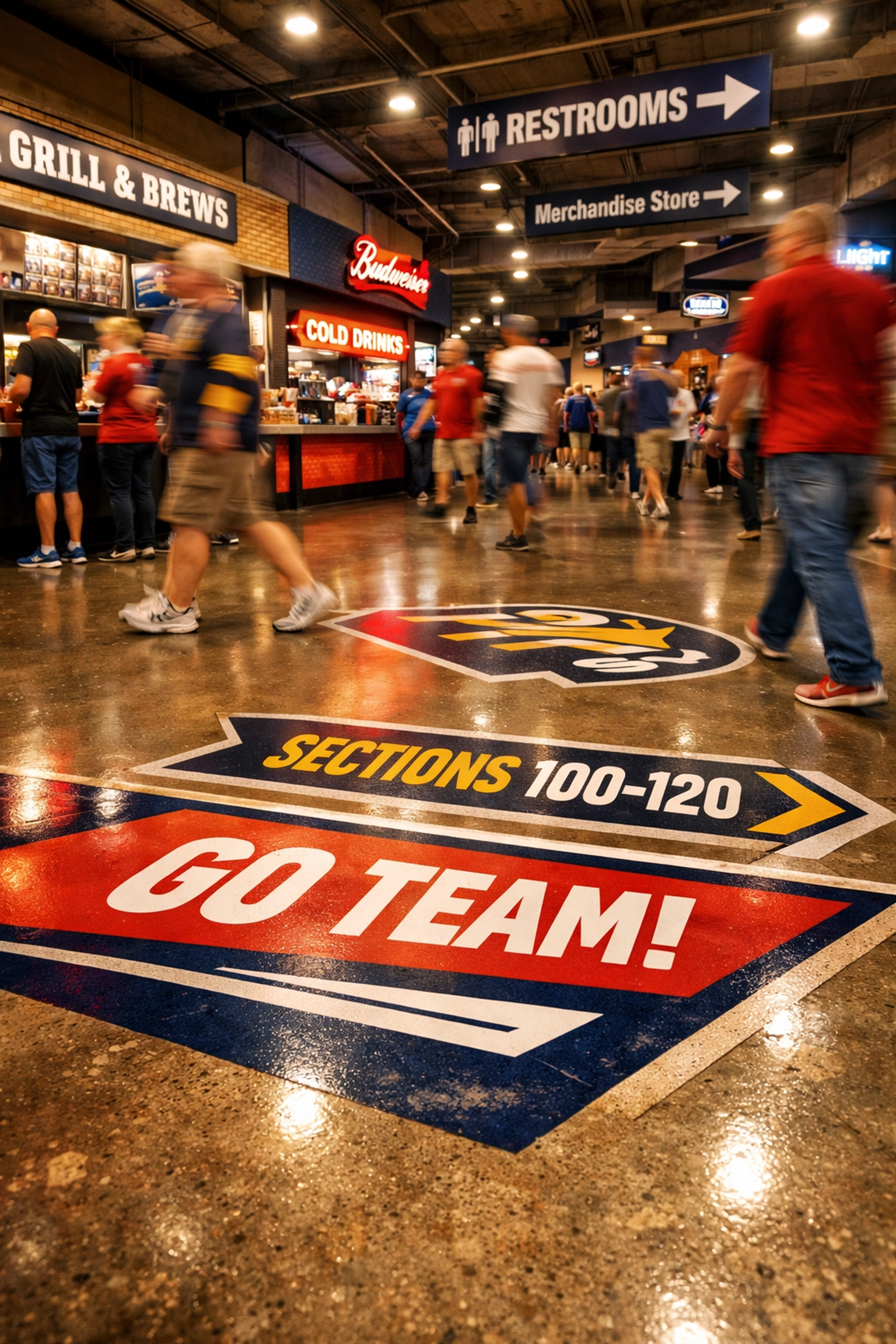
Within venue environments themselves, concourse floor graphics and concession area placements engage fans during natural pause points. Unlike digital ads that compete for attention with game action, these physical touchpoints connect with audiences when they're receptive to messaging: waiting in lines, navigating to seats, or socializing between quarters. This multi-layered approach acknowledges a fundamental truth about consumer behavior: different people respond to different stimuli at different moments.
Data-Driven Decision Making and Athlete Partnerships
Sports Media Inc. positions Sporttron within a broader sports marketing ecosystem that combines physical advertising infrastructure with digital analytics and fan sentiment analysis. The company's management of partnerships with over 20,000 athletes through Name, Image, Likeness (NIL) agreements provides valuable data streams about fan preferences and engagement patterns. This intelligence informs which venue locations generate optimal visibility and which messaging approaches resonate most effectively with specific audience segments.
For project managers, this data integration transforms OOH advertising from a relatively static medium into a responsive system. Campaign performance metrics: gathered from digital channels, social media engagement, and venue foot traffic analysis: can inform real-time adjustments to physical advertising placements. If certain messages generate disproportionate social media response, those elements can receive enhanced visibility in subsequent venue rotations.
Super Bowl 2026: The Broader Advertising Landscape
Super Bowl LX (2026) reflects advertising trends that extend beyond traditional commercial spots. Recent analysis indicates that AI platforms dominated with seven advertisements generating substantially more consumer engagement than traditional product categories. One AI platform generated 9.1 times as much impact as the median Super Bowl advertisement, signaling a significant shift in what captures audience attention and drives post-event conversation.
This trend toward technology-focused advertising reinforces the strategic importance of OOH placements. As television commercials become increasingly crowded with similar technology narratives, physical venue advertising offers differentiation through environmental ownership. When audiences encounter brand messages in the context of live sporting experiences, those impressions benefit from the emotional engagement that in-person events generate: something digital advertising struggles to replicate.
Major brands are adopting increasingly sophisticated multichannel approaches. State Farm's recent campaign combined digital, linear television, social media, out-of-home, and multiple video trailers to support a cohesive narrative. This integration acknowledges that modern consumers navigate seamlessly between physical and digital environments, expecting consistent brand experiences across all touchpoints.
The Attention Economy and Physical Environments
The underlying principle driving renewed interest in OOH advertising addresses a resource that has become increasingly scarce in modern marketing: undivided attention. Digital environments are characterized by fragmented attention spans, ad blocking technology, and algorithms that filter content based on user preferences. Physical venues, particularly during major sporting events, offer something different: audiences predisposed to engagement, present in the moment, and less likely to filter or skip brand messages.

Project managers who recognize this distinction can leverage venue environments as high-value touchpoints within integrated campaigns. Rather than treating OOH as supplementary to digital efforts, forward-thinking strategists position physical advertising as a primary channel for building brand presence and driving subsequent digital engagement.
Looking Forward: Strategic Implications
As Super Bowl 2026 approaches, project managers face both opportunities and elevated expectations. The availability of platforms like Sporttron Digital Network eliminates traditional excuses for fragmented execution or inconsistent brand representation. Stakeholders increasingly expect sophisticated, data-informed campaigns that span multiple formats while maintaining strategic coherence.
The competitive advantage will accrue to organizations that view venue advertising not as isolated placements but as integrated components of comprehensive marketing systems. This requires project managers to develop fluency in both traditional marketing disciplines and emerging data analytics capabilities, understanding how physical touchpoints generate measurable business outcomes.
The Super Bowl will continue to command extraordinary advertising investment, but the value increasingly extends beyond the broadcast itself. For project managers willing to embrace new platforms and operational approaches, the surrounding environment represents an opportunity to own customer attention at the moment of highest engagement: when fans are most receptive to brand messages and most likely to translate those impressions into action.





