
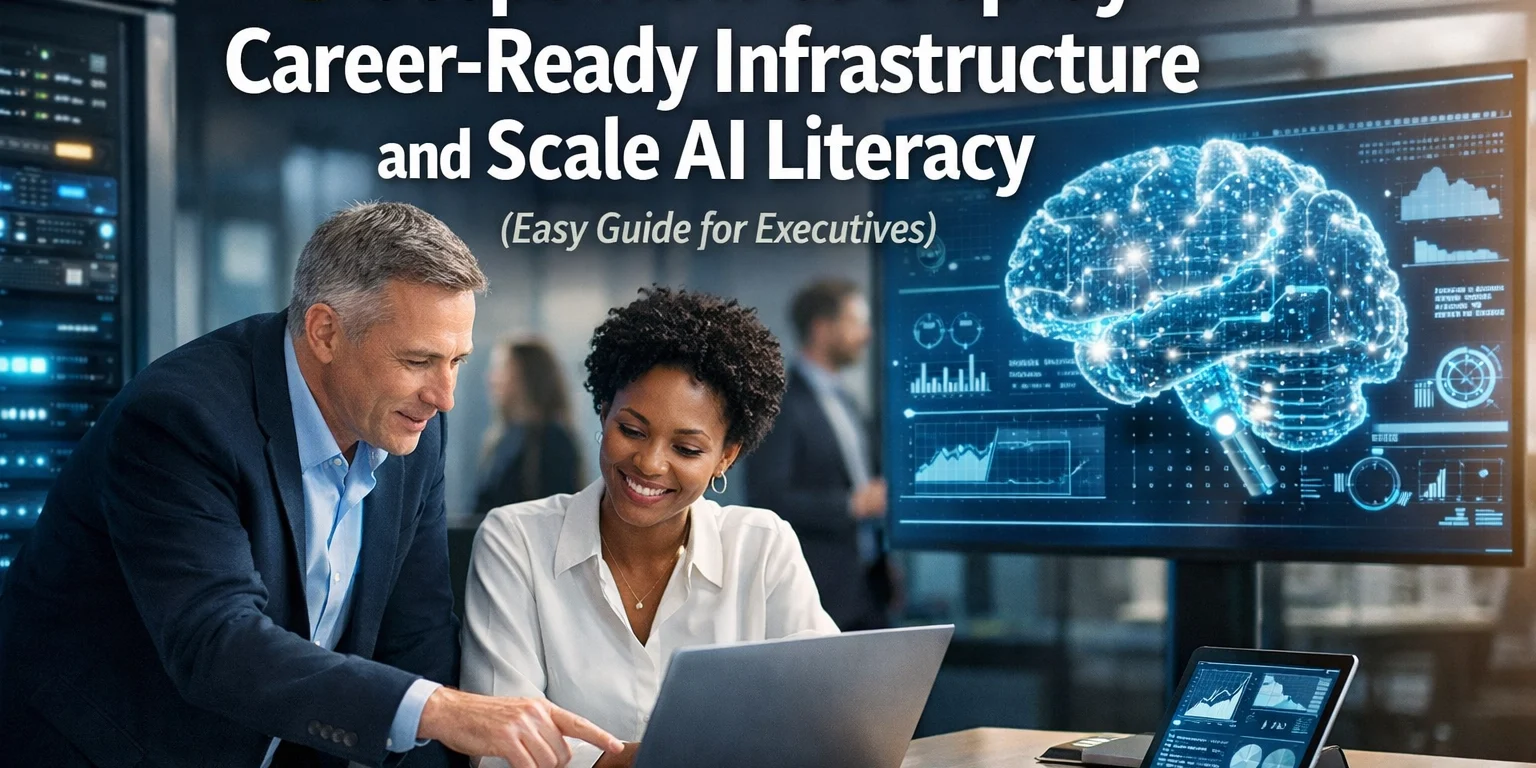
In the current landscape of 2026, the divide between organizations that merely utilize artificial intelligence and those that dominate through it is no longer defined by access to capital. Instead, the differentiator is the deployment of career-ready infrastructure and the systemic scaling of AI literacy. For Fortune 100 executives, the challenge is not just technical; it is a logistical and cultural undertaking that requires a national-scale perspective on workforce development.
As the digital economy accelerates, the demand for a workforce capable of navigating complex cloud environments and AI-driven workflows has outpaced traditional educational pipelines. At USA Entertainment Ventures LLC, we observe that the most successful enterprises are those viewing infrastructure not as a static back-office cost, but as a physical and digital distribution system for talent cultivation.
This guide outlines a five-step strategic framework for executives to deploy robust infrastructure and bridge the AI literacy gap through innovative, high-engagement models.
1. Audit Data Foundations and Define High-Value Objectives
Before committing to a national rollout of infrastructure, an organization must conduct a rigorous assessment of its existing capabilities. This involves more than a simple inventory of servers and software. It requires a deep dive into data quality, accessibility, and the current technical proficiency of the workforce.
According to industry benchmarks, nearly 80% of AI initiatives fail not because of the algorithms, but because of poor data foundations. Executives must identify specific business outcomes: whether that is predictive maintenance in manufacturing, hyper-personalized customer experiences, or automated supply chain logistics: before selecting the hardware and software layers.
An essential part of this step is establishing "Career-Ready" benchmarks. What does it mean for an employee to be AI-literate in your specific vertical? By defining these competencies early, you ensure that the infrastructure you deploy is purpose-built to support the development of those specific skills.
2. Secure Executive Sponsorship and Establish a Realistic Timeline
A common pitfall in digital transformation is the expectation of immediate results. Scaling AI literacy across a global or national enterprise is not a quarterly project; it is a multi-year commitment. Data from large-scale enterprise deployments suggests that a realistic timeline for reaching full production readiness and workforce integration is between 18 and 36 months.
Executive sponsorship is the cornerstone of this process. Without a clear mandate from the C-suite, infrastructure projects often stall at the pilot phase. This sponsorship must be accompanied by a long-term resource allocation strategy that covers both the technical "heavy lifting" and the human capital investment.

When planning these budgets, executives should tie success metrics to specific Key Performance Indicators (KPIs). Instead of aiming for "digital transformation," aim for "a 15% reduction in model deployment time" or "a 30% increase in cloud-certified staff." This precision allows for better accountability and keeps the investment focused on career-ready outcomes.
3. Architect Scalable, Cloud-Neutral Technical Infrastructure
To support a national rollout, the underlying technical architecture must be elastic, secure, and vendor-agnostic where possible. The goal is to build a "career-ready" environment that mimics the complexity of real-world AI workloads without being tethered to a single proprietary ecosystem.
The core layers of this infrastructure include:
- The Data Foundation: A unified layer where data is cleansed, governed, and prepared for machine learning.
- Scalable Compute: Elastic access to processing power (CPUs and GPUs) that allows teams to experiment and scale without hardware bottlenecks.
- MLOps and Deployment Pipelines: Automation tools that manage the lifecycle of an AI model, from training to production monitoring.
- Security and Compliance: A robust framework that ensures all AI activities meet the stringent regulatory standards of 2026.
By prioritizing a distributed architecture, organizations can ensure that their technical resources are accessible to employees regardless of their physical location, facilitating a truly national approach to workforce development. For more information on our strategic approach to these frameworks, visit our About Us page.
4. Deploy the 'Trojan Horse': Esports as a Catalyst for Literacy
Perhaps the most innovative strategy for scaling AI literacy is the use of esports as a "Trojan Horse" for technical training. To the uninitiated, esports may seem like mere entertainment. However, for the Fortune 100 executive, it represents a high-performance laboratory for cloud computing, low-latency networking, and real-time data analytics.
The technical requirements of professional-grade esports: distributed computing, edge processing, and massive data ingestion: are identical to the requirements of enterprise AI systems. By deploying esports infrastructure as part of a physical distribution system for workforce development, companies can engage employees in a way that traditional "corporate training" cannot.
The Logic of the Esports Integration:
- Engagement: Gamified learning environments see significantly higher retention and participation rates.
- Real-Time Problem Solving: Managing a high-stakes esports environment requires the same troubleshooting skills needed to manage an AI-driven cloud network.
- Data Literacy: Competitive gaming generates vast amounts of data. Using AI to analyze player performance or predict game outcomes provides a practical, hands-on introduction to data science.
This physical distribution system: placing high-tech learning labs in regional hubs: creates a visible commitment to career readiness. It transforms the office from a place of work into a center for technical excellence and innovation.

5. Implement Continuous Monitoring and Iterative Feedback Loops
The final step in deploying career-ready infrastructure is the establishment of feedback loops. AI and cloud technologies evolve at a pace that can render a static curriculum obsolete within months. Therefore, the infrastructure must include automated monitoring and reporting systems that track both system performance and employee progress.
Executives should look for MLOps (Machine Learning Operations) frameworks that allow for continuous integration and continuous deployment (CI/CD). This same philosophy should be applied to literacy. As the infrastructure evolves: for example, as new generative AI models are integrated: the training modules must automatically update to reflect these changes.
Investing in the implementation layer: the "how" of the rollout: is what separates the top 4% of successful AI-ready companies from the rest. This requires a commitment to ongoing model retraining and operationalization, ensuring that the workforce stays as current as the technology they utilize.
The Path Forward: Building a Resilient Workforce
The deployment of career-ready infrastructure is not merely a technological upgrade; it is a fundamental shift in how corporations approach human capital. By viewing infrastructure as a national distribution system and utilizing engaging platforms like esports to bridge the literacy gap, Fortune 100 companies can build a workforce that is not only prepared for the future but is actively shaping it.
As we move further into 2026, the mandate for executives is clear: Infrastructure and literacy must scale in tandem. The organizations that succeed will be those that move beyond strategy into the disciplined execution of distributed, career-ready systems.
For those looking to explore the intersection of entertainment, technology, and business consulting, we invite you to view our portfolio or learn more about our corporate vision.
The transition to an AI-literate enterprise is a marathon, not a sprint. By following these five steps, executives can ensure their organization remains competitive, resilient, and prepared for the next era of industrial innovation. For a deeper look at industry trends and our latest updates, you can browse our post sitemap.
About USA Entertainment Ventures LLC
USA Entertainment Ventures LLC is a leading business consulting firm specializing in the intersection of entertainment, technology, and infrastructure development. Under the leadership of CEO Dan Kost, we provide strategic guidance for organizations looking to navigate the complexities of the modern digital economy.





