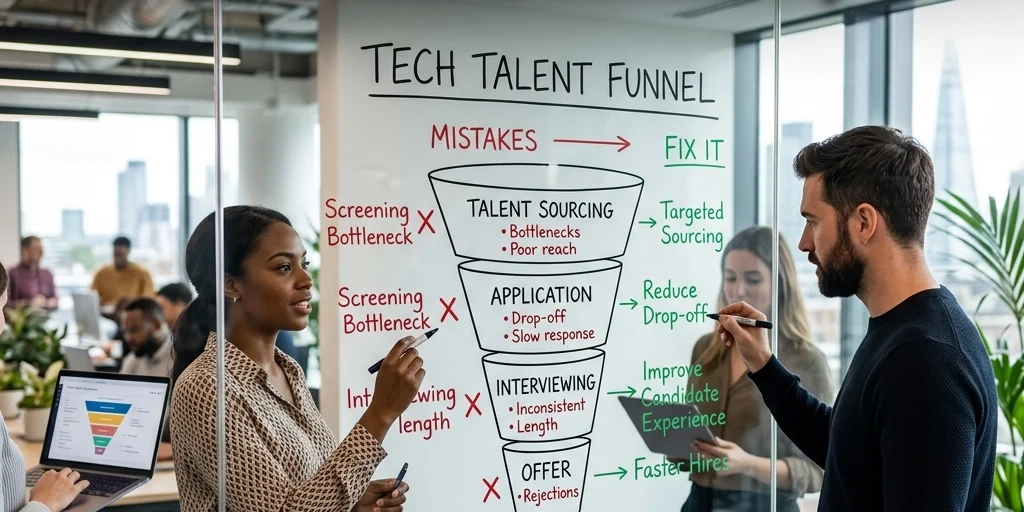
The global race for technical proficiency has moved beyond the walls of traditional human resources. Today, the demand for expertise in Cloud computing, Artificial Intelligence (AI), and Data Analytics has created a landscape where traditional recruitment methods are no longer sufficient. Companies that rely on outdated "talent funnels" often find themselves competing for a dwindling pool of expensive, late-stage candidates while missing the vibrant ecosystem of emerging innovators.
At USA Entertainment Ventures LLC, we observe that the most successful organizations are those that treat talent acquisition not as a seasonal HR task, but as a strategic, long-term business consulting priority. If your organization is struggling to fill technical roles or seeing high turnover in your digital departments, you are likely making one of several common errors in how you build your pipeline.
Here are the seven critical mistakes companies make with their tech talent funnels and the actionable strategies required to fix them.
1. Waiting Until University Graduation to Engage Talent
The most pervasive mistake in modern recruitment is the "graduation gap." Many firms begin their search at university career fairs, targeting seniors about to enter the workforce. However, in high-growth sectors like AI and Data Analytics, the most promising talent is often identified and "signed" much earlier.
By the time a student reaches their junior year of university, they have likely already completed internships with major tech firms or started their own freelance projects. The next generation of developers is specializing as early as 15 or 16 years old. If you aren't engaging with talent at the high school level, you are essentially entering the race when the lead runners are already at the finish line.
The Fix: Expand your funnel into high schools. Establish partnerships with local school districts or technical academies. By offering workshops, sponsored coding challenges, or simple career talks, you build brand recognition with future experts before your competitors even know they exist. This early-stage engagement is the cornerstone of a Next-Gen Talent Funnel.

2. The "Paper Ceiling": Over-Indexing on Degrees
For decades, the four-year degree was the ultimate gatekeeper. While formal education remains valuable, the rapid evolution of technology often outpaces traditional academic curricula. A student who has spent three years building neural networks in their spare time or contributing to open-source Cloud projects may possess more practical utility than a recent graduate who has only studied theoretical concepts.
Restricting your search to degree holders creates a "paper ceiling" that excludes self-taught innovators and those from non-traditional backgrounds. This is particularly relevant in Data Analytics, where specific certifications and hands-on portfolio work often carry more weight than a general diploma.
The Fix: Shift to skill-based hiring. Implement technical assessments and project-based evaluations that focus on what a candidate can actually do today. Review their GitHub repositories or their contributions to technical forums. When you prioritize demonstrated competence over credentials, you widen your funnel to include high-performers who are often overlooked by the rest of the market.
3. Relying on Vague or Uninspiring Job Descriptions
Many tech job postings are a collection of "alphabet soup": long lists of programming languages and required years of experience without any context regarding the work itself. For top-tier talent, a job is more than a paycheck; it is an opportunity to solve complex problems.
When descriptions are vague or overly focused on administrative requirements, they fail to attract the creative problem-solvers needed for AI and Cloud development. A generic posting signals a generic work environment, which is a major deterrent for high-potential candidates.
The Fix: Lead with impact. Describe the specific challenges the candidate will tackle. Instead of saying "Must know Python," explain how they will "Use Python to build predictive models that reduce supply chain waste by 20%." Be transparent about the tools, the team structure, and the company's long-term vision. Clarity is the best filter for a healthy funnel.

4. Friction-Heavy Application Processes
Candidate experience is often the most neglected part of the funnel. Statistics suggest that nearly 60% of top candidates abandon an application if the process is too lengthy or requires them to manually re-enter information already found on their CV. In a high-demand market, friction is a funnel killer.
If your application process feels like a bureaucratic hurdle, you are unintentionally filtering for people who are desperate for any job, rather than the high-performers who have multiple options. The latter will simply move on to a competitor with a one-click application process.
The Fix: Streamline and automate. Audit your application flow from a mobile perspective. Use AI-powered screening tools to handle initial sorting, allowing candidates to move through the stages quickly. Every hour of delay in your response is an opportunity for another company to make an offer. For more information on optimizing your digital presence, visit our digital services page.
5. Ignoring the "Soft Skill" Gap in Technical Roles
A common mistake is assuming that technical brilliance is the only requirement for a tech role. This leads to the "brilliant jerk" syndrome or, more commonly, a team of developers who cannot communicate their findings to stakeholders. In fields like Data Analytics, the ability to translate complex data into actionable business insights is just as important as the ability to write the code that generates the data.
When your funnel only tests for hard skills, you end up with a fragmented team that struggles with collaboration, ethics, and project management.
The Fix: Incorporate professional mentorship into your early-stage recruitment. When engaging with high school or entry-level talent, emphasize the importance of communication, teamwork, and presentation skills. Look for "T-shaped" individuals: those who have deep technical expertise in one area but a broad ability to collaborate across others.

6. Maintaining a Slow and Opaque Hiring Process
In the world of Cloud and AI, the "shelf life" of an active, high-quality candidate is often measured in days, not weeks. Many companies lose talent because their internal approval processes are too slow. If a candidate goes two weeks without hearing back after a successful interview, they assume they aren't a priority.
Opacity is equally damaging. Candidates want to know where they stand. Silence creates anxiety, and anxiety leads to candidates accepting other offers.
The Fix: Implement transparency and speed. Set internal SLAs (Service Level Agreements) for your hiring managers. Aim to provide feedback within 48 hours of an interview. Even if the answer is "we are still deciding," a quick update maintains the relationship. Treating candidates with the same respect you treat clients is essential for brand reputation.
7. Lack of Internal Development Pathways
The talent funnel does not end once a contract is signed. One of the biggest mistakes companies make is failing to provide a clear "What's Next?" to their young hires. If a talented Cloud architect joins your firm but sees no path for growth or further learning, they will likely leave within 18 months. This creates a "leaky funnel" where you are constantly spending money to replace talent you already had.
High-performers in tech are driven by growth. If they aren't learning new things about AI or advanced data modeling at your company, they will find a company that prioritizes their development.
The Fix: Create clear internal career progression maps. Offer "upskilling" opportunities as part of the benefits package. Show your entry-level hires that there is a long-term future for them within the organization. You can see how we approach team building on our career opportunities page.

Conclusion: Building a Future-Proof Pipeline
The shift toward a Next-Gen Talent Funnel is not just about filling roles; it is about ensuring the long-term viability of your business in an increasingly digital world. By engaging talent earlier: specifically in high schools: and prioritizing skills over traditional credentials, you create a sustainable pipeline that is resilient to market fluctuations.
Correcting these seven mistakes requires a shift in mindset. It requires moving from a "hiring" mentality to a "cultivating" mentality. When you invest in the education and development of young talent today, you aren't just helping your company; you are contributing to a more robust and capable workforce for the entire industry.
As we look toward the future of Cloud, AI, and Data Analytics, the companies that thrive will be the ones that tore down the barriers to entry and started building relationships with the innovators of tomorrow, today.
For further inquiries on how to optimize your business strategy or to learn more about our approach, feel free to visit our About Us page or contact our team directly.