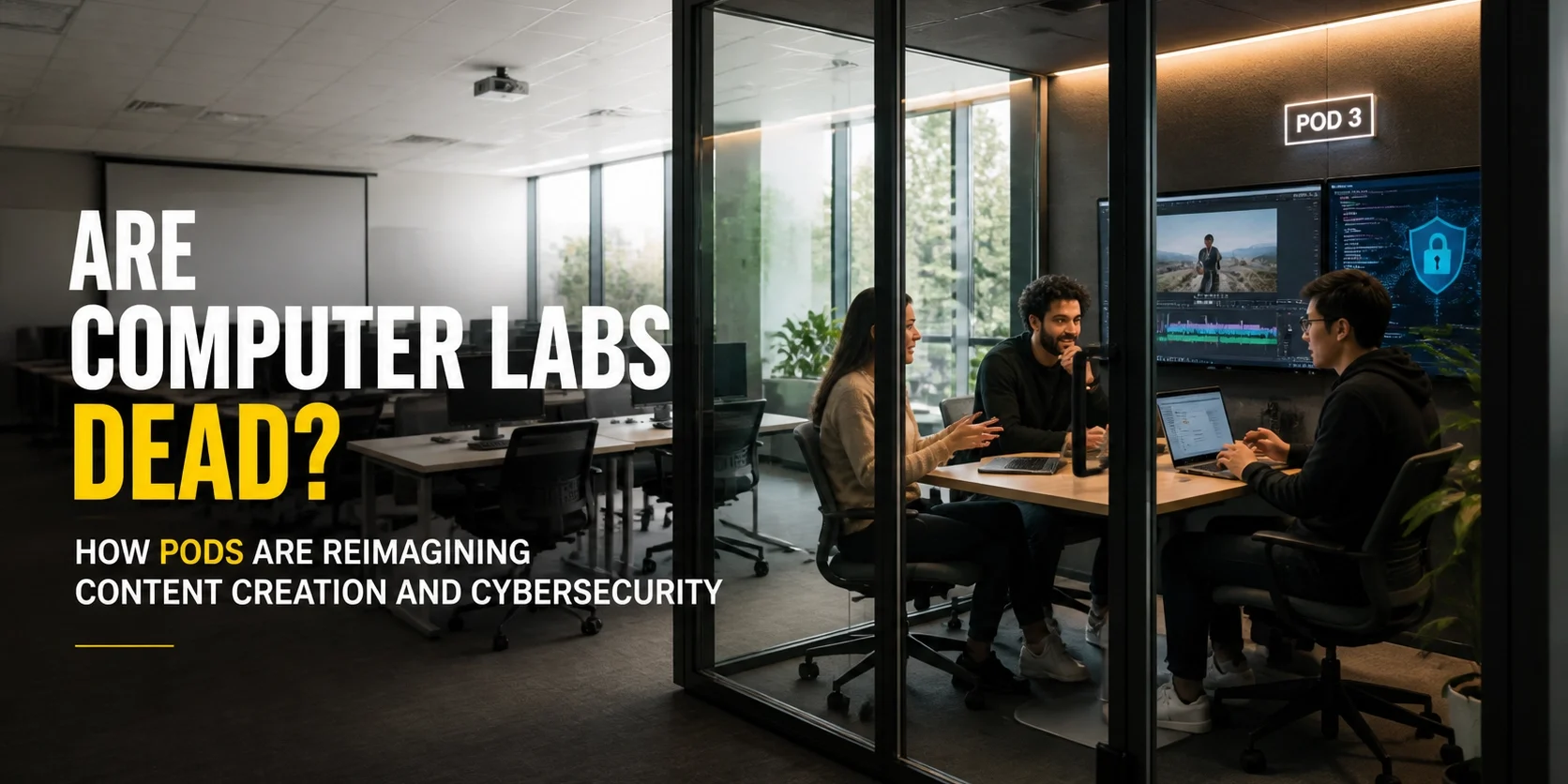
Remember the classic computer lab of the early 2000s? A windowless basement room filled with rows of beige towers, sticky mechanical keyboards, and that distinct smell of ozone and old carpet. It was a place you visited once a week to learn how to type or: if you were lucky: to play Oregon Trail while the teacher wasn't looking.
Fast forward to May 2026, and if you walk into a modern university or training center looking for that room, you might find a yoga studio or a coffee bar instead. The traditional computer lab: as we knew it: is officially on life support. But don’t mourn just yet. Tech-heavy spaces aren't disappearing; they are evolving into something much sleeker, smarter, and infinitely more effective: The Pod.
At USA Entertainment Ventures LLC, we’ve seen how physical infrastructure dictates career success. The shift from "rows of PCs" to "purpose-built pods" isn't just an interior design trend; it’s a fundamental reimagining of how we train for the high-stakes worlds of content creation and cybersecurity.
The Death of the Generic Lab
The "death" of the computer lab wasn’t a sudden murder; it was a slow transformation driven by three major shifts:
- BYOD (Bring Your Own Device): Almost every student and professional now carries a laptop more powerful than the supercomputers of the 90s. If you can write an essay or browse the web on your own MacBook, why go to a lab?
- The Cloud: Software that used to require a $5,000 workstation is now delivered via the cloud. SaaS and virtualization mean the "heavy lifting" happens on a server in Virginia, not the box under your desk.
- Collaboration is the New King: Sitting in a silent row of 40 people doesn't mirror the modern workplace. Today’s industries: especially in technology and media: rely on "sprint" teams and huddles.
However, the "I'll just work from my couch" model has hit a wall. You can’t edit 8K VR footage on a standard laptop without it catching fire, and you can’t simulate a massive cyberattack on a public Wi-Fi network at a Starbucks. This is where the Pod enters the chat.

What Exactly is a Pod?
Think of a pod as a specialized "micro-lab." Instead of 50 identical machines, a pod is a cluster of 4 to 8 seats designed for a specific mission. It’s an ecosystem. It’s got the high-end GPUs, the specialized peripherals, and the ergonomic layout that facilitates "war room" style collaboration.
These spaces are the bridge between the digital world and the physical reality of teamwork. Whether you're building the next viral esports tournament or defending a power grid from hackers, you need more than just an internet connection; you need an environment.
Reimagining Content Creation: The Studio Pod
The demand for high-quality digital content is at an all-time high. From TikTok influencers to professional film editors, the barrier to entry has lowered, but the ceiling for quality has skyrocketed.
Traditional labs were terrible for creators. They were too loud for audio recording and too bright for color grading. Modern Content Creation Pods are changing the game by providing:
- Studio-Grade Hardware: We’re talking workstations with dual GPUs, calibrated 4K monitors, and dedicated audio interfaces.
- The "Director" Workflow: Pods are often laid out so one person can be "driving" the edit while others view the playback on a large, shared screen. This mirrors how Hollywood post-production houses actually operate.
- Acoustic Control: Many pods are now built with sound-dampening materials, allowing for podcasting, voiceover work, or high-fidelity sound design without the background hum of 30 other cooling fans.
For those looking to break into the industry, these pods offer a pathway into business roles like creative director, lead editor, or media strategist. You aren't just learning software; you're learning how to lead a creative team in a high-pressure environment.

Cybersecurity: From Classrooms to "War Rooms"
If content creation is about beauty, cybersecurity is about battle. You can't learn how to stop a ransomware attack by reading a textbook. You need to be in the trenches.
The old lab model failed cybersecurity students because it was too static. You can't easily "sandbox" a row of 40 computers to prevent a virus from leaping to the rest of the campus network. Cybersecurity Pods solve this by functioning as mini Security Operations Centers (SOCs).
The SOC Pod Layout:
- The Big Board: Every pod has a massive central display showing real-time threat maps, server logs, or network traffic.
- Red vs. Blue: Pods are often paired. One group (The Red Team) tries to break in from their pod, while the other group (The Blue Team) defends from theirs.
- Role-Based Stations: One seat is for the analyst, one for the incident commander, and one for forensics. This teaches students that "Cybersecurity" isn't just one job: it's a logistics-heavy team sport.
This hands-on experience is vital. According to industry data, there is a massive global shortage of cybersecurity professionals who can work effectively in a team. Training in a pod environment makes you "job-ready" on Day One.
Career Pathways: Beyond the Keyboard
The shift to pods isn't just great for the people using them; it's creating an entirely new category of careers.
1. Logistics and Infrastructure Management
Someone has to design, build, and maintain these pods. This is a massive opportunity for those interested in logistics and business consulting. Managing the "physicality" of tech is a high-growth field. You need to understand power loads, heat dissipation, and ergonomic flow. It’s where services meet engineering.
2. Virtual Lab Architects
Since pods often rely on virtualized environments, there is a huge demand for "Cloud Architects" who can spin up a custom "cyber range" or a "render farm" for a specific pod on the fly.
3. Media Operations
In the world of events, managing the flow of content from a "capture pod" on-site to a "broadcast pod" for the web is a specialized skill set. It’s logistics, it’s tech, and it’s pure adrenaline.

Equity and the Future of Tech
One of the best arguments for the "Pod" model is equity. While many students have their own laptops, not everyone has a $4,000 gaming rig or a high-speed fiber connection at home. By moving away from massive, generic labs and into specialized pods, institutions can provide top-tier resources to those who need them most without wasting space on "general use" computers that end up just being used for checking email.
As we look toward the future: perhaps even toward the Super Bowl 2026 fan experiences: the "Pod" philosophy will be everywhere. From pop-up gaming stations to mobile command centers for event security, the physical infrastructure of our digital world is becoming more modular, more specialized, and much more collaborative.
Conclusion: It’s Not About the Computer
At the end of the day, the "computer lab" isn't really dead. It just got a promotion. We’ve realized that the computer itself is the least important part of the room. The most important parts are the people sitting around it and the way the space allows them to communicate.
Whether you are an aspiring filmmaker, a future white-hat hacker, or a business leader looking to optimize your office, the message is clear: Stop thinking about "screens per square foot" and start thinking about "collaboration per pod."
The era of the beige tower is over. Long live the pod.
Curious about how to modernize your space or launch a career in these high-tech fields? Check out our showcase for more inspiration, or contact us to see how we’re reimagining the intersection of entertainment and business.