
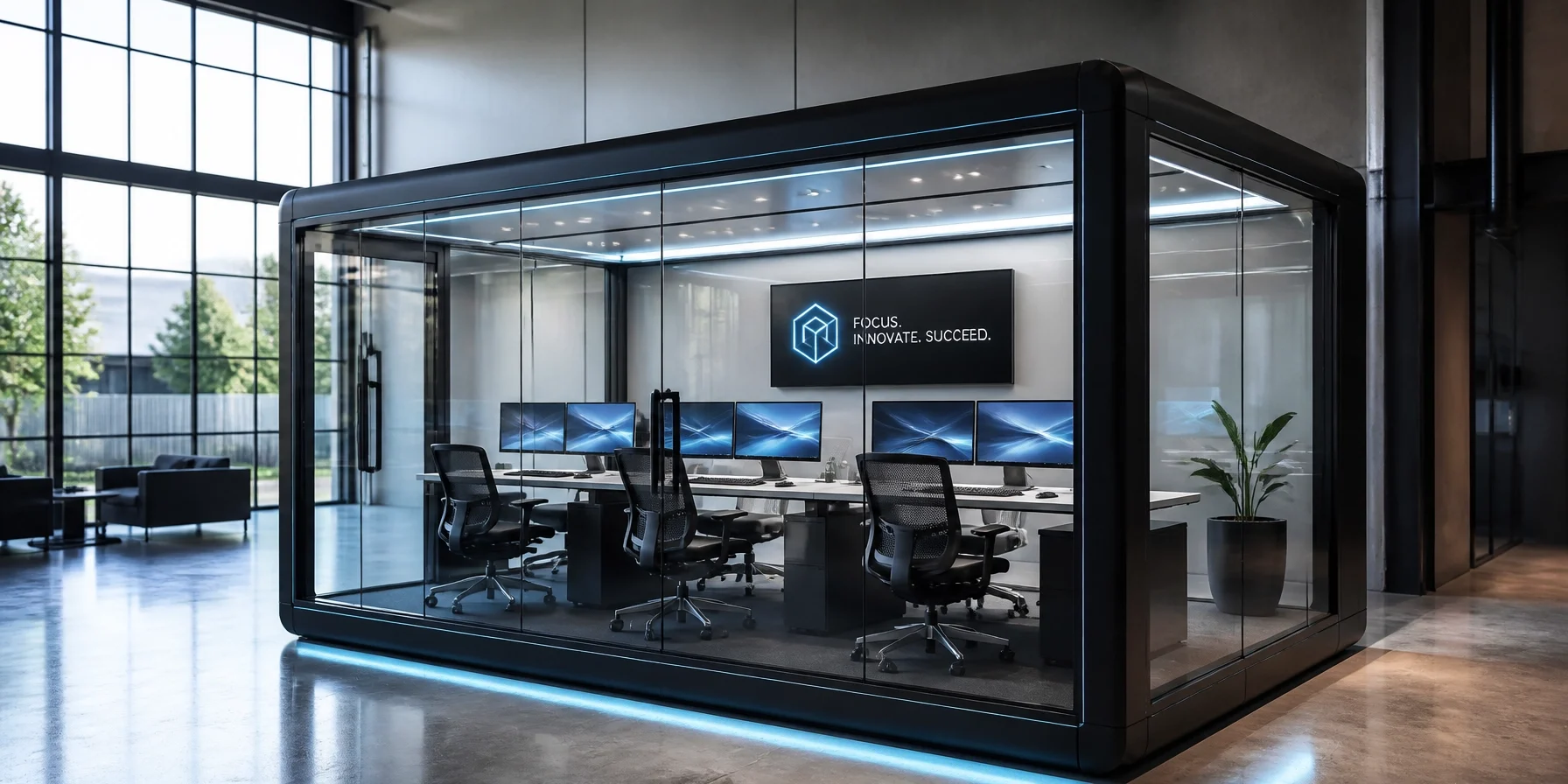
There is a specific nostalgia associated with the 1990s computer lab. It was a place of beige plastic towers, the rhythmic "thunk" of a floppy disk drive, and the distinct, ozone-heavy scent of twenty CRT monitors heating up simultaneously. For many organizations, that image remains the blueprint for "technical training space." However, as we navigate the complexities of 2026, the traditional, brick-and-mortar computer lab is increasingly becoming a relic of a slower era.
The question for modern businesses, educational institutions, and government agencies: especially those involved in intensive programs like DOD SkillBridge recruitment: is no longer about how many desktops you can bolt to a desk. It is about how quickly you can deploy a secure, high-tech environment that evolves as fast as the industry does.
Enter the Modular Pod. These aren't just portable offices; they are the next evolution of infrastructure, offering a "lab-in-a-box" solution that is disrupting how we train for logistics, cybersecurity, and content creation.
The Death of the Fixed Lab (And Why We Aren't Mourning)
Traditional construction is, to put it mildly, a marathon. When a company decides to build a new technical training center, they are usually looking at a timeline measured in years, not months. Between zoning, architectural design, and the inevitable delays of "finding a reliable contractor," the technology for which the lab was designed is often obsolete before the first ribbon is cut.

Modular pods flip this script. According to industry data, modular construction can be delivered and occupied up to 30–50% faster than traditional builds. While site preparation happens on-site, the pod itself is manufactured in a controlled factory environment. This parallel processing means a fully functioning, tech-rich lab can be ready for use in as little as 8 to 12 weeks.
At USA Entertainment Ventures LLC, we focus on managing high-level business developments where speed is a currency. In the world of DOD recruitment and workforce strategy, waiting eighteen months for a building to be finished is a luxury no one can afford.
Why "Modular" is More Than a Buzzword
The shift toward modular pods isn't just about speed; it’s about cost certainty and sustainability. In traditional construction, change orders and weather delays can send budgets spiraling. Factory-controlled modular processes virtually eliminate these variables. Furthermore, the environmental impact is significantly lower. Research indicates that modular construction results in an average 78.8% reduction in on-site waste.
For a business looking to meet ESG (Environmental, Social, and Governance) goals while expanding its training capacity, the choice becomes clear. You aren't just building a room; you are deploying a precision-engineered tool.
Career Path 1: The Logistics and Cybersecurity Nexus
One of the most urgent needs for modern infrastructure is in the field of supply chain security. As logistics become increasingly digital: relying on APIs, cloud platforms, and real-time data: the vulnerabilities increase.
A modular pod can be configured as a dedicated Cybersecurity Simulation Lab. Unlike a standard office, these pods can be built with isolated networks (air-gapping) and specific acoustic treatments to allow for high-stakes "Red Team vs. Blue Team" exercises.
In these environments, professionals train for roles such as:
- Supply Chain Cybersecurity Expert: Protecting the digital systems that track global shipments.
- Cloud-Middleware Logistics Expert: Ensuring secure data exchange across modular services.
By providing a dedicated, high-tech space, organizations can fast-track the development of these hybrid roles, which typically command salaries ranging from $70,000 to $150,000 depending on the depth of specialization.

Career Path 2: The Modern Content Creation Studio
The demand for high-quality technical content has never been higher. Whether it’s internal training videos, marketing assets, or technical documentation, the "creator economy" has moved into the corporate world.
However, the average office environment is a nightmare for content creation. Fluorescent lights, echoing hallways, and the hum of the HVAC system make professional-grade recording nearly impossible.
Modular pods solve this by offering purpose-built acoustic environments. A content creation pod can be outfitted with:
- Integrated soft-box lighting.
- Sound-dampening wall panels.
- High-end XLR microphone mounts and dual-monitor editing stations.
This allows a company to turn a corner of their parking lot or a section of their warehouse into a professional media studio without a single permit for structural renovation.

Career Path 3: Bridging the Gap for Veterans (DOD SkillBridge)
At the heart of what we do at USA Entertainment Ventures is the management of talent and opportunities. Our focus on DOD SkillBridge recruitment means we are constantly looking for ways to transition service members into high-impact civilian roles.
Modular pods provide the perfect "bridge" for this transition. They can be deployed directly on or near military installations, providing a familiar yet high-tech environment where transitioning personnel can learn logistics, IT, and management skills. These "transition pods" serve as a physical manifestation of a company’s commitment to veteran hiring, offering a space that is as mission-ready as the people inside it.
Future-Proofing: The Scalability Factor
The most significant advantage of the modular pod is its relocatability. A traditional computer lab is a permanent fixture of a building. If the company moves, the lab stays.
Modular pods are assets, not just expenses. If a training program in one city concludes, the pod can be decommissioned, loaded onto a truck, and redeployed to a new location in a matter of days. This flexibility allows for a "fluid" workforce strategy where infrastructure follows the talent, rather than forcing talent to migrate to the infrastructure.

Actionable Strategy: Making the Switch
If you are currently evaluating your organization's technical training needs, consider these practical steps:
- Identify the "Hot Zones": Where is your current infrastructure failing? Is it the noise levels for your content team? The security limitations for your IT staff?
- Run the Math on Speed: Compare a 12-week pod deployment to a 12-month renovation. Calculate the "opportunity cost" of ten months of lost training time.
- Think Beyond the Office: Could your training lab exist closer to your operational hubs (like a warehouse or a port) if you used a weather-proof modular unit?
Conclusion: Emphasizing Possibility
The transition from fixed, 90s-style labs to modular, pod-based infrastructure is more than a trend; it is a response to the reality of modern business. We live in a world that demands agility, sustainability, and specialized environments for specialized skills.
By embracing modularity, organizations can provide their teams with the tools they need to succeed in cybersecurity, logistics, and content creation today: and be ready to pivot toward whatever the industry demands tomorrow. For more information on how we manage these transitions and support specialized recruitment, visit us at USA Entertainment Ventures.
The future of work isn't just about what we do; it's about the spaces we create to do it. And right now, the future looks modular.





