
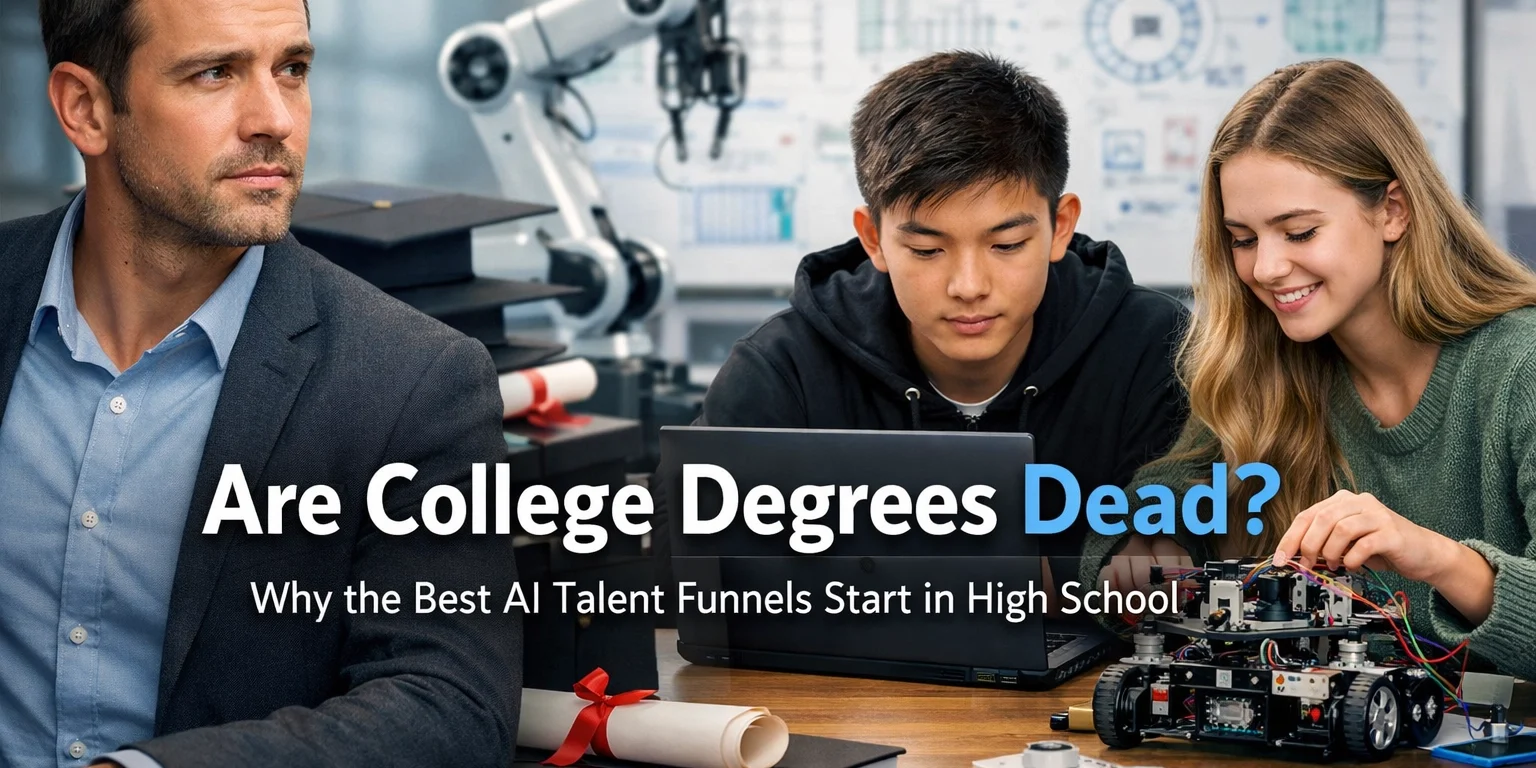
The landscape of professional recruitment is undergoing a fundamental transformation. As we navigate the early months of 2026, the traditional path from high school to a four-year university and then into a corporate role is no longer the only, or necessarily the best, route for securing elite technical talent. In the fields of Artificial Intelligence (AI), Cloud Computing, and Data Analytics, the pace of innovation has outstripped the speed of traditional academic curriculum development.
For many organizations, the question is no longer whether a candidate has a degree, but how quickly they can adapt to a technological environment that changes every quarter. This shift has led forward-thinking companies to look earlier in the pipeline. The most effective AI talent funnels now begin in high school, where students are already digital natives, often self-taught, and unburdened by legacy thinking.
The Degree Debate: Evolution, Not Extinction
It is important to clarify the current state of the labor market. Recent data for the Class of 2026 suggests that college degrees remain a valuable asset. Employers across the United States have indicated plans to hire approximately 7.3% more graduates this year compared to the previous year. STEM fields, particularly Computer Science and Engineering, continue to see unemployment rates near record lows of 2%.
However, the "value" of the degree is changing. While a diploma signifies discipline and foundational knowledge, it often fails to represent mastery of the most current AI tools. By the time a student enters their senior year of college, the AI models and data processing frameworks they learned as freshmen are frequently obsolete.
Industry professionals are beginning to notice a gap. While a degree helps a candidate "stand out" in a crowded field, it is the practical, hands-on experience with emerging tech that secures the position. This reality is driving a new strategy: the High School-to-Industry Funnel.

Why High School is the New Recruitment Frontier
The decision to target high school students for talent funnels is grounded in both cognitive science and economic logic. At this age, students possess a high level of neuroplasticity and a natural "fluency" in digital environments. They are not learning AI as a secondary language; they are growing up with it as a primary tool for problem-solving.
1. Accelerated Learning Curves
High school students who are passionate about technology often engage in "just-in-time" learning. Through online platforms, open-source communities, and coding bootcamps, they acquire specific skills in Python, machine learning, and cloud architecture years before their peers in traditional tracks. By engaging these students early, companies can help shape their learning paths to align with specific business needs.
2. Cultivating Loyalty and Brand Affinity
In a hyper-competitive market for AI talent, retention is a significant challenge. When a company invests in a student during their junior or senior year of high school, through mentorships, internships, or specialized training, they build a level of brand loyalty that is difficult to replicate through standard headhunting.
3. Reducing Talent Acquisition Costs
The cost of hiring a mid-career AI engineer in 2026 can be astronomical. By developing a "homegrown" pipeline, companies can lower their long-term acquisition costs. Training a high-potential high school student through a modern internship program allows the organization to vet the individual’s culture fit and technical aptitude long before a high-stakes salary negotiation takes place.
The Trifecta of Next-Gen Talent: Cloud, AI, and Data Analytics
To build a successful high school talent funnel, organizations should focus on three core pillars. These are the foundations of the modern digital economy, and they are areas where early intervention yields the highest returns.
Cloud Computing:
The infrastructure of the world now lives in the cloud. High schoolers who understand the nuances of AWS, Azure, or Google Cloud are ahead of the curve. Companies need talent that can manage scalable systems and understand the cost-efficiencies of cloud-native applications.
Artificial Intelligence:
Beyond just using AI tools, the next generation needs to understand how to build, tune, and ethically deploy models. High school students are currently experimenting with large language models (LLMs) and computer vision in ways that were previously reserved for PhD candidates.
Data Analytics:
Data is the fuel for AI. The ability to clean, interpret, and visualize data is a foundational skill. Students who can turn raw numbers into actionable insights are invaluable to Business Consulting firms and tech giants alike.

Building the Funnel: Practical Steps for Businesses
Transitioning from traditional recruitment to a high-school-focused funnel requires a shift in strategy. It is not about replacing college recruiting, but about augmenting it to ensure a steady stream of "pre-vetted" talent.
Establish Presence in Secondary Education
Companies should look to partner with local vocational schools and high schools that emphasize STEM. This can be achieved through guest speaking engagements, sponsoring hackathons, or providing equipment for computer labs. Being present in the classroom allows a brand to be the first name a student associates with a career in technology.
Design Meaningful Apprenticeships
A standard "shadowing" internship is no longer sufficient. To capture top-tier AI talent, programs must offer hands-on projects. Allowing a student to contribute to a real-world data cleanup project or assist in testing a new AI module provides them with the "industry-ready" skills that a classroom cannot replicate. You can see examples of how integrated tech services operate on our showcase page.
Offer Alternative Credentials
In 2026, certifications often carry as much weight as credit hours. Companies can incentivize high schoolers by sponsoring their certifications in specific cloud platforms or AI frameworks. This creates a tangible benefit for the student and a verified skill set for the employer.

The Societal Impact of Early Talent Identification
Moving the recruitment funnel to high school also addresses broader social and economic issues. It provides a pathway to high-paying careers for students who may not have the financial means to pursue a traditional four-year degree immediately. By focusing on skill and aptitude rather than just a university pedigree, companies can tap into a more diverse and representative talent pool.
This democratization of opportunity is a key component of sustainable business growth. As USA Entertainment Ventures LLC notes in our about-us section, we believe in fostering innovation through diverse perspectives and early-stage engagement.
Looking Ahead: The Class of 2030
As we look toward the end of the decade, the integration of industry and education will only deepen. The companies that are currently struggling to fill AI roles are the ones that waited for the talent to come to them. The companies that will lead the market in 2030 are the ones currently walking the halls of high schools, identifying the curious minds, and providing them with the tools to succeed.
The degree is not dead, but its monopoly on "qualification" is over. The "best" talent is no longer defined by a cap and gown, but by the ability to solve complex problems using the latest tools available.
Actionable Takeaways for Your Organization
If you are looking to secure your company’s future in the AI-driven economy, consider the following actions:
- Audit Your Requirements: Review your current job descriptions. Are you requiring a degree for roles where a specific certification or proven portfolio would suffice?
- Reach Out: Contact local high school guidance counselors or STEM department heads to discuss career opportunities and partnership possibilities.
- Invest Early: Allocate a portion of your recruitment budget to "early-stage" talent development. A small investment in a high school hackathon today could lead to your lead AI architect tomorrow.
- Simplify the Message: Ensure your brand tone is accessible. High school students are looking for clarity and purpose, not corporate jargon.
For organizations needing guidance on how to structure these talent funnels or modernize their digital strategy, exploring professional services can provide the necessary roadmap.

Conclusion
The race for AI talent is a marathon, not a sprint. However, the starting line has moved. By the time a student graduates from a university, they have already been "in the market" for four years as a consumer and a self-taught creator. By meeting them where they are, in high school, companies can secure a competitive advantage that lasts a generation.
The future of Cloud, AI, and Data Analytics is being written in high school classrooms today. The only question is whether your company is part of the story. For more information on how we help businesses navigate these transitions, please feel free to contact us.





