
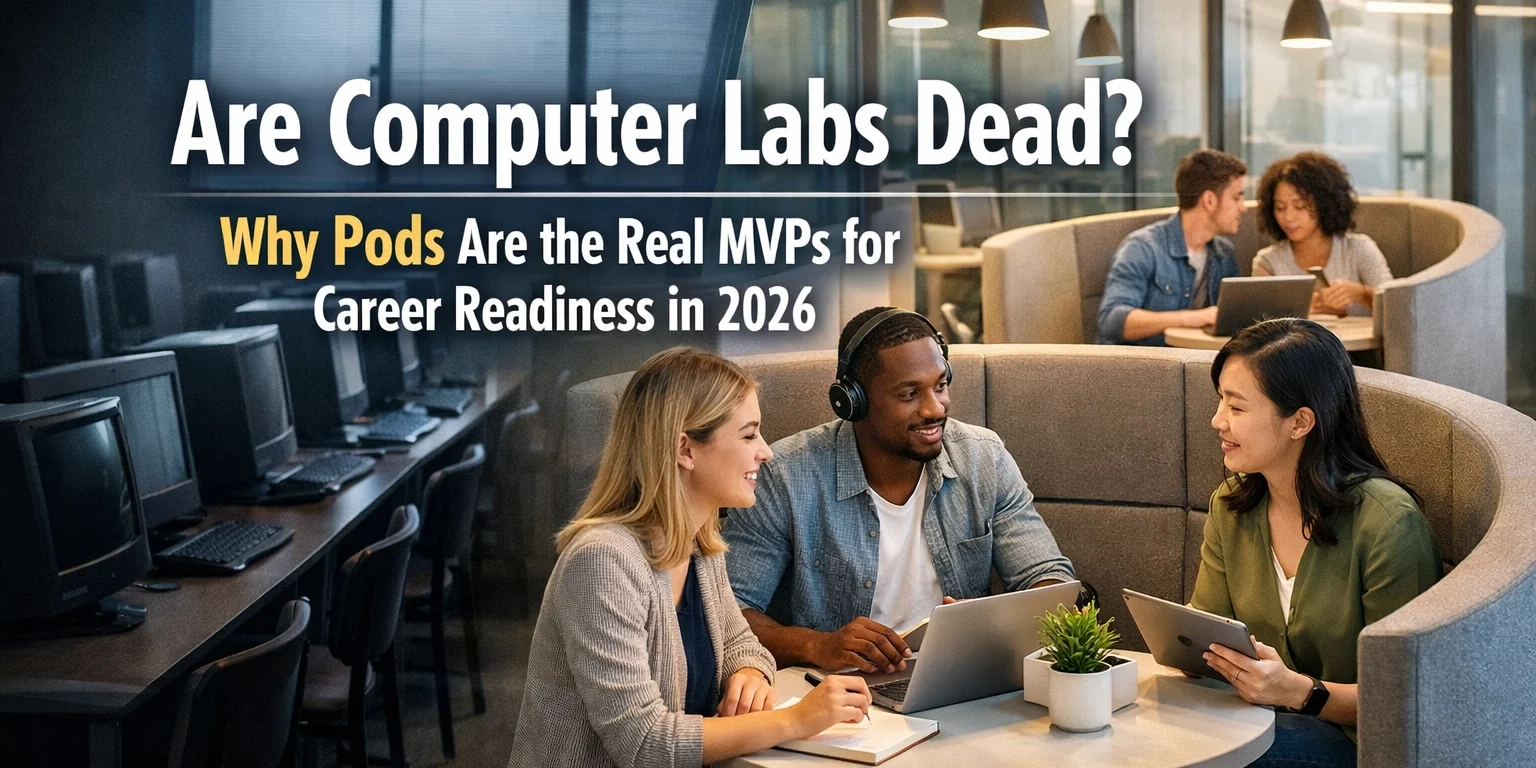
Let’s take a quick trip down memory lane. Remember the traditional computer lab? You’d walk into a room smelling faintly of ozone and industrial carpet, sit down at a beige tower that hummed like a lawnmower, and spend forty-five minutes learning how to format a spreadsheet or: if you were lucky: playing The Oregon Trail.
Fast forward to March 2026. If you walk into a modern educational facility or a forward-thinking corporate training center and see rows of identical desktops tethered to the floor, you’re looking at a dinosaur. The "computer lab" as we knew it isn't just on life support; it’s been replaced by something much faster, leaner, and infinitely more effective: The Pod.
At USA Entertainment Ventures LLC, we spend a lot of time looking at how infrastructure meets opportunity. Whether we’re consulting on business strategy or exploring the latest in media, the shift toward modular, pod-based learning is one of the most exciting trends on our radar. It’s not just about cool furniture; it’s about preparing a workforce for a world where "the office" is a fluid concept.
The Death of the "Row" Mentality
Why are we moving away from the classic lab? Because the classic lab teaches people to work in a silo. You look at your screen, the person next to you looks at theirs, and the teacher stands at the front like a lighthouse.
In 2026, that's not how anyone actually works. Modern careers in logistics, cybersecurity, and content creation require constant collaboration, multi-device management, and the ability to pivot on a dime.
Pods: modular, multi-functional work clusters: are the MVP of career readiness because they mirror the real world. Research shows that organizations using pod-based environments see a massive jump in student-to-student and student-to-teacher interaction. It turns out that when you sit people in a way that actually allows them to see each other, they start solving problems together. Imagine that!

Logistics: Preparing for the Global Supply Chain
If you think logistics is just driving a truck from point A to point B, you’re living in 1996. Today’s logistics professionals are data scientists in disguise. They are managing AI-driven fleets, tracking real-time inventory across three continents, and optimizing routes using predictive analytics.
A traditional computer lab can’t simulate this. A Pod, however, can.
In a logistics-focused pod, a trainee isn't just staring at one monitor. They are working across a tablet for inventory tracking, a laptop for data analysis, and perhaps a smartphone or a specialized handheld device for communication. This is "multi-platform coordination," and it is the bread and butter of the supply chain industry.
By training in a pod, students learn the "soft" skill of context-switching: moving from a high-level map view to a granular data sheet without losing their place. When they step into a real-world dispatch center or a fulfillment hub, they aren't overwhelmed by the hardware because their training environment felt exactly the same.
Cybersecurity: The Digital Front Line
Cybersecurity training has also undergone a radical makeover. The days of reading about firewalls in a textbook are over. In 2026, the best training happens in "War Room" pods.
Virtual lab environments, like those using the latest cloud platforms, allow trainees to practice penetration testing and network defense in a safe, sandboxed environment. But the physical setup matters just as much as the software.
In a pod, a team can act as a Security Operations Center (SOC). One person monitors incoming threats, another analyzes the code, and a third coordinates the response. This mirrors the high-stakes, collaborative nature of modern cybersecurity.
The kicker? It’s cheaper. Organizations have reported cost savings of 50 to 75 percent when switching to pod-based virtual environments. Instead of buying 30 high-end physical rigs that become obsolete in two years, they invest in modular pods that leverage the power of the cloud. It’s a win for the budget and a win for the students.

Content Creation: From Consumer to Creator
The creator economy isn't a "side hustle" anymore: it’s a massive vertical within the business world. Companies today need people who can produce high-quality video, manage social streams, and design immersive digital experiences.
Traditional labs are notoriously bad for this. They are too quiet, too rigid, and too boring.
Content creation pods are designed to be mini-studios. They include specialized lighting, soundproofing, and ergonomic setups for long editing sessions. These pods allow creators to collaborate on a project in real-time, moving files seamlessly between stations.
At USA Entertainment Ventures LLC, we understand that the intersection of technology and entertainment requires a specific kind of space. Whether it's Sports Media or digital marketing, the physical environment needs to inspire creativity, not stifle it. Pods give creators the "vibe" they need to produce their best work while providing the professional tools required to make it industry-ready.
Why Pods Win on Economics
Let’s talk brass tacks. As a business consulting firm, we’re always looking at the bottom line. Why should a school or a company invest in pods instead of a traditional lab?
- Scalability: Pods are modular. You can start with three and grow to thirty as your needs change. You aren't committed to a permanent floor plan.
- Flexibility: A pod used for logistics in the morning can be a cybersecurity hub in the afternoon. All you need to do is swap the software and perhaps a few peripherals.
- Space Efficiency: Pods often have a smaller footprint than traditional desks because they utilize vertical space and clever cable management.
- Device Agnostic: Most pods are designed to be "Bring Your Own Device" (BYOD) friendly, which saves the institution money on hardware while ensuring students are learning on the tools they actually own.
The Equity Factor: Don't Burn the Old Lab Yet
Now, before we take a sledgehammer to every old computer lab in the country, let's have a reality check. While pods are the future, traditional labs still play a vital role in equity.
Not every student has access to a high-speed laptop at home. Not every worker has a quiet place to study. Traditional labs provide a "guaranteed" level of access that is still critical for foundational digital literacy.
The smartest organizations in 2026 are using a hybrid model. They keep a smaller, traditional lab for basic access and introductory courses, but they funnel their "career readiness" budget into specialized pods for advanced training. This ensures no one is left behind while also ensuring that those moving into specialized fields are actually prepared for the job.
Practical Steps for the Transition
If you're an educator or a business leader looking to modernize your infrastructure, here’s the game plan:
- Audit Your Workflow: Don’t just buy cool desks. Look at how a professional in your field actually spends their day. Do they use two screens? Do they stand? Do they work in teams of three? Build your pods to match that reality.
- Prioritize Connectivity: A pod is only as good as its Wi-Fi and power. Ensure you have high-speed access and plenty of charging ports.
- Focus on Soft Skills: Use the pod layout to encourage communication. If your trainees aren't talking to each other, you've just built a fancy, circular computer lab.
- Stay Brand-Neutral but Quality-Focused: You don’t need the most expensive brand-name gear, but you do need equipment that won't break after three weeks of heavy use.

Final Thoughts: The MVP of 2026
The shift from labs to pods is more than just a change in furniture; it’s a change in philosophy. It’s an admission that the world is no longer a place where we work in straight rows and follow a single script.
The workforce of 2026 needs to be agile, collaborative, and tech-savvy across multiple platforms. Pods provide the physical infrastructure to make that happen. By simulating real-world workflows in logistics, cybersecurity, and content creation, pods ensure that when a student or a trainee walks into their first day on the job, they don’t just have the knowledge: they have the experience.
Are computer labs dead? The old ones certainly are. But in their place, something much better is growing. If you’re ready to see how these infrastructure shifts can impact your business or project, check out what we’re doing at USA Entertainment Ventures. The future is modular, and it’s time to find your pod.






