
If you close your eyes and think of a "computer lab," what do you see? If you’re like most of us, you’re probably picturing a windowless room filled with rows of beige towers, the faint hum of cooling fans, and the distinct smell of static electricity and stale coffee. It was a place where you sat in a straight line, staring at the back of someone’s head, trying to figure out how to code in C++ or format a spreadsheet in total isolation.
Well, I’ve got some news for you: that version of the computer lab is officially on life support. In fact, it’s basically a beige mausoleum at this point.
The traditional "factory model" of computing, where students or employees sit in rows like assembly-line workers, is being replaced by something far more effective, agile, and, frankly, a lot cooler. We’re talking about Pods.
At USA Entertainment Ventures LLC, we spend a lot of time looking at how infrastructure impacts performance. Whether you're trying to break into cybersecurity, manage global logistics, or dominate the content creation game, the physical space where you learn and work matters. Let’s dive into why the "Pod" model is the future and why the old-school lab is headed for the scrap heap.
The Beige Ghost in the Machine: Why Labs Are Fading
The decline of the traditional computer lab isn’t just a matter of "vibes." It’s driven by cold, hard data. Recent studies show that roughly 95% of students and young professionals now carry their own high-powered laptops or tablets. The days when you had to go to a specific room to access a "powerful" computer are over. Your phone probably has more processing power than the entire lab I used in college.
Furthermore, the rise of cloud-based software and BYOD (Bring Your Own Device) policies has made the static workstation redundant. Why sit in a cramped lab when you can run AutoCAD or Adobe Creative Cloud from a coffee shop or your couch? Usage data reveals that many traditional labs now sit empty 60% of the time, even during peak hours. It’s an economic drain and a waste of real estate.
But the biggest nail in the coffin isn't the hardware, it's the culture. Traditional labs were designed for isolation. Modern work, however, is a team sport.

Enter the Pod: The New Architecture of Learning
So, what exactly is a "Pod"?
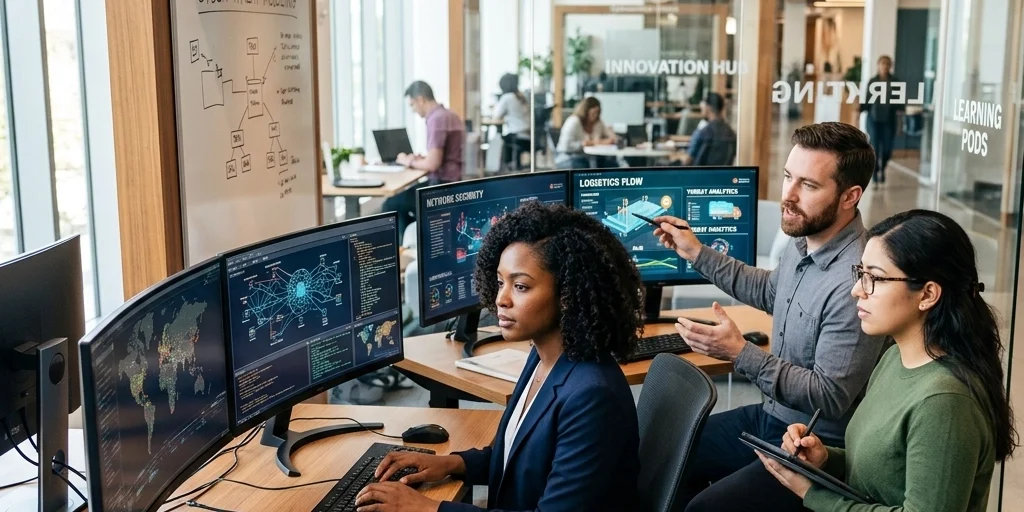
Think of a Pod as a modular, high-tech hub designed for collaboration rather than compliance. Instead of rows of desks facing a chalkboard, Pods feature round or hexagonal tables, shared monitors for screen-sharing, integrated power hubs, and often, "smart" whiteboard walls.
In a Pod, you aren't just a user; you’re part of a team. This shift reflects the "studio model" of education and professional development. It’s about creating an environment where the physical space facilitates the exchange of ideas. If you’re curious about how these spaces look in action, our showcase provides a glimpse into the modern aesthetic of collaborative environments.
Cybersecurity: It’s a Team Sport
If there is one field where the traditional computer lab fails most spectacularly, it’s cybersecurity.
Cybersecurity isn't just about a lone genius in a hoodie typing frantically in the dark (despite what movies tell you). It’s about communication. Modern cyber defense is built on the "Security Operations Center" (SOC) model. In a real-world SOC, analysts work in clusters. They need to be able to swivel their chairs, look at a teammate's screen, and say, "Hey, are you seeing this spike in traffic from IP 192.168.1.1?"
When you train for cybersecurity in a Pod, you’re simulating a real-world SOC environment. You can run "Red Team vs. Blue Team" exercises where one Pod acts as the attackers and the other as the defenders. This creates a high-pressure, collaborative atmosphere that develops "soft skills" like leadership and clear communication: skills that are just as vital as knowing how to run a penetration test.

Logistics: The Global War Room
The logistics industry has undergone a massive digital transformation. We aren't just talking about moving boxes from Point A to Point B anymore. Modern logistics is about big data, real-time tracking, and complex supply chain synchronization.
To master logistics today, you need to be able to manage "War Room" scenarios. Imagine a Pod dedicated to a simulated supply chain crisis: a port strike in Long Beach, a storm in the Atlantic, and a sudden surge in demand for semiconductors.
In a traditional lab, you’d be solving this in a silo. In a Pod, you have one person managing the data analytics, another handling vendor communication, and a third overseeing the financial impact. They are sharing screens, plotting routes on a central monitor, and making split-second decisions as a unit. This is how the giants like Amazon and FedEx operate. If you’re looking to build a career in this field, check out our career opportunities to see how we value these collaborative skill sets.

Content Creation and the Digital Studio
The world of content creation: streaming, podcasting, video editing, and digital marketing: also demands a move away from the "row of computers" model.
A Pod for content creators is essentially a mini-production studio. It might include sound-dampening materials, high-quality microphones on boom arms, and dual-monitor setups optimized for non-linear editing.
When creators work in Pods, they can collaborate on a single project in real-time. One person can be cutting the video while another mixes the audio and a third manages the social media rollout. It turns the creative process into a communal experience, much like a professional writers' room or a post-production house. This is the exact kind of digital integration we advocate for at USA Entertainment Ventures LLC.

The Economics of the Pod
You might be thinking, "This sounds expensive. Why would a school or a business consulting firm invest in this?"
The irony is that Pods can actually be more cost-effective in the long run. Because Pods are designed for BYOD, the institution doesn't necessarily have to buy 30 high-end PCs every three years. Instead, they invest in the infrastructure: high-speed mesh Wi-Fi, ergonomic furniture, smart screens, and reliable power.
Moreover, Pods are modular. If the needs of the business change, you can reconfigure the furniture and the tech far more easily than you can tear out rows of bolted-down desks and floor-wired electricity. It’s an investment in flexibility. For companies looking to overhaul their physical or digital infrastructure, our services focus on these exact types of strategic transitions.
Bridging the Gap to the Future
At the end of the day, the death of the computer lab isn't something to mourn. It’s a sign of progress. It means we are finally realizing that the way we use technology has changed. Technology is no longer a destination you "go to": it’s a tool you bring with you.
By shifting to Pod-based environments, we are preparing the next generation of cybersecurity experts, logistics wizards, and creative geniuses for the actual world they will inhabit. A world where they will have to talk to people, solve problems on the fly, and work across disciplines.
As Dan Kost often says, "You can't build a 21st-century career in a 20th-century box."
If you’re interested in learning more about how we’re rethinking business consulting and infrastructure, feel free to visit our about us page or reach out via our contact form. We’re always happy to chat about the future of work: ideally while sitting in a very comfortable, highly-connected Pod.
The beige boxes are gone. The walls are coming down. The Pods are here. Are you ready to step inside?





