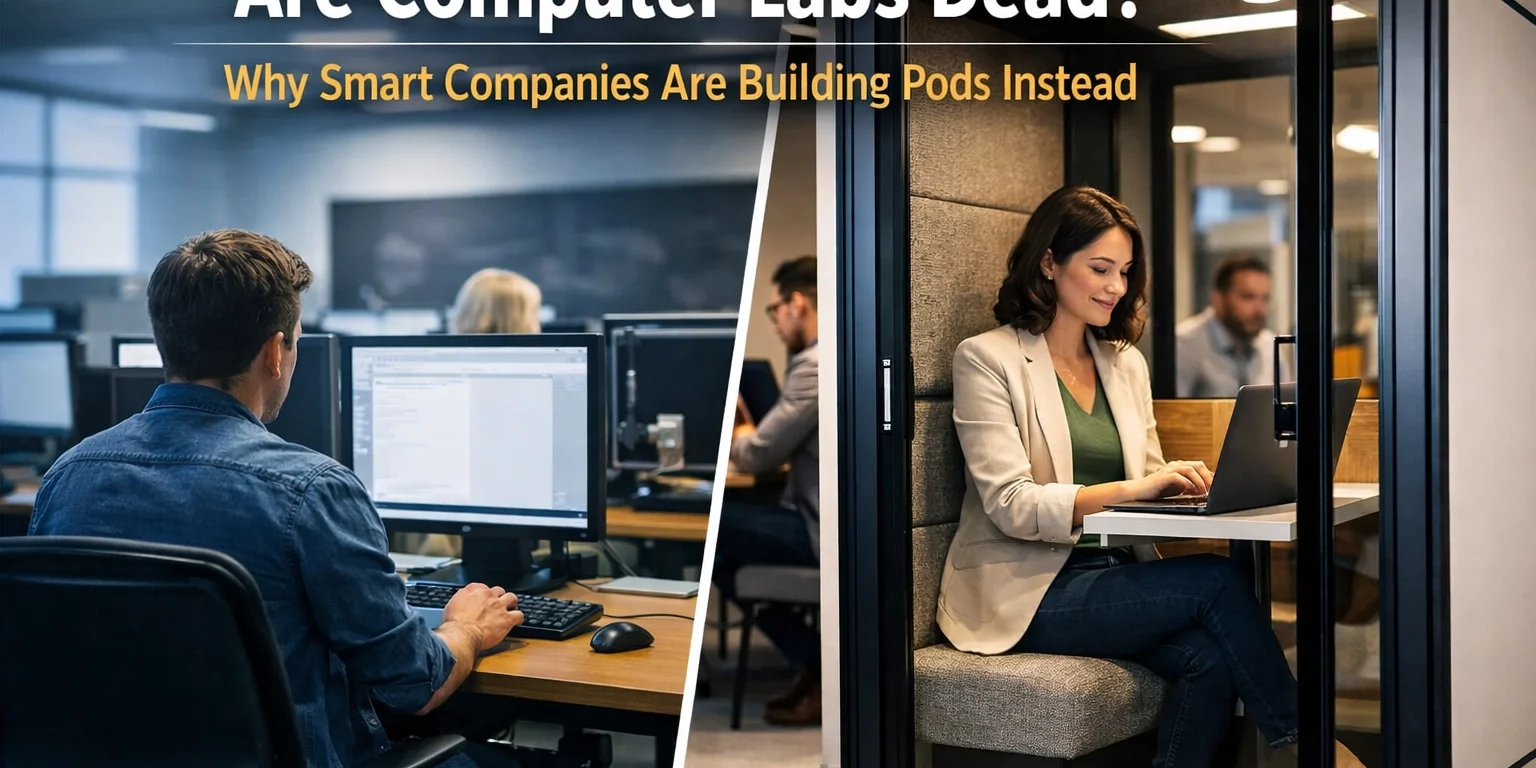
Remember those rows of beige computers in college, each separated by those awkward dividers that made you feel like you were taking the SATs for four years straight? Yeah, those computer labs are going the way of the floppy disk. Not because computers are obsolete (obviously), but because the way we actually work has fundamentally changed. And smart companies preparing their workforce are catching on.
The shift toward pod-based environments isn't just about aesthetics or following trends. It's about acknowledging a simple truth: modern careers require collaboration, not isolation. While traditional computer labs served their purpose when owning a personal computer meant sacrificing a semester's rent, that era is over. Today's workforce challenges demand something entirely different.
The Problem With Traditional Labs
Traditional computer labs weren't designed with collaboration in mind. They were built for access: a necessary solution when technology was prohibitively expensive for individuals. Students would book time slots, sit in isolation, complete assignments, and leave. This model made sense when computing power was the scarce resource.
But here's the thing: computing power isn't scarce anymore. What's scarce is the ability to work effectively in teams, communicate complex technical concepts to non-technical colleagues, and navigate the collaborative chaos that defines modern professional environments. Traditional labs, with their isolating dividers and individual workstations, actively hindered the development of these critical skills.

The layout itself presented fundamental limitations. Where could teams brainstorm before diving into technical execution? How could groups of varying sizes review work together on a single laptop screen? The answer: they couldn't, at least not comfortably. Students would cluster awkwardly around individual workstations, squinting at monitors while trying to provide feedback or coordinate efforts.
Enter The Pod: A Different Philosophy
Pods solve these problems by flipping the script entirely. Rather than treating computers as isolated workstations, pods treat them as collaborative hubs. The design philosophy centers on flexibility and teamwork. Large monitors mounted for group viewing. Movable furniture that accommodates teams of two, five, or ten. Access to professional-grade software tools. Extended hours that match modern schedules, not arbitrary institutional constraints.
Most importantly, pods create environments that mirror actual workplaces. They replicate the conditions professionals encounter daily, preparing workers for the realities they'll face rather than the idealized individual contributor fantasy that never really existed in the first place.
Career Pathways: Why Pods Matter For Your Industry
Logistics and Supply Chain Management
If you've ever worked in logistics, you know the job isn't sitting alone tracking packages. It's coordinating with warehouse managers, analyzing data with operations teams, and communicating supply chain disruptions to executives who need translation from technical jargon to business impact.
Pod environments enable logistics students and professionals to simultaneously access enterprise resource planning systems, visualization tools, and communication platforms. They can analyze complex supply chain networks as a team, identifying bottlenecks while someone else pulls historical data and another person models alternative routing scenarios.

This mirrors the actual conditions in modern supply chain operations centers, where analysts work collectively rather than in isolation. The ability to point to a shared display and say "Here's the problem, here's why it matters, and here's what we should do about it" is infinitely more valuable than silently staring at spreadsheets behind a divider.
Cybersecurity Training
Cybersecurity might seem like a solo endeavor: the stereotype of the lone hacker in a dark room remains persistent: but professional cybersecurity is intensely collaborative. Security Operations Centers run 24/7 with multiple analysts monitoring threat dashboards, coordinating incident responses, and communicating findings across technical and non-technical stakeholders.
Pods enable realistic training scenarios that traditional labs simply cannot accommodate. Red team versus blue team exercises require constant communication and real-time strategy adjustment. Participants need to articulate what they're seeing, coordinate defensive measures, and adapt to evolving attack patterns.
This collaborative environment develops skills that matter more than technical prowess alone: the ability to explain a vulnerability to someone who doesn't understand code, the capacity to coordinate response efforts under pressure, and the judgment to escalate appropriately. These skills don't develop when you're working alone behind a divider.
Content Creation and Digital Media
Modern content creation is definitively collaborative. Video production requires coordination between directors, videographers, editors, sound designers, motion graphics artists, and numerous other specialists. Podcasts need producers, audio engineers, and editors working in concert. Even written content increasingly involves collaboration between writers, designers, and strategists.

Pods accommodate this reality. Large displays enable teams to review rough cuts together, providing feedback that feels natural rather than awkwardly gathering around someone's laptop. Teams can evaluate design iterations side-by-side, comparing options and discussing trade-offs in real time.
The collaborative review process matters more than individual technical execution in many content creation scenarios. Can you take feedback well? Can you articulate why a particular editing choice serves the story? Can you negotiate creative differences productively? These skills develop through repeated collaborative work, not isolated practice.
The Hybrid Approach: Best of Both Worlds
Smart organizations aren't completely abandoning traditional lab resources. Rather, they're adopting hybrid models that preserve what justified traditional labs while incorporating pod-based collaboration spaces.
This approach maintains access to specialized resources: high-end rendering workstations, specific hardware configurations for testing, or proprietary software requiring dedicated machines. But it supplements these resources with collaborative pods for the work that actually requires teamwork.
Many organizations now offer virtual lab capabilities accessible remotely, laptop loan programs for students without personal devices, and cloud-based resources distributed across campuses. This maintains accessibility while acknowledging that physical infrastructure should support how people actually work, not preserve outdated models because "that's how we've always done it."

What This Means For Workforce Development
The shift from computer labs to pods represents a broader recognition: workforce preparation isn't about access to tools anymore. It's about developing the soft skills that distinguish competent technicians from valuable team members.
Can you communicate technical concepts clearly? Can you coordinate with colleagues under deadline pressure? Can you contribute productively to team discussions while respecting others' expertise? These capabilities matter more than your individual technical prowess in most professional contexts.
Organizations investing in pod-based infrastructure signal their understanding of this reality. They're preparing people for actual careers, not idealized scenarios that bear little resemblance to professional environments.
The Infrastructure Investment Question
Building pods requires investment, both financial and philosophical. It means rethinking space allocation, furniture procurement, and equipment configuration. It means prioritizing collaboration over individual work, even when collaboration feels messier and harder to measure.
But the alternative: continuing to prepare workers in environments that don't reflect actual professional conditions: carries its own costs. Organizations discover these costs when new hires struggle with teamwork, communication, and collaborative problem-solving despite strong technical skills.
The infrastructure investment in pods represents a bet on a simple proposition: the skills that matter most in modern careers develop through practice in realistic environments, not through isolated individual work. Early evidence suggests this bet pays dividends in workforce readiness and career success.
Looking Forward
Traditional computer labs aren't entirely dead, but they're evolving. The organizations building pods recognize that infrastructure should serve the way people actually work, not preserve legacy models because changing feels uncomfortable.
For professionals entering logistics, cybersecurity, content creation, or countless other fields, this shift matters. The ability to work effectively in collaborative environments increasingly determines career success. Pods provide space to develop these capabilities under realistic conditions, preparing people for the teamwork that defines modern professional life.
The question isn't whether your organization should abandon traditional labs entirely. It's whether your infrastructure reflects the collaborative reality of modern work: or whether it's still preparing people for a world that no longer exists.