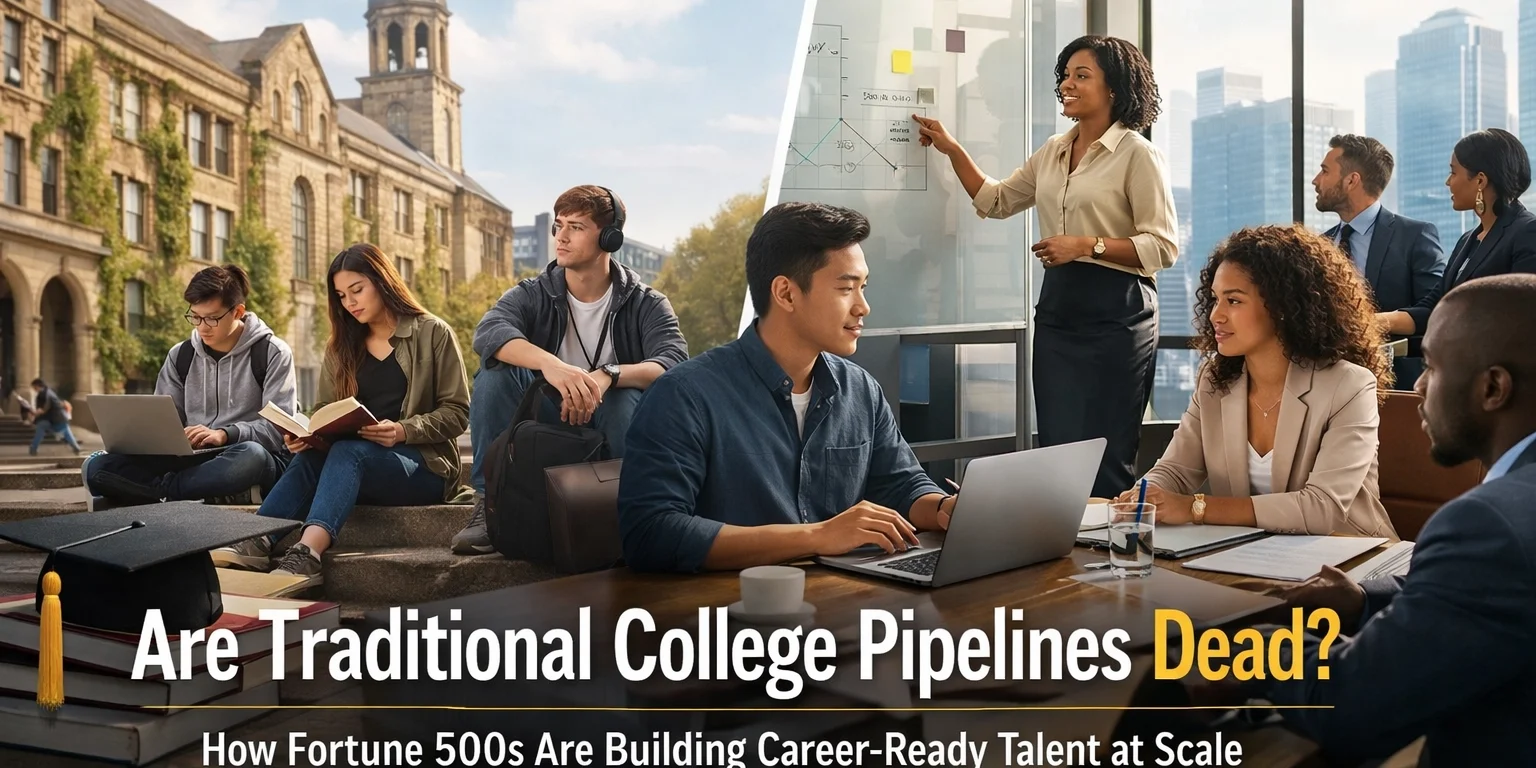
The Traditional Pipeline Is Cracking
The numbers tell a stark story. Undergraduate enrollment in the United States has fallen to 14.8 million students as of Spring 2024, down from over 17 million just a decade ago. Community colleges, traditionally the entry point for workforce development, have experienced a 37% decline since 2012. Fitch Ratings recently issued a "deteriorating" outlook for higher education in 2026, citing a shrinking prospective student base and mounting uncertainty around institutional funding.
But here's what makes this moment different: high school graduates are projected to peak in 2026, after which the traditional-age college student population will decline significantly. WICHE forecasts a 13% decline in high school graduates by 2041: approximately 576,000 fewer students over a four-year period. For Fortune 500 companies relying on four-year degree pipelines to fill technical roles, this isn't just an education problem. It's a talent supply chain crisis.
The response from leading corporations isn't to wait for universities to adapt. Instead, they're building parallel infrastructure: career-ready talent systems that operate at scale, independent of traditional academic timelines and geographies.

The Talent Readiness Gap
Approximately 50% of new college graduates land in jobs unrelated to their fields of study, according to recent workforce analyses. This misalignment reveals a fundamental disconnect: traditional academic programs are often designed around theoretical frameworks rather than the specific technical competencies enterprises need today.
For Fortune 500 companies competing in cloud computing, artificial intelligence, data analytics, and digital infrastructure, waiting four years for candidates to emerge from degree programs no longer matches the pace of technological change. The skills required for cloud architecture, machine learning operations, or distributed systems can become outdated within the duration of a single undergraduate program.
This reality has driven a strategic shift. Rather than recruiting from the end of the college pipeline, leading enterprises are building their own talent development infrastructure: systems designed to identify, train, and deploy career-ready professionals in months rather than years.
The Infrastructure Play: Physical Distribution Meets Workforce Development
The most significant corporate workforce initiatives now mirror physical distribution networks. Just as logistics companies built nationwide warehouse and fulfillment center networks to reach customers, Fortune 500 companies are establishing physical footprints for talent development across secondary and tertiary markets.
These facilities serve multiple functions simultaneously. They act as training centers, providing hands-on access to cloud infrastructure, AI development tools, and enterprise software platforms. They function as assessment hubs, identifying technical aptitude and cultural fit before traditional recruitment cycles begin. And critically, they operate as community anchors, bringing career pathways to regions where four-year universities may be declining or absent.
The model is deliberately decentralized. Rather than concentrating talent development in coastal technology hubs where competition for skilled workers drives compensation to unsustainable levels, this infrastructure targets mid-sized cities and rural communities. The economic logic is straightforward: deploy career training where talent costs are lower, retention rates are higher, and community impact is measurable.

Esports: The Trojan Horse for Technical Literacy
One of the most innovative elements of this new infrastructure uses competitive gaming: esports: as the entry point for cloud and AI skill development. This isn't about training professional gamers. It's about using a high-engagement activity that already attracts millions of young participants as the foundation for teaching distributed systems, network architecture, real-time data processing, and collaborative problem-solving.
Here's why this approach works: modern competitive gaming requires many of the same technical competencies Fortune 500 companies need. Running esports tournaments involves cloud-based game servers, content delivery networks, real-time analytics, streaming infrastructure, and cybersecurity protocols. Participants learn to troubleshoot network latency, optimize server performance, manage database queries, and coordinate distributed teams: all within a context they find intrinsically motivating.
The "Trojan Horse" strategy introduces technical infrastructure through entertainment, then gradually exposes participants to the underlying systems. A student who starts by competing in gaming tournaments can transition to managing tournament infrastructure, then to cloud systems administration, and eventually to roles in DevOps, site reliability engineering, or AI operations. The pathway is continuous, skills-based, and requires no four-year degree.
This model also solves a critical diversity challenge. Traditional computer science programs skew heavily male and exclude many communities where four-year college attendance isn't the default expectation. Competitive gaming attracts a broader demographic base, creating pathways for talent that conventional recruitment would miss entirely.

The Certification Economy Replaces the Degree Credential
Fortune 500 companies building these systems are simultaneously rewriting their own hiring requirements. Major corporations have removed bachelor's degree mandates for technical roles, replacing them with skills-based assessments and industry certifications. This shift recognizes what workforce data has shown for years: degree attainment correlates weakly with job performance in technical fields.
The new model emphasizes stackable credentials. Rather than requiring four years of general education followed by entry-level work, career-ready infrastructure enables participants to earn certifications in cloud platforms, cybersecurity, data analytics, or AI development in sequential modules. Each certification represents a marketable skill; combined certifications create career pathways comparable to traditional degrees: but achieved in 12 to 18 months rather than four years.
This compression matters enormously for both individuals and enterprises. Individuals enter the workforce younger, with less debt and more specific technical capabilities. Enterprises gain access to talent pools that refresh more quickly and align more precisely with current technology stacks.
The National Rollout Model: 2026 and Beyond
The infrastructure model described here isn't hypothetical. Fortune 500 companies are actively deploying it across the United States, with significant expansion planned through 2027. The rollout targets approximately 100 metropolitan and micropolitan areas, creating a distributed network of career-ready facilities that function as both talent development centers and enterprise service hubs.
This national scale changes workforce economics fundamentally. Instead of talent concentrating in expensive coastal metros, career pathways emerge in communities where traditional college enrollment has declined most sharply: the Midwest and Northeast regions experiencing demographic contraction. The result is a more distributed knowledge economy, reducing geographic inequality while improving enterprise access to skilled labor.
The physical infrastructure also creates local economic multipliers. Each facility employs instructors, administrators, and technical staff. Successful participants often remain in their home regions rather than migrating to technology hubs, retaining talent within communities that previously exported educated young people.
What This Means for Executives
For Fortune 100 leaders evaluating talent strategy through 2027, the implications are clear. Relying exclusively on traditional college pipelines means accepting declining talent supply, geographic concentration, credential inflation, and misalignment between academic curricula and enterprise needs.
The alternative: building career-ready infrastructure at scale: requires upfront capital investment and operational commitment. But it delivers controllable talent supply chains, reduced recruitment costs, improved skills alignment, and strategic flexibility as technology requirements evolve.
The companies moving first on this infrastructure are creating lasting competitive advantages. They're accessing talent pools competitors overlook, reducing time-to-productivity for new hires, and building brand presence in communities where they'll operate for decades.
The question isn't whether traditional college pipelines will recover: the demographic data suggests they won't, at least not to previous levels. The question is which enterprises will build the alternative infrastructure that defines workforce development for the next generation. The rollout is already underway. The window to participate is narrowing.