
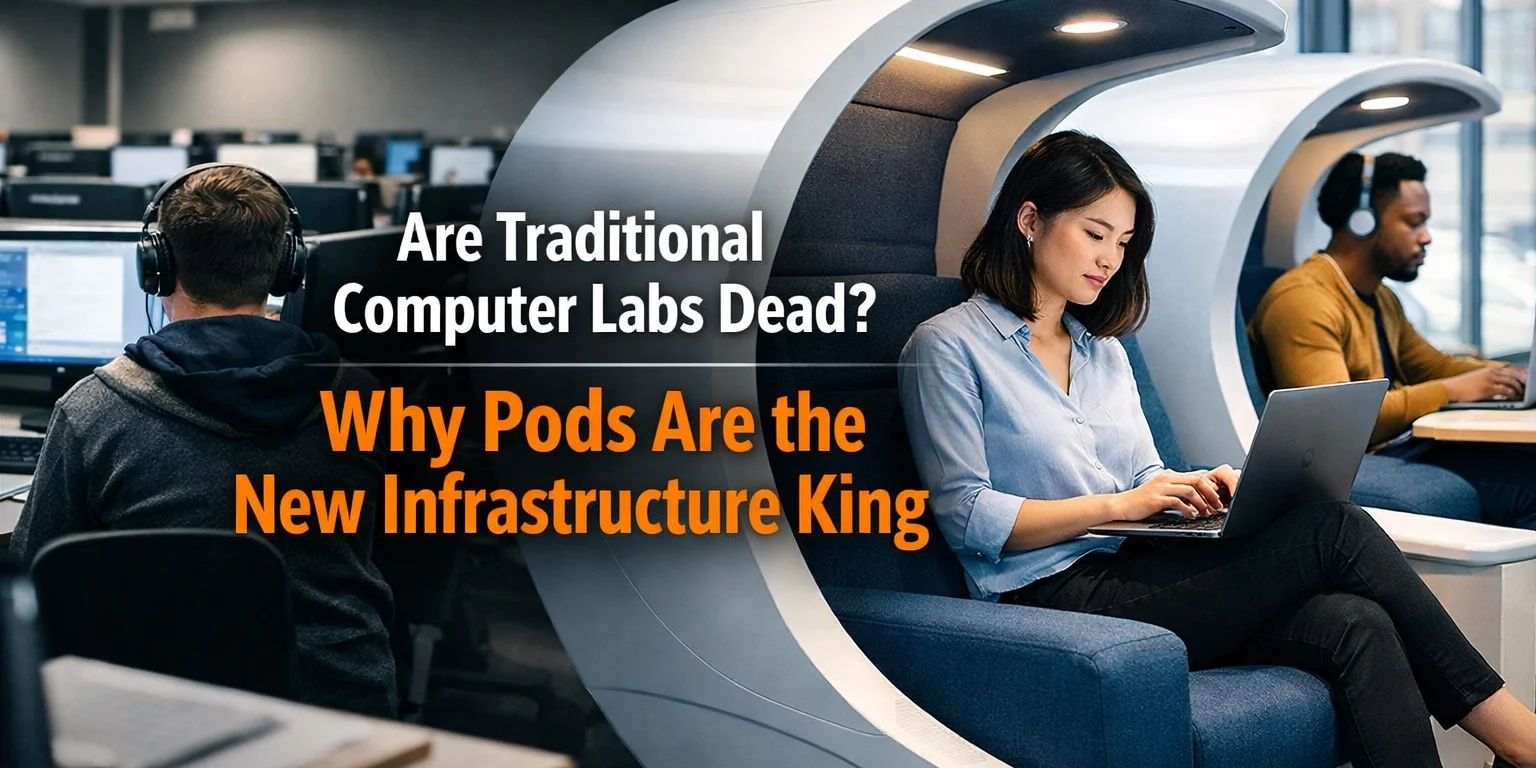
Walk into a traditional computer lab today and you might feel like you’ve stepped into a museum, one where the exhibits smell faintly of ozone and desperate late-night printing sessions. You remember the vibe: rows of beige (or maybe matte black) towers, glowing monitors that weigh more than a small dog, and a strict "no drinks" policy that everyone ignored anyway.
But here’s the reality check: traditional computer labs are effectively on life support. According to recent data, roughly 95% of students and young professionals now carry their own computing power in their backpacks. When everyone has a laptop, the old-school lab, once the crown jewel of campus infrastructure, becomes little more than an expensive, air-conditioned storage unit for outdated hardware.
So, what’s taking its place? Enter the "Pod." At USA Entertainment Ventures LLC, we’ve seen the shift firsthand. We’re moving away from rows of isolated desks and toward modular, high-performance environments designed for collaboration and specific career outcomes. The infrastructure king is dead; long live the Pod.
The Economic Collapse of the "Tower" Model
The old model of computer labs was built on a problem that no longer exists: the high cost of entry. Twenty years ago, if you wanted to run CAD software or edit video, you needed a $4,000 workstation that stayed bolted to a desk. Today, a mid-range laptop can handle most of those tasks.
For institutions, the traditional lab is a financial sinkhole. You have the "hardware refresh" cycle, that painful every-three-years ritual where you spend a fortune to replace machines that are already obsolete by the time the plastic wrap is removed. Then there’s the real estate. In a world where space is at a premium, dedicating hundreds of square feet to rows of empty chairs is a management nightmare.

What is a Pod, Anyway?
If a traditional lab is a bus station: utilitarian, cold, and a bit lonely: a Pod is a private jet. It’s a self-contained, high-tech environment designed for a specific purpose.
Unlike the "one size fits all" approach of the past, Pods are modular. They are built for team-based projects, often featuring large shared monitors, ergonomic layouts, and specialized hardware that a standard laptop simply can’t match. Think of the E-Sports Pod model. It’s not just a place to sit; it’s an ecosystem.
These units are the new infrastructure king because they bridge the gap between "I have a laptop" and "I have a career." They provide the specialized software: enterprise resource planning, penetration testing platforms, and professional editing suites: that students and professionals need to actually get work done in the real world.
Career Pathway #1: The Logistics Revolution
When we talk about Pods, we aren’t just talking about the computers inside them. We’re talking about the massive logistics and supply chain machine required to deploy them.
The shift to modular infrastructure has created a booming career pathway in logistics. These aren't just boxes; they are sophisticated pieces of equipment that require precise staging, transport, and setup. This is where consulting meets physical execution.
If you’re interested in logistics, the Pod model offers a masterclass in modern supply chain management. From managing the "last mile" delivery of a fully integrated E-Sports suite to the technical assembly of hybrid cloud architectures, the demand for professionals who can move and maintain this hardware is skyrocketing. It’s about more than just moving a crate; it’s about deploying a functional workplace in a matter of hours, not months.
Career Pathway #2: Cybersecurity and the Hardened Edge
One of the biggest arguments for the traditional lab used to be security. A locked room is easier to guard than a thousand roaming laptops. However, Pods take this to the next level through "hardened" infrastructure.
For those looking into cybersecurity, Pods represent the front line of physical and digital defense. Because Pods often operate on a hybrid architecture: combining local computing power with cloud-based security layers: they offer a controlled environment for high-stakes tasks like penetration testing or secure data analysis.
In a Pod environment, cybersecurity isn't just a software package; it’s baked into the physical infrastructure. We are seeing a massive demand for security experts who can design these "clean room" digital environments. They ensure that even if the outside world is a chaos of unsecured Wi-Fi and malware, the work inside the Pod remains pristine.

Career Pathway #3: Content Creation and Digital Media
Let’s be honest: you can’t render a 4K feature film or stream a professional-grade e-sports tournament on a standard school-issued Chromebook. This is where the Pod truly shines.
The content creation pathway is perhaps the most visible beneficiary of this new infrastructure. Pods are being designed specifically for digital media production, equipped with sound-dampening materials, high-end GPUs, and professional-grade lighting.
This isn't just about "playing games." It’s about the professionalization of the creator economy. Whether it’s video editing, 3D modeling, or live broadcast production, these Pods serve as the training ground for the next generation of media moguls. They provide the high-performance tools that allow creators to push the boundaries of what’s possible, turning a hobby into a high-paying career.
Why the "Hybrid" Approach Wins
One of the coolest features of modern Pod infrastructure is its resilience. Traditional labs are tethered to the building's backbone. If the internet goes down or the server room overheats, the whole thing is a brick.
Modern Pods often utilize a hybrid architecture. This means they have enough local "grunt" to keep working even if the connection to the cloud gets spotty. In underserved areas or regions with shaky infrastructure, this is a game-changer. It ensures that learning and production never have to stop just because the Wi-Fi decided to take a nap.
This reliability is why we’re seeing Pods pop up in places you’d never expect: from corporate lobbies to community centers. They offer a "plug-and-play" solution to technical education that a fixed lab could never match.
The Human Element: Collaboration Over Isolation
Perhaps the biggest "win" for the Pod model isn't technical: it’s social.
The traditional computer lab was a place of isolation. You sat in a row, stared at your screen, and tried to ignore the person clicking their pen next to you. It was a model designed for data entry, not innovation.
Pods are inherently collaborative. They are designed for "we," not "me." With open floor plans, shared displays, and modular seating, they mimic the modern tech office. This environment encourages the "soft skills" that employers actually care about: communication, teamwork, and collective problem-solving. Research shows that students and workers in these collaborative environments report higher levels of emotional fulfillment and intellectual satisfaction. They aren't just learning how to code; they’re learning how to work in a team.

The ROI of the Modular Shift
For the decision-makers: the CEOs, school board members, and facility managers: the move to Pods is ultimately about ROI.
- Space Efficiency: You can fit a high-functioning Pod into a fraction of the space required for a traditional lab.
- Scalability: Need more capacity? You don't need to renovate the wing of a building; you just add another Pod.
- Career Readiness: By providing industry-specific environments, you are producing graduates and employees who are ready to hit the ground running on day one.
At USA Entertainment Ventures LLC, we believe that infrastructure should work as hard as the people using it. Whether it's through our work with Zoo Imagery or our various digital projects, the focus is always on the future.
Final Thoughts: The Future is Modular
The traditional computer lab had a good run. It ushered us into the digital age and gave a generation of users their first taste of the internet. But the world has changed. Our tools are mobile, our work is collaborative, and our careers are more specialized than ever.
The rise of the Pod as the new infrastructure king isn't just a trend in furniture; it’s a fundamental shift in how we view the relationship between space, technology, and talent. By investing in modular, career-focused environments, we aren't just updating a room: we’re building the runways for the careers of tomorrow.
So, the next time you see a dusty room full of old towers, don't think of it as a lab. Think of it as a vacancy: waiting for the next Pod to arrive.
Want to learn more about how we’re changing the game? Check out our latest projects and see what Dan Kost and the team are up to at USA Entertainment Ventures LLC.





