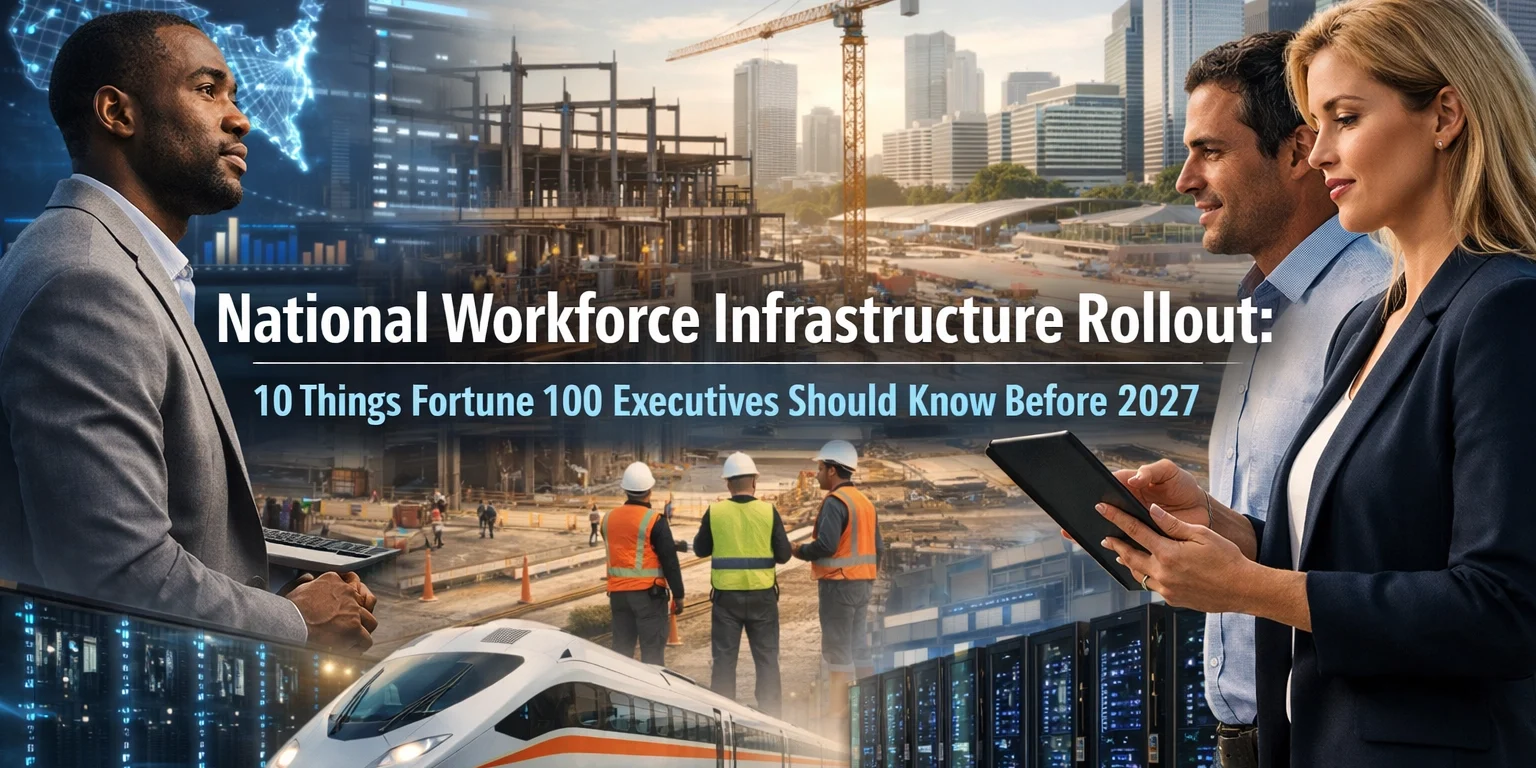
The convergence of federal infrastructure investments, evolving workforce demands, and competitive pressure for talent has created a unique window for Fortune 100 companies to establish leadership in workforce development. Between now and the end of 2027, decisions made about physical infrastructure, community partnerships, and training delivery systems will determine which organizations secure advantageous positions in the emerging landscape of career-ready programming.
1. Federal Funding Creates a Time-Bound Strategic Window
The Infrastructure Investment and Jobs Act (IIJA), CHIPS Act, and Inflation Reduction Act (IRA) have directed unprecedented funding toward infrastructure projects through the end of this decade. The current Workforce Innovation and Opportunity Act (WIOA) planning period, spanning 2024-2027, represents a strategic alignment opportunity that will not repeat on this scale for years to come.
Organizations that position their workforce development initiatives to complement these federal programs can access public funding streams, establish credibility with government partners, and demonstrate corporate citizenship in measurable terms. The window for first-mover advantage in securing these partnerships narrows with each passing quarter.

2. Physical Distribution Networks Solve the Accessibility Challenge
Workforce development has historically struggled with geographic inconsistency. Programs succeed in urban centers but fail to reach suburban and rural communities where talent pipelines are equally critical. Companies with established physical presence across diverse geographies possess a ready-made solution to this challenge.
Existing distribution networks, retail locations, and community touchpoints can be leveraged to deliver consistent, quality workforce programming across varying population densities. This approach transforms logistical infrastructure into human capital infrastructure, creating dual-use value from physical assets. The key advantage lies not merely in reach but in standardization: ensuring that a participant in rural Montana receives the same quality training as someone in downtown Chicago.
3. Esports Functions as an Engagement Gateway to Cloud and AI Literacy
The challenge of teaching cloud computing architecture or artificial intelligence fundamentals to non-technical populations has confounded workforce developers for years. Esports programming, however, has emerged as what strategic planners call a "Trojan Horse" for digital literacy development.
Competitive gaming naturally introduces participants to cloud infrastructure concepts, low-latency networks, data processing, and real-time analytics in a context that maintains engagement rather than triggering intimidation. Players develop intuitive understanding of system performance, bandwidth requirements, and computational power through gameplay that translates directly to enterprise technology concepts.
Fortune 100 companies deploying workforce infrastructure should consider esports not as recreation but as pedagogical methodology: a proven engagement tool that builds foundational digital literacy before introducing formal technical training. The progression from casual participant to career-ready candidate becomes measurable and replicable.
4. State Workforce Development Systems Are Undergoing Fundamental Restructuring
The National Governors Association and U.S. Department of Labor are facilitating unprecedented peer learning among states implementing their 2024-2027 workforce plans. This represents a systematic overhaul of how public workforce systems operate, creating opportunities for private sector partners who understand the evolving landscape.
Executives who comprehend these state-level changes can align corporate programs with emerging public infrastructure, ensuring compatibility and maximizing the leverage of combined resources. States are increasingly receptive to private sector leadership in workforce development, provided that programs demonstrate alignment with public objectives and transparent measurement of outcomes.

5. Geographic Expansion Requires Retail Strategy Discipline
The temptation to scale quickly across all markets simultaneously undermines program effectiveness and strains organizational capacity. Successful workforce infrastructure deployment follows proven retail expansion methodology: pilot programs in diverse market types before broader rollout.
Select one urban center, one suburban region, and one rural area for initial deployment. These pilots should differ not in program content but in delivery mechanisms, partnership structures, and community engagement approaches. Data from diverse pilot markets reveals which elements require local customization and which can standardize across geographies. This phased approach reduces risk, improves outcomes, and generates the proof points necessary for securing additional investment and partnership support.
6. Cross-Functional Integration Is Mandatory, Not Optional
Workforce infrastructure deployment fails when treated as solely a human resources initiative. Success requires coordination among human resources, real estate and facilities management, community relations, government affairs, and business development functions. This coordination does not happen organically: it requires executive mandate and clear sponsorship from senior leadership.
The most successful programs establish dedicated cross-functional teams with defined decision-making authority and budget control. These teams operate with autonomy but report directly to C-suite leadership, ensuring that workforce infrastructure receives the strategic attention and resource commitment necessary for meaningful impact.
7. Broadband Expansion Creates Immediate Workforce Sector Opportunities
States are increasingly highlighting broadband and digital infrastructure development in their workforce plans, recognizing that network expansion creates employment opportunities across skilled trades, technical roles, and project management positions. For Fortune 100 companies involved in infrastructure sectors, workforce development becomes integral to operational success rather than corporate social responsibility.
The next 18 months will see accelerated broadband deployment in underserved areas, driven by federal funding and state mandate. Companies that establish training pipelines for broadband-related occupations position themselves advantageously for both talent acquisition and community partnership development. The workforce requirements of infrastructure expansion create natural alignment between business needs and community benefit.

8. Comprehensive Skills Audits Prevent Resource Misallocation
The starting point for any workforce infrastructure investment is a detailed analysis of current workforce competencies and projected needs over a five-year horizon. This audit must identify specific technical skills gaps, geographic talent distribution challenges, and anticipated growth areas with precision.
Too many programs begin with assumptions about workforce needs rather than data-driven assessment. The result is training programs that produce graduates for positions that do not exist or that develop skills misaligned with actual operational requirements. A comprehensive skills audit mapped against recognized certification frameworks ensures that infrastructure investment produces measurable return through reduced time-to-productivity, improved retention, and enhanced talent pipeline strength.
9. Measurement Systems Must Launch Concurrently with Programs
Workforce infrastructure cannot be evaluated effectively if measurement systems are added after program launch. From program inception, organizations must track participation metrics including enrollment and completion rates, outcome indicators such as skill acquisition and certifications earned, employment outcomes for participants, employer satisfaction with program graduates, and cost per participant trained.
Transparent, rigorous measurement serves multiple strategic purposes. It strengthens public-private partnerships by providing government partners with evidence of program effectiveness. It enables continuous improvement through data-driven program refinement. It generates the documentation necessary for securing additional funding and partnership support. Most critically, it provides executives with the evidence needed to justify continued investment or program modification.
10. First-Mover Advantage Compounds Over Time
Competition for community partnerships, physical locations, and participant attention will intensify as more companies recognize the strategic value of workforce development investment. Organizations that move decisively in the next 12 months will capture the most advantageous positions in their target markets.
This advantage is not merely about being first: it is about establishing trusted community presence, building partnership networks, and creating brand association with career opportunity that becomes progressively more difficult for competitors to replicate. In workforce development, trust and reputation compound over time. Early movers establish themselves as category leaders, while late entrants struggle to differentiate and must often accept less favorable partnership terms and secondary market positions.

The Path Forward
Fortune 100 executives face a decision point. The convergence of federal funding cycles, state workforce system restructuring, and competitive dynamics creates opportunity that is both significant and time-limited. Organizations that treat workforce infrastructure as strategic investment rather than philanthropic obligation will establish sustainable competitive advantages in talent acquisition, community positioning, and operational capability.
The next 18 months will determine which companies lead in workforce development and which companies follow. The infrastructure deployed, partnerships established, and measurement systems implemented before the end of 2027 will define competitive positioning for the decade that follows.