
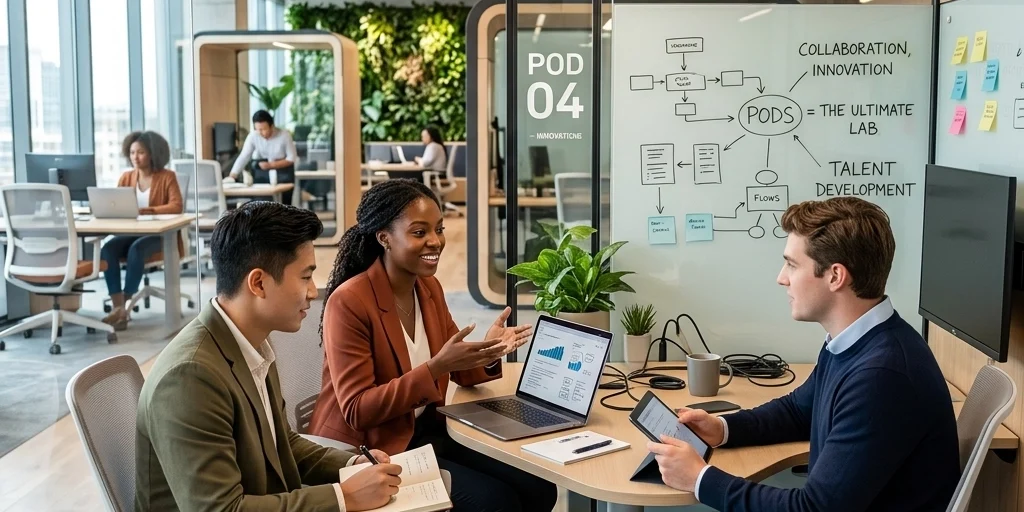
Remember the school computer lab? That windowless room filled with beige towers, glowing CRT monitors, and the faint, unmistakable smell of ozone and floor wax? For a generation, that was the gateway to the future. It was where we learned that "Oregon Trail" was a lesson in mortality and that typing "asdf jkl;" actually mattered.
Fast forward to 2026. We’ve been told for a decade that the future is "remote," "cloud-based," and "decentralized." We were promised a world where a laptop and a decent Wi-Fi connection were all you needed to conquer the digital economy. But here’s the cold, hard truth: the digital world still needs a physical home.
As it turns out, the "cloud" is just someone else’s computer in a giant warehouse, and "next-gen talent" still needs a place to plug in, level up, and collaborate. At USA Entertainment Ventures LLC, we’re seeing a massive shift back to the physical. We call them Pods. They are the evolution of the computer lab, and they are becoming the ultimate training ground for the careers of tomorrow.
The Physicality Paradox: Why We Can’t Go 100% Virtual
There is a growing paradox in workforce development. While the jobs themselves are increasingly digital, the pathway to those jobs is often blocked by physical barriers. We call this the "Infrastructure Gap."
If you’re a 19-year-old with the potential to be a world-class cybersecurity analyst but you live in a house with three siblings, a spotty internet connection, and no quiet space to focus, your "potential" is effectively stuck behind a paywall of physical circumstance. Remote learning assumes a level of domestic infrastructure that many talented individuals simply don't have.
Physical distribution is the most overlooked aspect of workforce development. You can have the best online curriculum in the world, but if a student can’t access the high-performance hardware or the high-speed connectivity required to run it, the curriculum is useless. This is where the Pod ecosystem comes in. By creating localized, physical hubs, we are building a national network that systematically distributes opportunity regardless of a person's zip code.

What Exactly is a Pod? (And No, It’s Not a Space Capsule)
Think of a Pod as a high-tech, multi-purpose laboratory that fits into the existing fabric of a community: malls, community centers, or even repurposed retail spaces. It is a sophisticated piece of physical infrastructure designed to be a "Next-Gen Talent Funnel."
Inside a Pod, you won’t find beige boxes. You’ll find high-performance gaming rigs, AI-integrated simulation stations, and broadcast-quality content creation suites. But the magic isn't just in the hardware; it’s in the convergence of industries. A Pod is a place where AI literacy meets high-performance gaming, and where simulation technology meets real-world career training.
1. The Logistics Leap: Trucking and Beyond
When most people think of "logistics," they think of a guy in a brown truck dropping off a package. In reality, logistics is a high-stakes, data-driven industry that keeps the global economy breathing. It’s also an industry facing a massive talent shortage.
Through Pod-based simulations, we can take a gamer who has spent thousands of hours navigating complex digital environments and transition them into trucking and logistics. Modern supply chain management is essentially a massive game of real-time strategy. By using physical Pods equipped with advanced simulators, we can provide hands-on training that mimics the pressure and precision of the real world without the risk of crashing a multi-million dollar rig on day one.
2. Cybersecurity: Defending the Digital Fortress
Cybersecurity is no longer just a "tech" job; it’s a national security priority. However, learning to defend against a sophisticated DDoS attack or a ransomware threat isn't something you can easily do on a Chromebook at a coffee shop.
Pods provide a secure, high-bandwidth environment where talent can engage in "Red Team vs. Blue Team" exercises. This physical proximity allows for immediate coaching and collaboration: elements that are often lost in translation over a Zoom call. By grounding cybersecurity training in physical infrastructure, we create a "lab" environment where mistakes are learning opportunities and successes are celebrated in person.
3. Content Creation: The New Media Powerhouse
We live in a world where "Influencer" is a top career choice for Gen Z. But being a professional content creator requires more than just a smartphone and a ring light. It requires an understanding of digital distribution, brand management, and high-end production.
Pods serve as the ultimate media production labs. They provide access to the kind of "pro-sumer" gear: 4K cameras, soundproofing, and editing suites: that most young creators could never afford on their own. By lowering the barrier to entry, Pods are turning "gamers" into "producers" and "hobbyists" into "media entrepreneurs."
Bridging the "Friction" Points
Why does the physical location matter so much? Because of "friction." In business consulting, we look for the points where a process slows down or stops. In workforce development, friction looks like:
- Lack of Transportation: If the training center is two hours away, people won't go.
- Lack of Childcare: If you can’t bring your life with you, you can’t learn.
- Lack of Community: Learning in a vacuum is hard; learning in a Pod with peers is motivating.
By placing Pods in accessible, everyday locations, we remove these friction points. We are meeting the talent where they already are. It’s a strategy that shifts the focus from "finding talent" to "building talent."

The Economic Impact of Brick-and-Mortar Talent Hubs
From a business perspective, the Pod model is a goldmine for local economies. When a company like USA Entertainment Ventures LLC helps develop these hubs, we aren't just building a room; we're building an ecosystem.
These Pods attract top-tier retail talent and create a "halo effect" for surrounding businesses. Think about it: a mall that was once struggling to keep foot traffic now has a dedicated "Innovation Hub" that draws in hundreds of young, tech-savvy individuals every day. This creates opportunities for sports advertising, local events, and a renewed sense of community purpose.
Furthermore, the data collected within these Pods: through AI-driven analytics and vendor tracking: allows businesses to understand exactly what skills are being mastered in real-time. It’s a level of transparency that traditional education systems simply can’t match.
Looking Forward: The National Workforce Infrastructure
The goal isn't just to have a few cool rooms in a few cool cities. The goal is a National Workforce Infrastructure. We are looking at a future where Pods are as ubiquitous as public libraries were in the 20th century.
This is the bridge between the digital future we’ve been promised and the physical reality we live in. It’s where the next generation of distribution experts and digital innovators will be forged.

As we look toward the end of 2026 and beyond, the companies that will win are the ones that recognize that talent needs more than just a "login." They need a place to belong, a place to practice, and a place to grow. The Pod isn't just a lab; it's the heartbeat of the new economy.
Whether you are a business owner looking for a more robust talent pipeline or a community leader looking to revitalize your local economy, it’s time to start thinking about the physical space. Because in a world that’s increasingly virtual, the things that are real matter more than ever.
Ready to see how physical infrastructure can transform your workforce strategy? Explore our consulting projects and let’s build the future, one Pod at a time.





