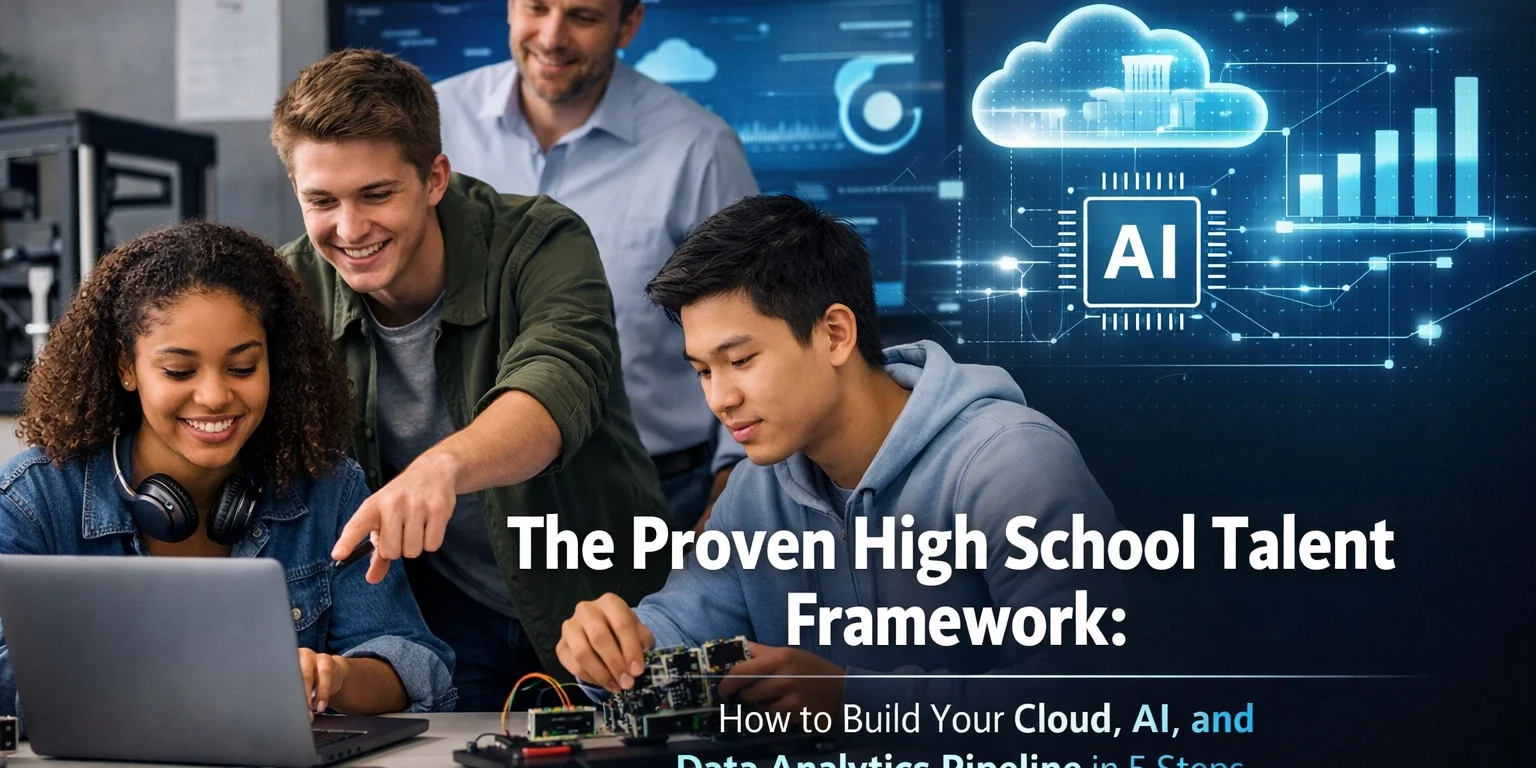
The talent shortage in cloud computing, artificial intelligence, and data analytics has reached critical levels. Organizations that wait until college recruiting to build their technical workforce are starting too late. The data is clear: companies that establish high school partnerships now are securing competitive advantages that will compound over the next decade.
According to recent workforce analysis, the demand for cloud architects, AI specialists, and data analysts continues to outpace supply by significant margins. Traditional recruiting channels: university career fairs, LinkedIn campaigns, and third-party recruiters: are no longer sufficient. The companies winning the talent war have shifted their strategy downstream, building relationships with future talent while students are still in high school.
Why High Schools Matter More Than Ever
The technical skills gap is not a future problem. It exists today, and it is widening. While many organizations focus exclusively on hiring experienced professionals or recent college graduates, they overlook a fundamental reality: the students currently in high school will enter the workforce between 2027 and 2031, precisely when the demand for cloud, AI, and data analytics expertise will reach unprecedented levels.

High school students represent more than just future employees. They are digital natives who have grown up with technology that previous generations encountered only in professional settings. Their familiarity with cloud-based applications, their comfort with algorithmic systems, and their intuitive understanding of data-driven decision-making provide a foundation that earlier generations lacked at the same age.
The question is not whether companies should engage with high school talent. The question is how to do so effectively, with structure and measurable outcomes.
The Five-Step Framework
Step 1: Launch Strategic Pilot Programs
Effective high school talent development begins with focused pilot programs rather than broad, unfocused initiatives. Organizations should identify two to three high schools that already have technology education infrastructure in place: computer labs, coding courses, or STEM-focused curricula.
Starting with schools that have existing technical programs allows companies to test their approach, refine their curriculum, and measure results before committing to larger-scale expansion. This measured approach reduces risk and provides valuable data on what works and what does not.
The pilot phase should run for at least one academic year, giving both the organization and the school sufficient time to establish routines, build trust, and evaluate student progress. Rushed implementations often fail because they lack the time necessary for relationships to develop and for students to demonstrate genuine capability growth.
Step 2: Assign Dedicated Program Leadership
High school partnerships require dedicated management. Treating these programs as supplemental responsibilities for existing employees: adding them to already full workloads: virtually guarantees underperformance.

Organizations should designate a program leader with both educational expertise and relationship management capabilities. This individual serves as the bridge between the company and educational institutions, managing logistics, communicating with teachers and administrators, and ensuring that programs remain aligned with both educational standards and business objectives.
The program leader should have authority to make decisions, allocate resources, and adjust strategies based on real-time feedback. Without clear ownership and decision-making authority, high school partnerships become diffuse, inconsistent, and ultimately ineffective.
Step 3: Build Structured Learning Pathways
Successful technical talent development requires clear progression. Students need structured learning pathways that build skills systematically over multiple years, not disconnected workshops or one-time events.
A well-designed pathway might introduce freshmen to foundational concepts: data literacy, basic programming principles, and introductions to cloud computing concepts. Sophomores could progress to cloud architecture fundamentals, learning about infrastructure-as-a-service, platform-as-a-service, and basic networking concepts. Junior year might introduce machine learning principles and practical applications of AI, while seniors work on capstone projects that integrate cloud infrastructure, data analytics, and algorithmic decision-making.
This four-year progression creates genuine expertise rather than superficial familiarity. Students graduate with practical skills and, equally important, with confidence in their ability to continue learning in these technical domains.
The curriculum should balance theoretical understanding with hands-on application. Technical knowledge without practical experience produces students who can discuss concepts but struggle to implement solutions. Conversely, hands-on work without conceptual grounding produces students who can follow tutorials but cannot adapt when faced with novel problems.
Step 4: Evaluate Through Projects and Problem-Solving
Traditional academic metrics: test scores, GPAs, class rankings: provide incomplete pictures of technical capability. Organizations building high school talent pipelines should evaluate students primarily through projects and problem-solving demonstrations.

Project-based evaluation reveals how students approach ambiguous problems, how they collaborate with peers, and how they handle setbacks and technical challenges. These capabilities matter more for long-term success than standardized test performance.
This evaluation approach also identifies talented students who may not excel in traditional academic environments. Some of the most innovative technical professionals perform adequately but not exceptionally in conventional classroom settings. Project-based assessment captures capabilities that standardized metrics miss.
Organizations should design evaluation frameworks that assess both technical execution and problem-solving process. How did students define the problem? What resources did they consult? How did they test their solutions? What did they learn when initial approaches failed? These process elements often predict professional success more accurately than final project outcomes.
Step 5: Implement Clear Measurement Frameworks
High school talent development programs require rigorous measurement to justify continued investment and to enable continuous improvement. Organizations should track both immediate engagement metrics and long-term outcomes.
Short-term metrics include student participation rates, program completion rates, and skill progression assessments. These data points indicate whether programs are reaching students effectively and whether students are developing genuine capabilities.
Long-term metrics track conversion rates: What percentage of program participants pursue relevant college majors? What percentage apply for company internships? What percentage ultimately join the organization as full-time employees? These outcome metrics demonstrate return on investment and inform strategic decisions about program expansion or modification.
Measurement frameworks should also capture qualitative feedback from students, teachers, and company mentors. Quantitative data reveals what is happening; qualitative feedback explains why it is happening and suggests improvement opportunities.
The Competitive Advantage
Organizations that build high school talent pipelines today are creating competitive advantages that compound annually. Each cohort of students who progress through structured programs represents potential employees who already understand the company's technology stack, share its values, and have demonstrated both technical capability and cultural fit.
This approach reduces recruiting costs, accelerates onboarding, and increases retention. Employees who joined organizations through high school programs often demonstrate stronger loyalty and longer tenure than those recruited through traditional channels.
The companies that will dominate cloud, AI, and data analytics in 2030 and beyond are not waiting for talent to appear. They are cultivating it systematically, starting now, in high schools across the country. The framework is proven. The opportunity is clear. The question is whether your organization will act while competitive advantage remains available.