
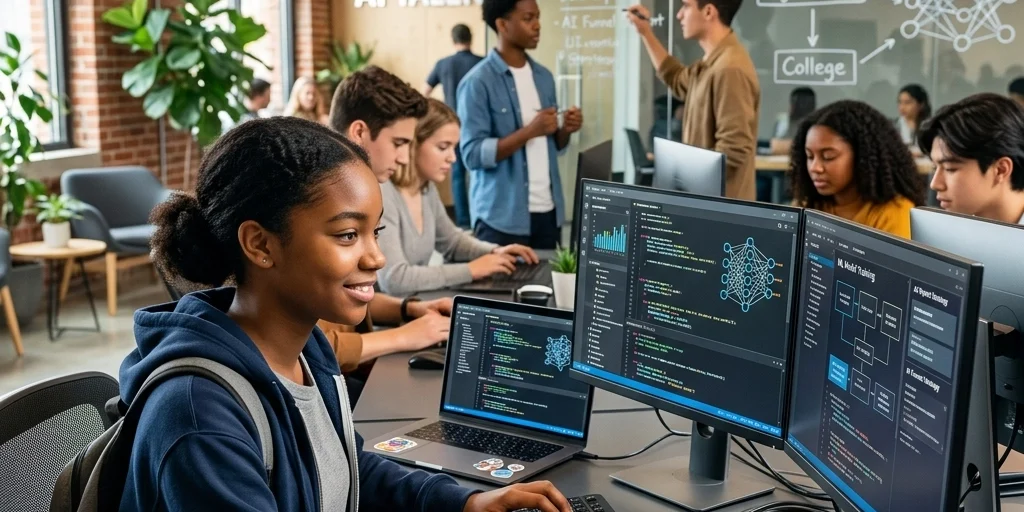
The landscape of professional recruitment is undergoing a seismic shift. In 2026, the traditional pipeline: four years of high school followed by four years of university: is no longer the only, or even the most efficient, route to securing top-tier technical talent. As Artificial Intelligence (AI), Cloud Computing, and Data Analytics continue to evolve at a breakneck pace, the skills required to navigate these industries are often being mastered by students long before they set foot on a college campus.
For businesses looking to remain competitive, the message is clear: the hunt for talent must begin earlier. High school is becoming the new college for talent acquisition. This guide explores why this shift is happening and how your organization can build a robust AI-driven funnel to capture the brightest minds of the next generation.
The Acceleration of the Skills Gap
The primary driver behind this shift is the widening gap between academic curricula and industry needs. While traditional higher education institutions provide valuable foundational knowledge, the sheer speed of innovation in fields like AI and Data Analytics often leaves four-year degree programs struggling to keep up. By the time a student reaches their senior year of college, the technologies they studied as a freshman may already be outdated.
Recent industry data suggests that technical proficiency in specialized coding languages and cloud architecture is now emerging in younger demographics. High school students today have grown up in a world where AI is a baseline reality, not a futuristic concept. They are self-teaching through decentralized platforms, participating in global hackathons, and contributing to open-source projects before they are old enough to vote.

Why High Schoolers are the New Tech Elite
There are several psychological and economic reasons why high school engagement is becoming a strategic necessity for modern enterprises.
1. Neuroplasticity and Rapid Learning
Younger brains are uniquely wired for the kind of rapid, iterative learning required in the AI sector. The ability to grasp complex algorithmic logic and adapt to new software interfaces is often higher in the teenage years. By engaging talent at this stage, companies can nurture these innate abilities before they are funneled into more rigid, traditional academic structures.
2. Early Brand Loyalty
The "War for Talent" is real. By the time a gifted software engineer reaches their junior year of college, they are likely being courted by every major tech firm in the world. By establishing a presence in high schools, your brand becomes the first point of contact. Early mentorship creates a sense of loyalty and alignment that is difficult to disrupt later on.
3. Diversity and Inclusion
Building a talent funnel in high schools allows companies to reach students from diverse socioeconomic backgrounds who might not have considered a career in tech or who might lack the resources for a traditional four-year degree. By focusing on skill-based identification rather than pedigree, organizations can build a more representative and innovative workforce.
Building the AI-Driven Funnel: A Step-by-Step Approach
Creating a high school talent funnel is not about sending a recruiter to a career fair once a year. It requires a sophisticated, data-driven approach that utilizes the same technologies the students are learning.
Step 1: Identify "Signal" Over "Noise"
Traditional recruiting relies on resumes. High school recruiting relies on "signals." These signals include performance in robotics clubs, contributions to GitHub, or success in data science competitions. Use AI-powered screening tools to scan these alternative platforms to identify high-potential individuals early.
Step 2: Integrated Learning Programs
To truly engage this demographic, companies must offer value. This can take the form of sponsored curriculum modules, summer intensives, or virtual "shadowing" programs. If your company specializes in digital solutions, creating a mini-course for local high schools on the basics of Cloud architecture provides immediate value to the students while serving as a long-term vetting process for your firm.

Step 3: Automated Engagement and Mentorship
Maintaining a relationship with a 16-year-old for several years requires automation. Use personalized AI communication streams to provide these students with relevant industry news, invite them to webinars, and offer them micro-internships. This keeps your brand top-of-mind without requiring thousands of manual man-hours.
The Role of Cloud and Data Analytics
Why focus specifically on Cloud and Data? Because these are the infrastructures upon which all modern business is built. A high school student who understands the basics of AWS or Azure and can perform basic data cleaning in Python is already more valuable to a business than a generalist with a standard liberal arts degree.
By focusing your services on these specific niches within the high school ecosystem, you are creating a specialist pipeline. These students are not just "good with computers"; they are becoming specialized practitioners in the tools that will dominate the 2030s.
Overcoming the "College-Only" Bias
The biggest hurdle to building a high school talent funnel is often internal. Management teams must move past the "degree-required" mindset. In 2026, a portfolio of successful AI projects is a more accurate predictor of job performance than a diploma.
Industry leaders are already making this pivot. Companies are beginning to offer "Apprenticeship-to-Hire" tracks where high school graduates bypass college entirely, or attend it part-time, while working in junior roles. This allows the company to shape the employee's skills to their specific tech stack from day one.

Actionable Takeaways for Your Organization
If you are ready to start building your next-gen talent funnel, consider these immediate steps:
- Review Your Entry-Level Requirements: Are you requiring a degree for roles that could be filled by a certified high school graduate?
- Audit Local High School Tech Programs: Identify which schools in your region have robust STEM or computer science tracks.
- Launch a Micro-Internship: Create a two-week virtual project for high schoolers to solve a real-world data problem.
- Leverage Your Current Talent: Encourage your senior engineers to act as mentors. This not only helps the students but also improves the career opportunities and engagement levels of your current staff.
The Future of the Workforce
The shift toward high school engagement is a response to a fundamental change in how knowledge is acquired and applied. We are entering an era of "continuous recruitment," where the lines between education and professional contribution are increasingly blurred.
Organizations that wait for the "finished product" of a college graduate will find themselves fighting over the leftovers. The winners of the AI era will be those who recognize potential early, provide the tools for growth, and build a funnel that starts long before the graduation cap is thrown.

As we look toward the remainder of 2026 and beyond, the integration of AI into our recruitment processes is not just a luxury: it is a survival mechanism. By focusing on the high school level, you are not just hiring employees; you are cultivating the future architects of your industry.
For more information on how to modernize your business consulting approach or to see how we help organizations navigate these shifts, visit our about us page or reach out via our contact form. The future of talent is already here; it's just sitting in a classroom, waiting for the right opportunity to lead.





