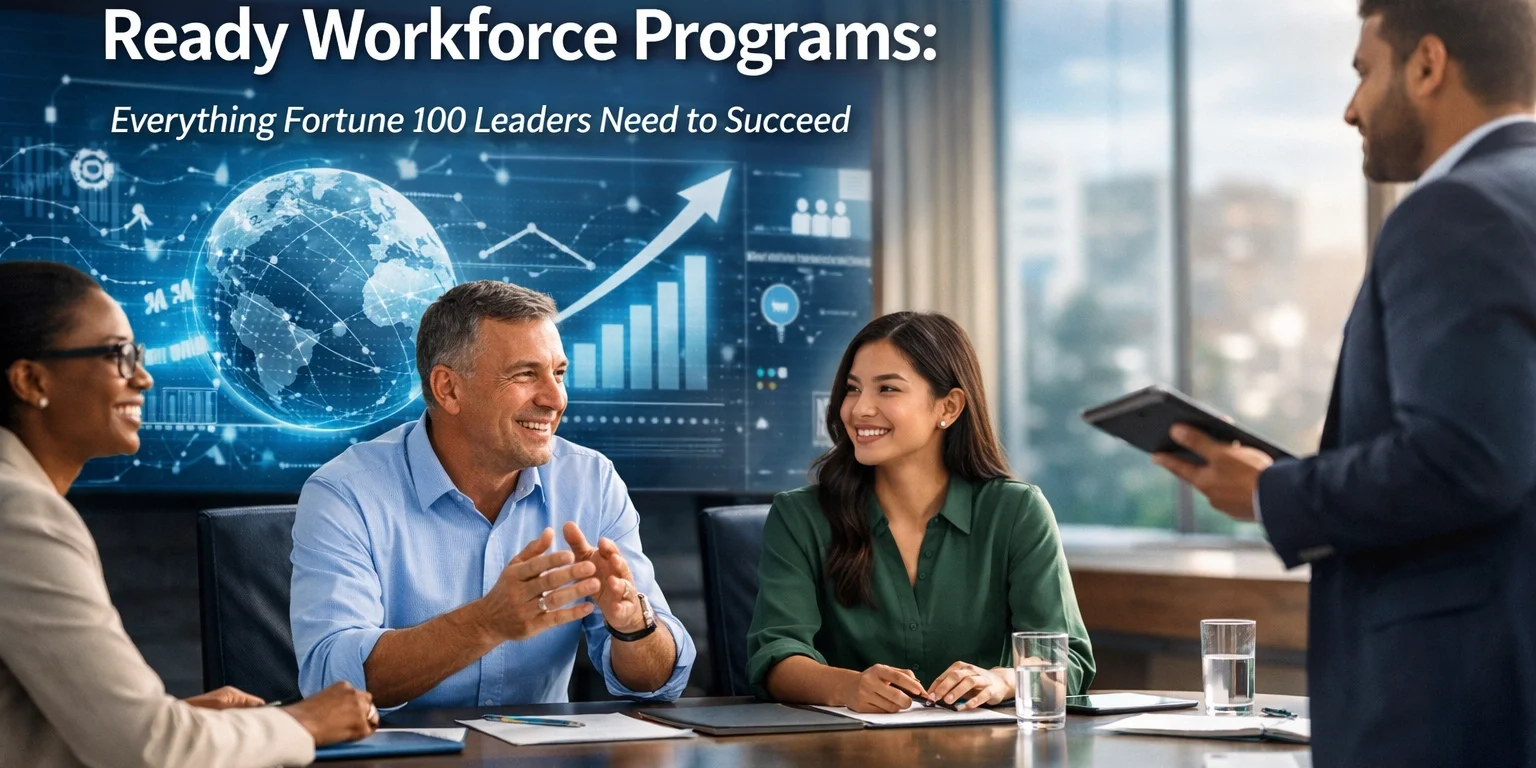
Fortune 100 leaders face a straightforward question in 2026: Is your talent pipeline prepared for the workforce demands of 2029, or are you training for yesterday's challenges? Nearly 40% of companies report that skill gaps represent the single largest barrier to organizational transformation. The organizations that will maintain competitive advantage in the next three years aren't just hiring differently: they're building Future Ready workforce programs with measurable outcomes tied directly to business performance.
The Measurement Gap in Workforce Development
Most workforce development initiatives fail not from lack of investment, but from inability to measure what matters. Traditional training programs track completion rates and satisfaction scores while business leaders need predictive analytics on skill acquisition, application velocity, and performance impact.

Data analytics dashboards designed specifically for Future Ready programs provide executive teams with real-time visibility into three critical metrics: skill gap closure rates across priority competencies, time-to-proficiency for emerging roles, and correlation between program participation and key performance indicators. Organizations implementing comprehensive dashboard systems report 34% faster identification of workforce vulnerabilities and 28% improvement in resource allocation efficiency.
The most effective dashboards integrate data from multiple sources: learning management systems, performance reviews, project outcomes, and external benchmarking: to create a unified view of workforce readiness. This integration allows leadership teams to answer strategic questions: Which departments show the highest adaptability scores? Where should upskilling investments concentrate for maximum ROI? How does our talent bench strength compare to industry standards?
NIL Education: The Unexpected Workforce Preparation Tool
Name, Image, and Likeness (NIL) education emerged from collegiate athletics, but forward-thinking organizations recognize its broader application as workforce preparation. At its core, NIL education teaches individuals to understand their professional value, manage their personal brand, navigate complex contracts, and make strategic decisions about partnerships and opportunities.

These capabilities translate directly to modern workforce requirements. Employees who understand personal branding contribute more effectively to organizational thought leadership initiatives. Contract literacy reduces friction in vendor negotiations and partnership development. Strategic decision-making skills enhance cross-functional collaboration and resource prioritization.
Organizations incorporating NIL education frameworks into their Future Ready programs report measurable outcomes: 42% increase in employees willing to serve as company ambassadors, 31% improvement in professional networking effectiveness, and 26% higher engagement in voluntary skill development activities. The education creates workforce members who think strategically about their career trajectory while aligning personal growth with organizational objectives.
The NIL education framework includes four core competencies: valuation and negotiation skills, legal and compliance literacy, digital presence management, and strategic partnership evaluation. Each competency addresses specific workforce gaps that traditional training often overlooks, particularly for employees transitioning from individual contributor roles to positions requiring broader business acumen.
Media Literacy as Competitive Advantage
In an environment where misinformation spreads faster than facts and deepfake technology challenges trust, media literacy represents a critical but undervalued workforce competency. Fortune 100 organizations face reputational risk when employees cannot distinguish credible sources from manipulated content, fail to recognize coordinated influence campaigns, or inadvertently amplify misleading information.

Media literacy outcomes from comprehensive Future Ready programs demonstrate measurable business impact. Organizations with structured media literacy training report 47% reduction in internal misinformation incidents, 38% faster crisis response times when facing external misinformation campaigns, and 29% improvement in cross-functional communication effectiveness.
The workforce application extends beyond defense against misinformation. Media-literate employees make better strategic decisions by evaluating data sources critically, identifying bias in market research, and synthesizing information from diverse channels more effectively. They contribute to stronger organizational intelligence gathering, more nuanced competitive analysis, and clearer communication of complex ideas to stakeholders.
Media literacy training in Future Ready programs should address source evaluation frameworks, manipulation detection techniques, verification methodologies, and responsible information sharing practices. These skills prove particularly valuable for roles in communications, marketing, strategy, and any position requiring synthesis of external information into internal decision-making.
The Anchor School Model for Enterprise Implementation
Rather than deploying workforce development initiatives uniformly across entire organizations: a strategy that often produces diluted results: leading enterprises are adopting an anchor school approach. This model designates specific business units, geographic locations, or functional teams as Future Ready anchors where comprehensive programs launch first, results are measured rigorously, and best practices are refined before broader rollout.
The anchor school model provides several strategic advantages. It concentrates resources for maximum impact, creates internal case studies with quantifiable results, develops cadres of trained facilitators who can support expansion, and allows iterative program improvement based on real-world performance data rather than theoretical assumptions.
Successful anchor implementations share common characteristics: executive sponsorship at the division or unit level, dedicated program management resources, integration with existing performance management systems, and transparent communication about results: both successes and challenges. Organizations typically see measurable outcomes within 90 days of anchor program launch, with full maturity achieved in 12-18 months.
The anchor school approach also addresses change management challenges inherent in workforce transformation. Early adopters become program advocates, sharing firsthand experience with peers and creating organic demand for expansion. This bottom-up momentum complements top-down strategic direction, accelerating adoption while maintaining program quality.
Building Integrated Future Ready Systems
The most effective Future Ready workforce programs don't operate as standalone initiatives but integrate deeply with talent management, performance evaluation, succession planning, and strategic workforce planning systems. This integration ensures that skill development connects directly to career advancement opportunities, that performance metrics reflect Future Ready competencies, and that workforce planning accounts for emerging capability requirements.
Integration requires deliberate technical and process design. Learning data must flow into talent management platforms. Dashboard insights should inform compensation decisions and promotion pathways. Media literacy and NIL education competencies need representation in job descriptions and performance review frameworks.
Organizations achieving full integration report 51% higher program participation rates, 43% better skill retention over time, and 37% stronger correlation between program completion and career advancement. The integration signals to employees that Future Ready development isn't optional professional development but core to organizational success and individual career trajectory.
Moving Forward: From Concept to Execution
The distinction between organizations that build truly Future Ready workforces and those that simply talk about workforce development comes down to three factors: measurement discipline through comprehensive analytics, strategic focus on high-impact competencies like NIL education and media literacy, and systematic implementation through proven models like the anchor school approach.
For Fortune 100 leaders evaluating workforce readiness heading into 2027, the path forward requires honest assessment of current capabilities, commitment to measurable outcomes rather than activity metrics, and willingness to invest in comprehensive programs that address the full spectrum of future workforce requirements. The organizations making these commitments today are building the competitive advantages that will define market leadership tomorrow.