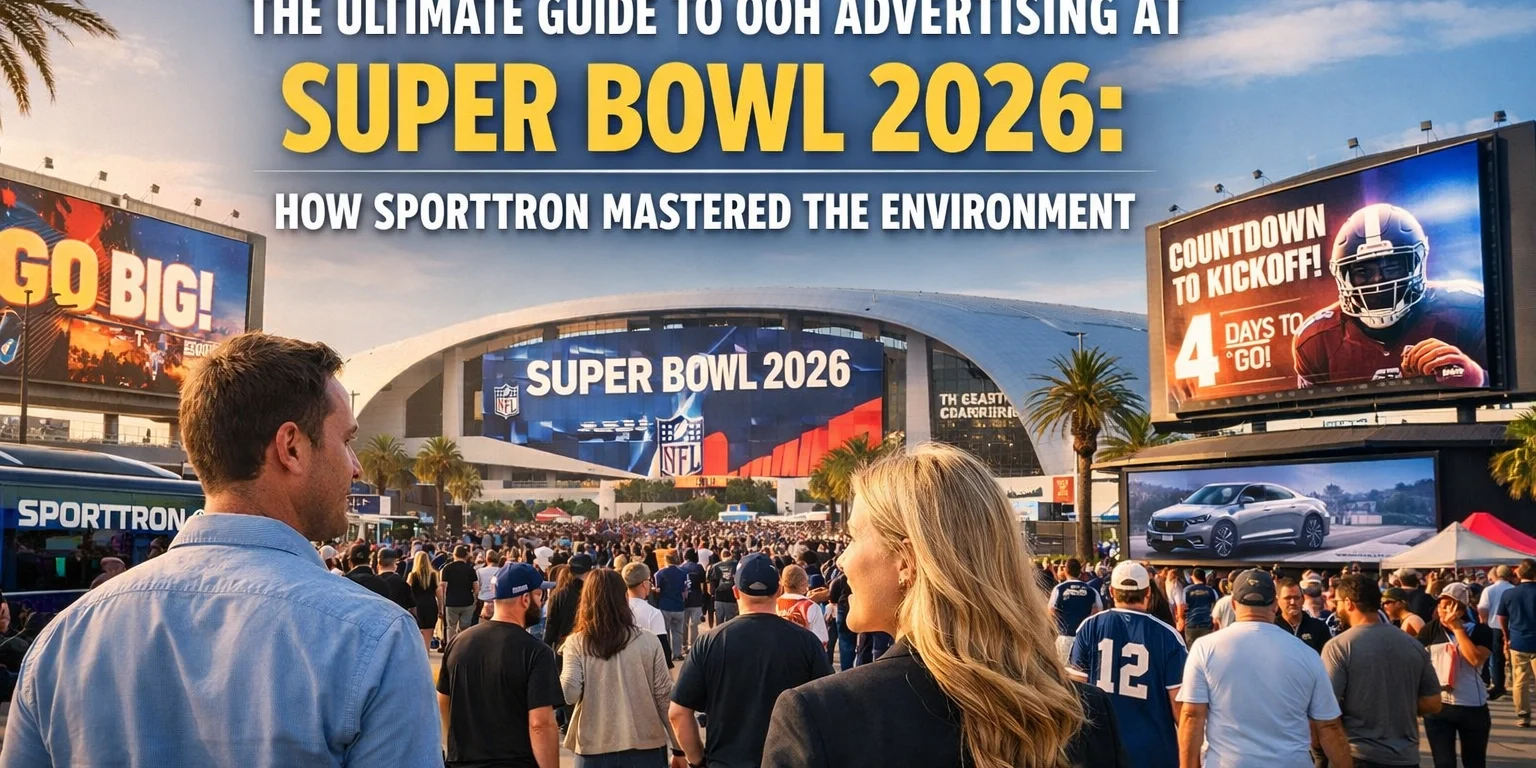
The landscape of Super Bowl advertising is undergoing a fundamental transformation. While brands continue to compete for coveted 30-second broadcast slots at premium prices, a strategic shift is taking place that's changing how marketers approach the biggest sporting event in America. Out-of-home (OOH) advertising has emerged as a powerful alternative, delivering sustained brand exposure across the entire Super Bowl experience rather than fleeting moments during commercial breaks.
At the forefront of this evolution stands the Sporttron Digital Network, which has demonstrated how strategic environmental ownership can deliver superior results compared to traditional broadcast-only strategies. By dominating the physical spaces where Super Bowl fans actually spend their time, Sporttron has redefined what it means to advertise at the Big Game.
The New Reality of Super Bowl Advertising
The economics of Super Bowl advertising present a stark reality. A single 30-second commercial spot during Super Bowl 2026 commands millions of dollars, offering brands a brief window to capture viewer attention amid bathroom breaks, snack runs, and divided attention spans. These precious seconds evaporate quickly, leaving marketers to hope their message resonated during that narrow timeframe.
OOH advertising operates on an entirely different temporal and spatial scale. Rather than competing for seconds, brands can own entire environments for days or weeks. This sustained presence creates accumulated impression value that compounds over time, reaching audiences at multiple touchpoints throughout their Super Bowl journey.
Mapping the Fan Journey
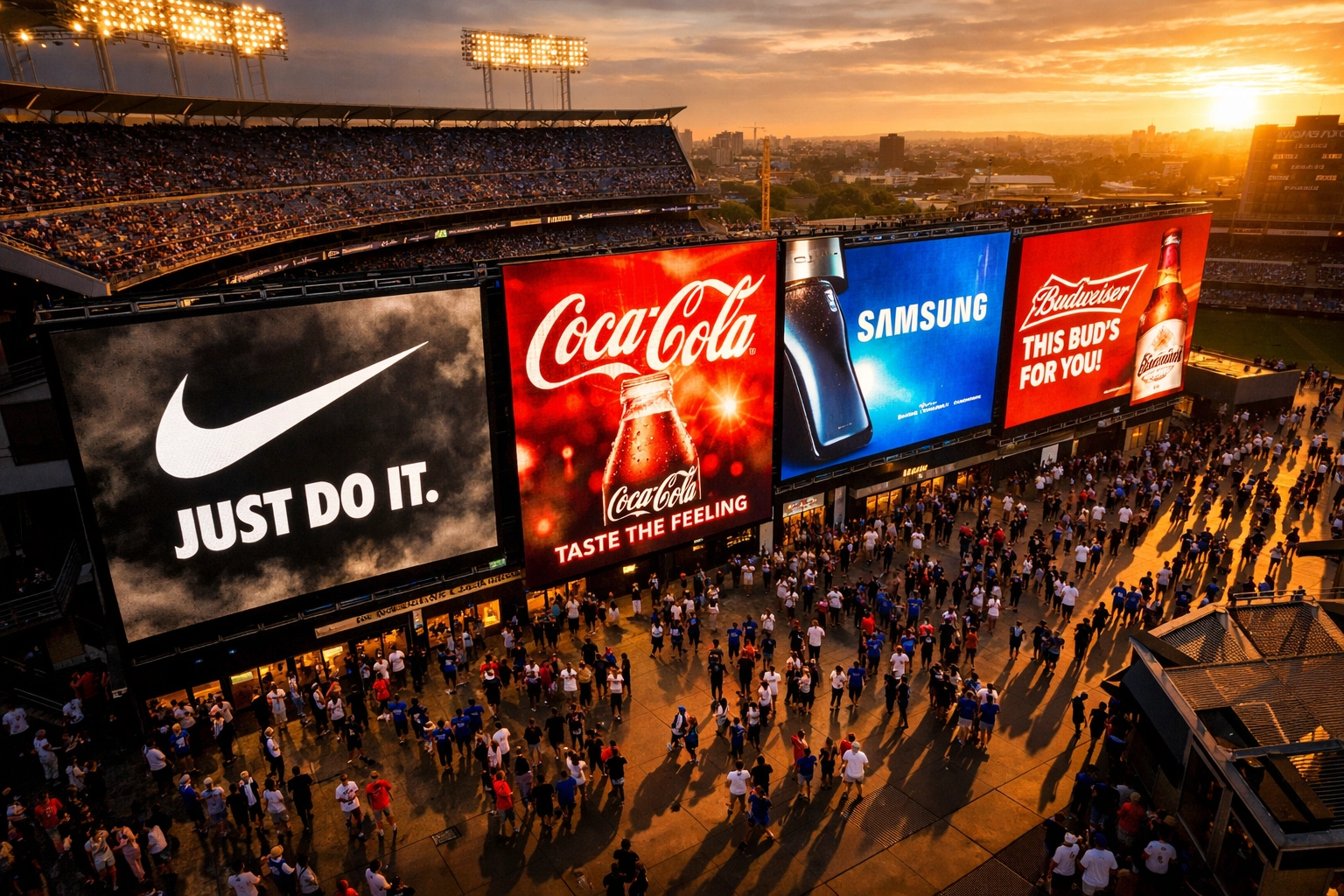
Super Bowl attendees don't simply materialize at the stadium for kickoff. They follow a predictable path that creates numerous advertising opportunities, and Sporttron has mastered the art of strategic placement along this journey. The typical fan experience begins at the airport, continues through hotel check-in, extends to restaurants and entertainment districts, builds through pre-game festivities, reaches its crescendo at the stadium approach, and concludes with post-game celebrations.
Each of these touchpoints represents an opportunity for brand engagement. A traveler might encounter a digital billboard at the airport upon arrival, see floor graphics in the hotel lobby during check-in, pass transit shelter ads while exploring the city, and view multiple digital displays while walking to the stadium. This repeated exposure creates frequency that television advertisers chase far less efficiently, all while the fan is in a receptive, celebratory mindset.
The strategic value of this multi-touchpoint approach cannot be overstated. Research consistently shows that marketing effectiveness increases exponentially with repeated exposure across different contexts. By owning the environment rather than renting seconds of airtime, brands create a comprehensive presence that permeates the entire Super Bowl experience.
Sporttron's Multi-Format Dominance
The Sporttron Digital Network exemplifies modern OOH strategy through its integration of diverse advertising formats working in concert. This isn't simply about placing billboards in high-traffic areas: it's about creating a cohesive brand ecosystem that surrounds audiences in three-dimensional space.
Digital billboards form the backbone of this approach, delivering dynamic content that evolves throughout the day. A single display might promote breakfast offerings at 8 AM, shift to game-time specials at noon, and transition to post-game venue promotions by evening. This flexibility allows brands to remain relevant to audience needs as they change throughout the day.
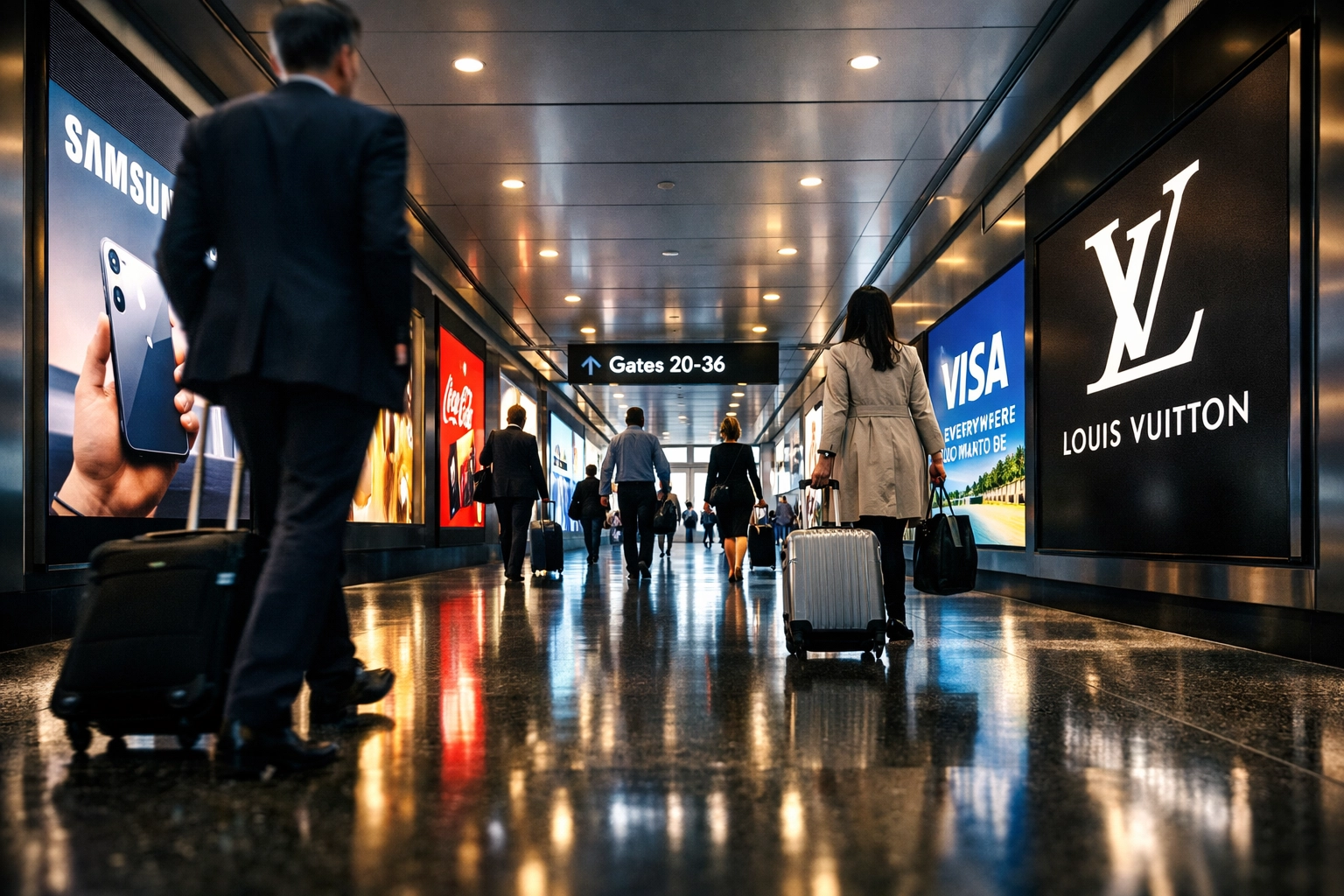
Street-level placements, transit shelters, and floor graphics in high-traffic areas create multi-sensory brand moments at eye level and underfoot. Sporttron's integrated approach ensures consistent brand storytelling across vertical billboards, horizontal floor placements, and everything in between. This mirrors how consumers actually experience environments: in 360 degrees, not in isolated vertical frames.
Integration Beyond Physical Space
The most sophisticated OOH campaigns function as physical anchors for broader multi-channel strategies, and Sporttron has mastered this integration. QR codes on transit ads drive immediate mobile engagement, transforming passive viewers into active participants. Branded hashtags on digital billboards encourage social sharing, extending campaign reach far beyond the physical installation.
Location-based mobile campaigns can retarget audiences who pass specific OOH placements, creating a seamless bridge between physical and digital experiences. For example, a digital billboard near the stadium might feature a live social media feed of fan photos using a branded hashtag, while simultaneous Instagram campaigns encourage fans to post selfies with OOH placements for contest entry. This transforms OOH from one-way broadcasting into two-way conversation.
The data generated from these integrated campaigns provides valuable insights into audience behavior and engagement patterns. Brands can track QR code scans, monitor social media engagement, and analyze foot traffic patterns to measure campaign effectiveness with unprecedented precision.
The Temporal Advantage
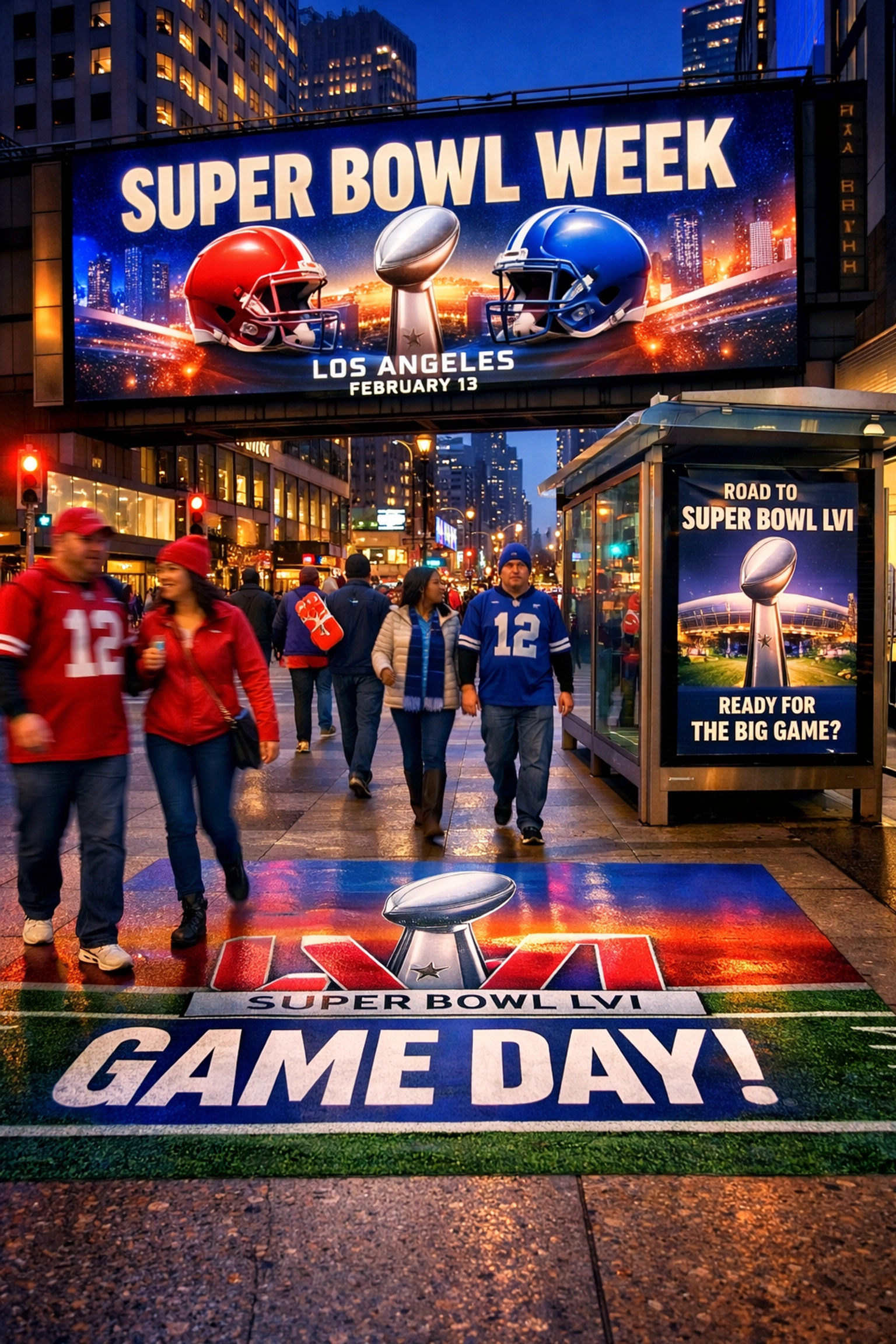
Television spots vanish in 30 seconds. OOH operates on a fundamentally different timeline, offering continuous presence that accumulates impression value over extended periods. Sporttron campaigns can dominate the entire event window: from the moment the championship matchup is confirmed through the week of fan arrival and beyond: while TV advertisers compete for mere seconds during the game itself.
This sustained visibility creates what marketing researchers call "environmental saturation": a state where brand presence becomes so pervasive within a defined space that it shapes the overall experience of that environment. Super Bowl attendees don't just see advertisements; they move through branded spaces that become part of their event memories.
The cost efficiency of this approach becomes clear when comparing impression costs. While a 30-second Super Bowl commercial might reach 100 million viewers for a few fleeting seconds, strategic OOH placements can deliver millions of impressions over multiple days to the exact audience attending the event: the most engaged, high-value segment of Super Bowl viewers.
Actionable Insights for Future Campaigns
The Sporttron approach offers several takeaways for brands planning future Super Bowl marketing initiatives. First, think beyond the broadcast window. The Super Bowl experience extends far beyond the three hours of game time, and effective campaigns should reflect this reality.
Second, embrace format diversity. Different advertising formats serve different purposes and reach audiences in different mindsets. A comprehensive OOH strategy leverages multiple formats to create environmental dominance.
Third, integrate physical and digital touchpoints. OOH placements should serve as launchpads for deeper engagement through mobile and social channels, not as isolated brand encounters.
Finally, prioritize sustained presence over momentary spikes. Building brand awareness and preference requires repeated exposure over time, not just a single memorable moment.
The Competitive Landscape
As more brands recognize the strategic value of environmental ownership, OOH advertising at major sporting events will become increasingly competitive. The Sporttron Digital Network has demonstrated that modern OOH networks can deliver guaranteed eyeballs at a fraction of the cost of broadcast advertising, creating superior ROI for forward-thinking marketers.
The evolution continues as technology enhances OOH capabilities. Programmatic OOH buying, real-time content optimization, and advanced audience measurement tools are making environmental advertising more sophisticated and measurable than ever before.
Looking Forward
The Super Bowl 2026 experience illustrates a broader shift in how brands approach event marketing. While competitors burn budgets on broadcast seconds, strategic marketers are owning the physical environments where fans actually spend their time. The Sporttron Digital Network has proven that mastering the environment delivers better results than fighting for attention during commercial breaks.
As we move forward, the integration of OOH with digital channels will only deepen, creating seamless experiences that span physical and virtual spaces. Brands that recognize this shift and adapt their strategies accordingly will find themselves with a significant competitive advantage: not just at the Super Bowl, but across all major events where audiences gather and brands compete for attention.
The ultimate guide to OOH advertising at Super Bowl 2026 isn't about following a prescribed formula. It's about understanding how audiences experience events, mapping strategic touchpoints along their journey, and creating sustained brand presence that transforms passive viewing into active engagement. Sporttron has shown the way: now it's up to other brands to follow or risk being left behind in an advertising landscape that's moving beyond the broadcast model.