
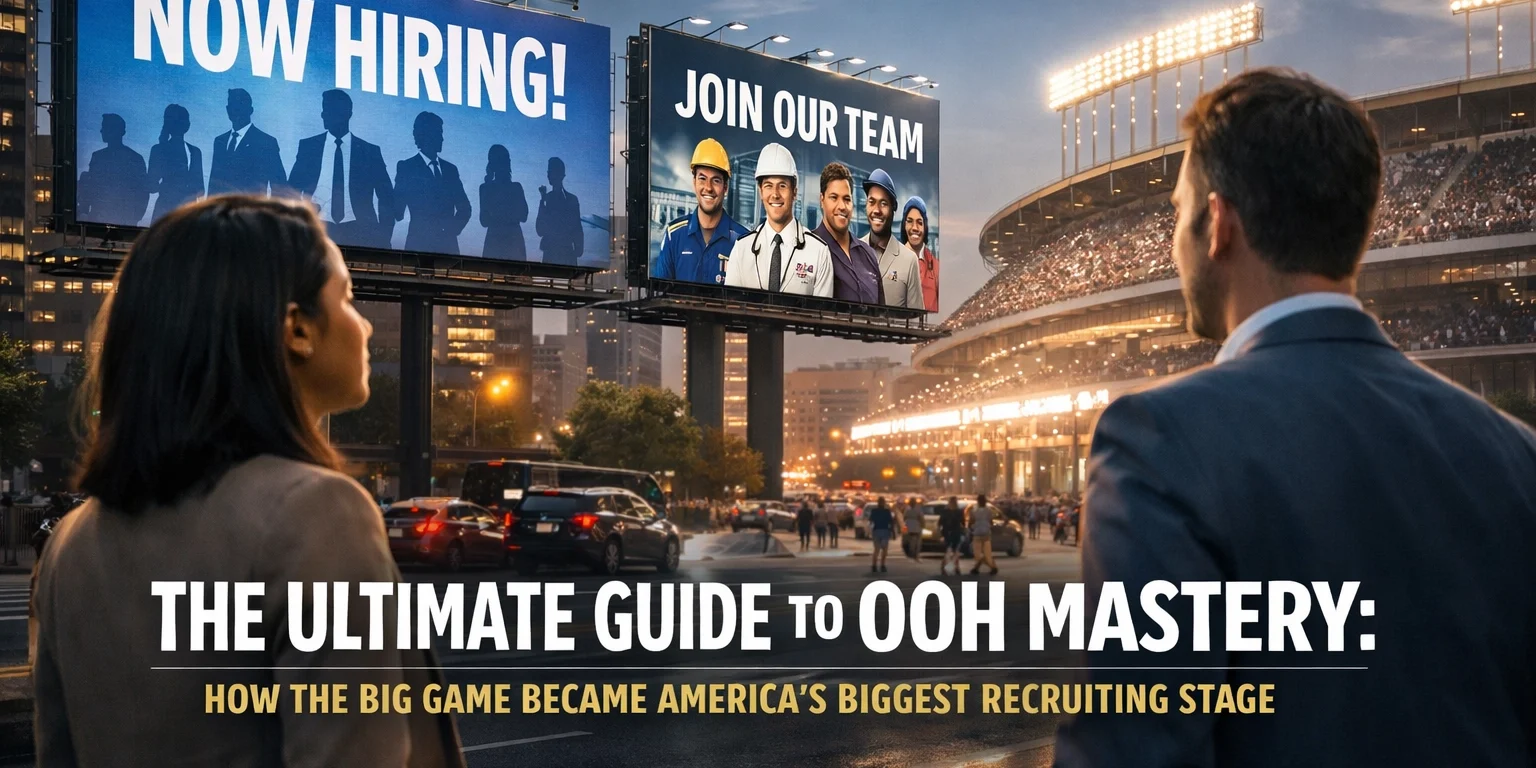
The landscape of out-of-home (OOH) advertising has undergone a fundamental transformation. While brands have traditionally focused on consumer-facing messages during major sporting events, a parallel opportunity has emerged that forward-thinking organizations are beginning to exploit: the intersection of OOH advertising and talent acquisition at scale.
The Big Game represents more than just a broadcasting phenomenon: it's a physical convergence point where millions of people gather, travel, and interact with their environment. This creates a unique opportunity for companies to deploy strategic recruitment messaging in ways that traditional channels cannot replicate.
Understanding the OOH Advantage in High-Traffic Environments
Out-of-home advertising encompasses any visual marketing that reaches consumers outside their homes, from billboards and transit displays to digital networks in stadiums and entertainment venues. At major events like the Big Game, OOH advertising takes on amplified significance due to concentrated audience density and extended dwell time.
The statistics support this strategy. Event attendees spend an average of 4-6 hours in and around venues, providing repeated exposure opportunities that far exceed traditional advertising impressions. When combined with the emotional engagement that sporting events generate, OOH messaging achieves retention rates that digital advertising alone struggles to match.

For organizations seeking talent, this environment offers distinct advantages. High-value candidates: executives, specialists, and emerging talent: congregate at these events. They're not just passive viewers; they're active participants in an experience, making them more receptive to messaging that speaks to career advancement and organizational culture.
The Sporttron Digital Network: Owning the Physical Environment
The emergence of digital OOH networks has revolutionized how brands can occupy physical space during major events. Sporttron Digital Network represents a case study in environmental ownership: the strategic deployment of digital displays that create an immersive brand presence throughout the venue ecosystem.
This video demonstrates how digital networks can transform venue environments from passive spaces into active communication channels. The technology enables real-time content management, allowing organizations to adjust messaging based on crowd flow, timing, and engagement metrics.
What separates environmental ownership from traditional advertising is consistency and saturation. Rather than competing for attention in a cluttered media landscape, brands can create a cohesive narrative that follows attendees throughout their journey: from parking areas to concourses, from entry points to seating sections.
The Recruiting Revolution: Why Talent Acquisition Belongs at the Big Game
The conventional wisdom suggests that major sporting events are inappropriate venues for recruitment marketing. This perspective, however, overlooks fundamental shifts in how high-performing talent evaluates opportunities.
Today's workforce, particularly in competitive sectors, makes career decisions based on cultural alignment and brand affinity. They want to work for organizations that demonstrate vision, innovation, and market presence. When a company establishes a commanding OOH presence at a premier event, it sends an unmistakable signal about its ambitions and capabilities.

Consider the demographics. The Big Game attracts a disproportionate number of business leaders, entrepreneurs, and professionals with discretionary income: exactly the talent pool that many organizations struggle to reach through traditional recruiting channels. These individuals are already in a heightened state of engagement, making them more receptive to bold messaging that challenges them to consider their next career move.
The strategy works because it flips the traditional recruitment model. Instead of chasing candidates through LinkedIn messages and job boards, companies can position themselves as destination employers in environments where top talent is already gathered and primed for engagement.
Strategic Implementation: Beyond the Billboard
Effective OOH recruiting campaigns at major events require more than simply placing a "We're Hiring" message on a digital screen. The most successful implementations follow several key principles.
First, message architecture matters. Recruitment-focused OOH content should emphasize organizational mission, culture, and impact rather than specific job openings. The goal is to create brand recognition and interest that drives subsequent engagement, not immediate applications.
Second, timing and placement must align with audience flow. High-value positions might be advertised in premium areas: club sections, VIP entrances: while volume hiring campaigns can target general concourses and transportation hubs. Digital networks like Sporttron enable this level of segmentation and customization.
Third, integration with digital channels amplifies effectiveness. QR codes, custom URLs, and social media handles transform passive OOH exposure into active engagement. When attendees photograph displays for social sharing, recruitment messaging gains organic distribution far beyond the physical venue.

Fourth, measurement frameworks must account for both direct and indirect outcomes. Attribution models should track not just application volume but also brand awareness metrics, social engagement, and referral traffic. The true ROI of OOH recruiting often manifests weeks or months after the event as brand recognition influences candidate decision-making.
The Competitive Advantage: First-Mover Benefits
Organizations that establish OOH recruiting strategies at major events benefit from several competitive advantages. The scarcity of premium placements creates natural barriers to entry: once prime locations are secured, competitors face limited alternatives.
Moreover, consistent presence across multiple events builds cumulative brand equity in the talent market. When the same organization appears at successive major sporting events, industry events, and entertainment venues, it reinforces a narrative of stability, growth, and market leadership that resonates with career-focused professionals.
The environmental psychology also works in favor of early adopters. First exposures create lasting impressions, and subsequent competitive messaging must overcome the anchoring effect of initial brand associations. Companies that establish themselves as recruiting innovators through OOH mastery gain positioning advantages that persist beyond individual campaigns.
Implementation Considerations and Next Steps
For organizations evaluating OOH recruiting strategies at major events, several practical considerations warrant attention. Budget allocation requires balancing premium placements with strategic frequency: a single high-impact display may generate less value than a coordinated network of well-positioned screens.
Content development should involve both marketing and talent acquisition teams to ensure messaging aligns with both brand standards and recruiting objectives. The unique constraints of OOH formats: limited text, brief viewing times, visual hierarchy: demand specialized creative approaches that differ from traditional recruitment marketing.
Partnership selection matters critically. Working with established networks like Sporttron provides access to proven infrastructure, technical support, and strategic guidance that internal teams may lack. These partnerships also facilitate data collection and performance analytics that inform future optimization.
Regulatory and venue compliance requires careful attention, particularly regarding claims, testimonials, and equal opportunity messaging. Working with experienced consultants can help navigate these requirements while maintaining creative impact.

The Future of Experiential Recruiting
The convergence of OOH advertising and talent acquisition represents more than a tactical opportunity: it signals a broader evolution in how organizations compete for human capital. As remote work and digital recruitment have commoditized access to talent pools, physical presence at major events offers differentiation that virtual channels cannot replicate.
The technology trajectory supports this evolution. Advances in programmatic OOH, artificial intelligence-driven content optimization, and augmented reality integration will expand what's possible in venue-based recruiting. Organizations that develop capabilities now will be positioned to leverage these innovations as they mature.
The Big Game has indeed become America's biggest recruiting stage, but not in the way many expected. The opportunity lies not in television commercials but in the strategic ownership of physical environments where talent congregates. For organizations willing to challenge conventional approaches to recruitment marketing, OOH mastery at major events offers a pathway to competitive advantage in an increasingly challenging talent market.
For businesses seeking guidance on implementing these strategies, USA Entertainment Ventures LLC provides consulting services that bridge entertainment marketing and organizational growth objectives. The future of talent acquisition is being written in the venues where America gathers to celebrate: and the most forward-thinking organizations are already authoring that narrative.





