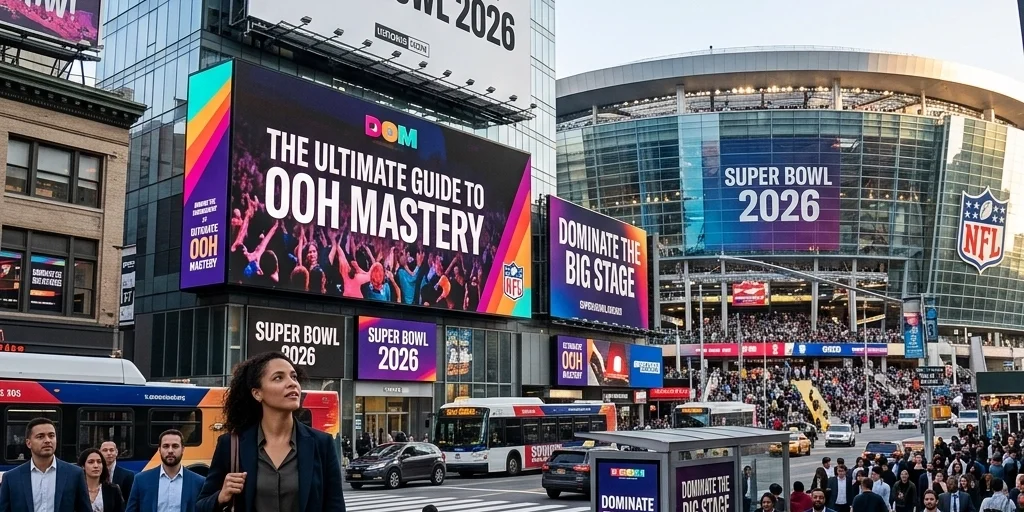
Super Bowl LX has officially set the gold standard for how brands interact with the physical world. In the high-stakes arena of sports marketing, the goal has shifted from simply "buying a billboard" to "owning the environment." When millions of fans descend upon a host city, the competition for attention is fiercer than the action on the gridiron.
At USA Entertainment Ventures LLC, we’ve watched the evolution of Out-of-Home (OOH) advertising move from static posters to fully integrated digital ecosystems. Mastery in this space means controlling the fan’s surroundings from the moment they step off the plane until they cheer for the final whistle. It’s about being omnipresent, relevant, and impossible to ignore.
What Does "Owning the Environment" Really Mean?
In the context of the Big Game, owning the environment is the strategic process of surrounding your target audience with a consistent, evolving brand presence. Instead of a single high-priced placement, mastery involves a multi-touchpoint strategy that maps to the physical movement of the crowd.
Think about the fan journey. They aren't just sitting in a stadium for four hours; they are living in the host city for four days. They are moving through airports, riding in Ubers, eating in entertainment districts, and walking the "last mile" to the gates. By leveraging the Sporttron Digital Network, brands can ensure that their message isn't just seen, it’s experienced.
The Fan Journey: A Three-Phase Approach
To achieve OOH mastery, you must map your campaign against the three distinct phases of the fan experience.
Phase 1: Arrival and Transit Hubs
The weekend begins at the airport. Major hubs and regional transit stations are the first touchpoints. This is where you establish brand recognition and create an immediate association between your company and the excitement of the Big Game. High-impact digital displays in baggage claims and rideshare zones are essential for that first "wow" moment.
Phase 2: The Build-Up (Fan Zones and City Life)
Once the fans are checked into their hotels, they head to the Super Bowl Experience, fan festivals, and nightlife districts. This is the "shareability" phase. OOH placements here should act as backdrops for social media content. Interactive kiosks and large-scale digital walls in high-traffic spots like ZooMedia locations turn a physical ad into a global social media impression.
Phase 3: Game Day (The Last Mile)
On Sunday, the focus narrows. The environment consists of the streets leading to the stadium, the entry gates, and the concourses. This is where total integration happens. Every screen: from the concessions to the massive stadium wraps: should tell a unified story.

The Backbone of Mastery: Sporttron Digital Network
A key component of our success at USA Entertainment Ventures LLC is the utilization of specialized networks like the Sporttron Digital Network. Static boards are great for scale, but Digital Out-of-Home (DOOH) is the engine that drives mastery.
DOOH allows for real-time creative swaps. If there is a massive upset or a highlight-reel play, the creative can change in minutes to reflect the current mood of the city. This level of agility is what separates a standard media buy from an environmental takeover.
Watch how this looks in action:
https://www.youtube.com/watch?v=l6J-0zileKE
By using centralized control systems, brands can sync their content across hundreds of screens simultaneously. This ensures that whether a fan is at a sports bar or standing at the stadium gate, they see the same high-impact messaging at the exact same time.
A 5-Step Framework for OOH Dominance
For businesses looking to implement these strategies, we follow a rigorous five-step framework. This process is designed to maximize ROI and ensure that every dollar spent contributes to the "omnipresence" effect.
1. Map High-Traffic Zones with Precision
A beautiful creative on a side street is invisible. We use foot traffic data, rideshare patterns, and transit flows to identify the exact coordinates where fans congregate. We prioritize "bottleneck" areas: places where fans are forced to wait or move slowly: giving them more time to engage with the brand.
2. Leverage Dynamic DOOH Capabilities
Static is for permanence; digital is for relevance. Mastery involves "dayparting": changing the message from a morning "Get Ready" vibe to a late-night "The Party Continues" tone. We also use weather-triggered creative. If it’s raining, the ad might pivot to a message about indoor activations or gear.
3. Create Tangible Fan Connections
Modern OOH isn’t a one-way conversation. It’s a bridge to digital action. Using QR codes and AR (Augmented Reality) triggers, we turn billboards into gateways. A fan can scan a board to unlock an exclusive AR filter or enter a contest. This takes the physical presence and puts it directly into the fan’s pocket.
4. Data-Driven Orchestration
True mastery is an operational feat. It requires coordinating with partners, venues, and rights holders in real time. We monitor the game’s pulse. If a specific player is trending on social media, we can pivot our DOOH assets to feature that player, making the brand feel like it is part of the live conversation.
5. Synchronize the Physical and Digital Worlds
We design every installation to be "Instagrammable." If a fan takes a selfie in front of your OOH placement and shares it with their 5,000 followers, your impression count just grew for free. Every piece of OOH should be framed so that branding is clearly visible in a standard smartphone photo.

The Friday-Sunday "OOH Window"
While the marketing build-up can last weeks, the high-impact "OOH Window" is a 72-hour sprint from Friday afternoon to Sunday evening. During this period, the host city becomes a dense concentration of decision-makers, influencers, and superfans.
By saturating the environment during these peak hours, you create a psychological effect where fans feel like your brand is the unofficial sponsor of their entire trip. This level of saturation is achieved through a mix of Mobile Highway Ads and fixed digital assets. It’s not just about being the biggest; it’s about being everywhere they look.
Measuring Success: Beyond the Gaze
In the past, OOH was measured by "estimated impressions." Today, we use more sophisticated metrics. We look at mobile location data to see how many people who passed an ad later visited a brand’s website or a physical activation. We track social media mentions that include photos of the OOH assets.
As Dan Kost, CEO of USA Entertainment Ventures LLC, often emphasizes, the goal is to provide business consulting that moves the needle. We aren't just selling space; we are selling a strategy that integrates 360 Sports Media into the very fabric of the event.

Looking Ahead: The Future of Sports OOH
The lessons from Super Bowl 2026 show us that the future of advertising is immersive. As technology like transparent OLED screens and 3D anamorphic displays becomes more accessible, the "environment" will become even more interactive.
For brands, the takeaway is clear: don't just buy a spot in the game; buy a spot in the fan’s life. Whether you are working with ZooMedia News or leveraging the latest in highway transit tech, the key is to be intentional, data-driven, and relentlessly focused on the fan journey.
Mastery isn't an accident; it’s an orchestration. By controlling the environment, you don't just reach the audience: you lead them.
If you’re ready to take your brand to the next level of OOH mastery, explore our specialized services and see how we can help you own your next major event environment. Check out our portfolio and partners to see who else is leading the way in this new era of entertainment marketing.