
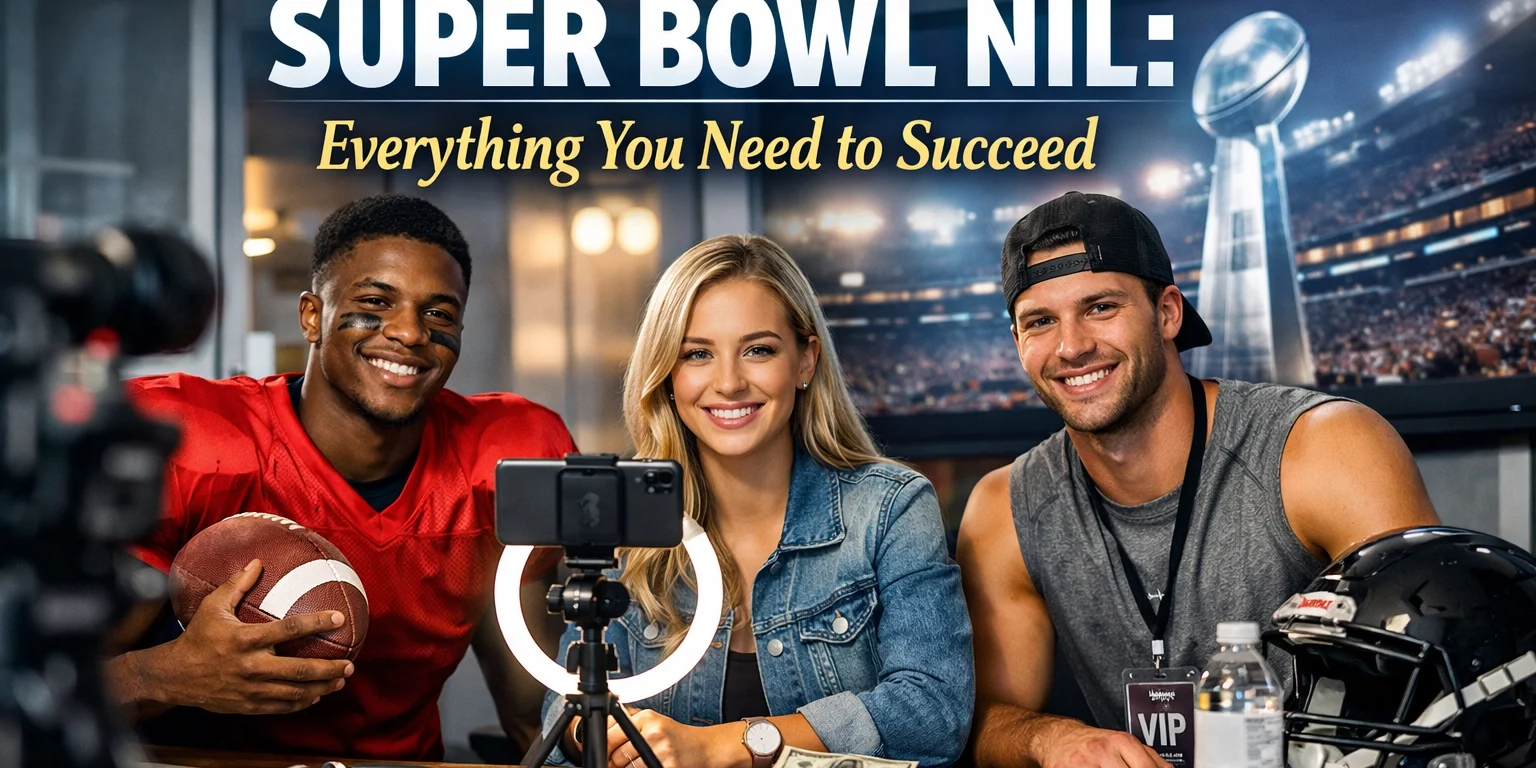
Super Bowl week has always been a brand proving ground. What’s changed is who can help you win it.
The NIL revolution (Name, Image, Likeness) has moved college and amateur athletes from the sidelines of brand marketing into the center of it: especially during the most attention-dense window in American sports. Super Bowl Sunday consistently produces more social activity than any other sporting event in North America, and that “second-screen” behavior is where NIL thrives: short-form video, creator-led storytelling, and rapid social amplification.
For Fortune 100 brands, NIL at the Super Bowl is not a novelty play. It’s a modern distribution engine: one that can extend a 30–60 second ad concept into weeks of authentic content across hundreds (or thousands) of athlete channels, with measurable lift and controlled compliance.
Watch: The NIL Revolution : Bridging the Gap at the Super Bowl
Use this video as a quick anchor on why NIL is becoming a primary Super Bowl-week channel, not an add-on:
https://www.youtube.com/watch?v=l6J-0zileKE
Why Super Bowl NIL matters now (and why Fortune 100 brands are leaning in)
Super Bowl LX is shaping up as a step-change moment for NIL marketing. Industry coverage points to 1,000+ college and amateur athletes connecting with major brands in record-breaking partnership volume during Super Bowl week, with $15M+ in partnership opportunities emerging in a 72-hour window in recent cycles. Even if your brand is not chasing “viral,” the scale of attention makes NIL a rational, performance-oriented bet.
Three forces are driving urgency:
- Attention has shifted from broadcasts to ecosystems. The Super Bowl is still the center, but the surrounding content universe: TikTok, Instagram Reels, YouTube Shorts, podcasts, creator livestreams: now dictates what gets repeated, remixed, and remembered.
- Authenticity outperforms polish in social. Athlete-created content often beats brand-created content on engagement because it feels native to the platform and personal to the audience.
- NIL adds reach without losing trust. College athletes bring real community ties: campus, hometown, conference, and fan identity. For brands, that means distribution that doesn’t feel like distribution.
As marketing professor and author Scott Galloway has observed about modern media dynamics, distribution is often the moat: owning attention pathways can matter more than owning a single “big moment.” In Super Bowl terms: the ad is the spark; NIL can be the oxygen.
The core idea: turn one Super Bowl moment into a multi-week content machine
Traditional Super Bowl spend concentrates value into one day. NIL lets you spread the same strategic idea across phases, audiences, and formats: while maintaining brand control through briefs, approvals, and measurement.
A practical mental model:
- Your TV/CTV story = the “hero narrative”
- Athlete NIL content = the “distribution layer”
- Experiential activations = the “credibility layer”
- Measurement + optimization = the “performance layer”
This is the bridge: the Super Bowl creates cultural gravity; NIL converts it into repeatable, trackable attention.

The three-phase Super Bowl NIL playbook (the structure that wins)
The highest-performing programs follow a simple rhythm that mirrors how fans behave: anticipate, react, then relive.
Phase 1: Pre-game hype (Jan 15 – Feb 7)
This is where you build the runway. The goal is not only reach: it’s learning. You’re testing messages, creators, and formats while the stakes are lower than game day.
What to publish
- “Countdown” content: athlete anticipation, travel, training, watch-party plans
- Behind-the-scenes brand integrations: product-in-the-wild, casual usage, routines
- Teasers for brand activations: limited drops, pop-ups, meet-and-greets, NIL House
How Fortune 100 teams should run it
- Set a clear hypothesis per week (e.g., “humor beats inspiration with Gen Z”)
- Use whitelisted/boosted posts selectively to validate what scales
- Build a bench of creators so you’re not dependent on a handful of athletes
What success looks like
- You identify 10–20% of athletes who outperform on engagement and retention
- You refine the creative brief so game-day content lands without revisions
Phase 2: Game day execution (Feb 8)
Game day is about real-time relevance. Over-produced content can underperform because it feels scheduled. The winning approach blends preparedness with spontaneity.
What to publish
- Real-time reactions (first quarter, halftime, big play moments)
- Fan POV: watch parties, tailgates, brand-hosted experiences
- Quick-turn product moments tied to what’s happening right now
Operational best practices
- Staff a rapid approval lane (legal + brand) with pre-approved language options
- Create “if-this-then-that” content prompts (if overtime, if underdog leads, etc.)
- Monitor performance continuously and shift paid support to top posts in-flight
Phase 3: Post-game engagement (Feb 9 – 11)
This is where most brands stop: and where many of the cheapest wins still live. Audience attention remains elevated for 72 hours as highlight reels circulate and debates continue.
What to publish
- “Best moment” recaps from the athlete’s perspective
- Behind-the-scenes clips from brand events and fan interactions
- Follow-up offers: loyalty sign-ups, limited-time bundles, retail call-to-action
Why it matters
If recent NIL reporting is directionally correct: $15M+ in opportunities emerging in 72 hours: then the post-game window is not “cleanup.” It’s prime conversion time when competitors have gone quiet.
Campaign architecture: the tiered athlete model (how to scale without losing control)
A common mistake is choosing athletes like you’d choose TV talent: a few big names and hope it lands. The better model is a portfolio.
Tier 1: Anchor athletes (100K+ followers)
High-production, higher-cost, higher scrutiny. Use them for narrative clarity: the key message, the hero asset, the big reveal.
Tier 2: Mid-tier athletes (10K–100K followers)
Your volume layer. Often the best balance of cost, responsiveness, and engagement. Use them to repeat the message across formats and niches.
Tier 3: Micro-athletes (<10K followers)
Your authenticity and locality layer. Ideal for hyper-local retail, campus activations, and peer-to-peer credibility.
This tiered structure extends the life of your Super Bowl creative. Instead of a single exposure event, you get weeks of compounding impressions across many trust-based communities.

The planning timeline Fortune 100 brands actually need (90–120 days)
Super Bowl NIL is not “influencer marketing with athletes.” It’s closer to a mini-media network launch: contracts, compliance, creative, distribution, measurement.
A proven planning cadence:
- 120 days out: define objectives, budget, brand safety rules, athlete selection criteria
- 90 days out: recruit athletes, negotiate terms, confirm deliverables, lock usage rights
- 60 days out: content production begins; draft approvals; create contingency assets
- 30 days out: publishing schedules, paid strategy, real-time ops planning, event integration
The most expensive mistake at this level is rushing the program into the final month and losing leverage: fewer athlete choices, weaker terms, and less time to build performance learning before game day.
If you’re aligning NIL with broader Super Bowl week activations, it’s helpful to map NIL content to fan experiences and touchpoints. (Related: https://usaentertainmentventures.com/the-ultimate-guide-to-super-bowl-2026-fan-experiences-everything-you-need-to-succeed-2)
Compliance isn’t optional: protect the athlete and the brand
NIL success is built on trust: and compliance is how you keep it.
A major compliance signal for Division I is reporting: athletes must report NIL deals valued at $600 or more to NIL Go within five business days (per widely cited NIL reporting requirements). Brands should not assume the athlete’s school will “handle it.” If compliance is missed, the athlete can face eligibility issues: and your brand can face reputational risk from an avoidable process failure.
What your brand should standardize
- Contract templates that clarify deliverables, timelines, and usage rights
- Payment workflows that are transparent and trackable (no ambiguity, no delays)
- Disclosures and posting requirements (#ad, platform rules, brand guidelines)
- State-by-state considerations and category restrictions (where applicable)
Operational recommendation
Use a platform or partner process that centralizes contracting, approvals, payments, and documentation. Your goal is simple: make it easy for athletes to do the right thing, every time.
For organizations that want a structured consulting approach to compliance + activation design, explore our services: https://usaentertainmentventures.com/services
Creative that works: give athletes guardrails, not scripts
If the content feels like a commercial read, performance drops. If the content is too loose, brand risk rises. The middle path is a creative system that preserves the athlete’s voice while controlling the essentials.
A strong NIL brief includes
- One message priority (what must be remembered)
- Two supporting points (what can be remembered)
- “Do/Don’t” guardrails (claims, language, competitive mentions)
- Visual cues (product placement, logo visibility, setting)
- Mandatory disclosures and link rules
- Submission and approval timing
Best-performing formats during Super Bowl week
- POV videos (watch-party, travel day, event access)
- Short “hot takes” tied to real-time moments
- Duets/remixes that invite participation
- Quick interviews at brand activations (“one question” format)
As Nielsen has repeatedly emphasized in its work on trust in advertising, people tend to trust recommendations from people they perceive as real and relatable more than traditional ad units. Athlete NIL succeeds when you preserve that relatability.
Measurement: what to track (and what to ignore)
Fortune 100 programs need more than likes. NIL can and should be managed like a performance channel: without pretending everything is last-click.
Track in three layers
-
Distribution & attention
- Impressions, reach, video completion rate, average watch time
- Follower growth, saves, shares (signals of “worth keeping”)
-
Brand impact
- Brand lift studies (where feasible)
- Sentiment and share of voice during Super Bowl week
- Message recall proxies (comments and re-shares repeating key phrases)
-
Business outcomes
- Site traffic lift, email/SMS sign-ups, app installs
- Promo code usage and retail/geo lift (when integrated)
- Cost per engaged view or cost per incremental visit
What to ignore
- Follower count as a primary KPI
It’s a filter, not a forecast. Engagement quality and audience fit routinely outperform raw scale.
Experiential integration: “NIL Houses” and fan-first activations
The strongest Super Bowl NIL programs connect digital content to physical experiences. The idea is simple: fans don’t just want to watch; they want proximity: photos, stories, access.
NIL Houses (and similar setups) work because they combine:
- Athletes as hosts (built-in distribution)
- Fans as participants (built-in content)
- Brands as enablers (built-in value exchange)
Examples of what brands can do inside a controlled activation footprint:
- product demos and limited releases
- meet-and-greet rotations with structured content capture
- mini-games, leaderboards, and giveaways tied to social posting
- short-form interview stations (fast, repeatable, high-output)

Risk management for big brands: brand safety without killing performance
Enterprise brands can move fast in NIL without taking unnecessary risks: if you design the program for safety upfront.
Key controls to implement
- Clear category exclusions (competitors, restricted products, sensitive topics)
- Content approval SLAs that match platform speed
- Crisis escalation paths (who decides, within what time window)
- Morals clauses and behavior expectations written in plain language
- Media training modules for top-tier athletes (short and practical)
Also consider regional and cultural nuance. A message that works in one fan base can backfire in another. That’s another advantage of tiered athletes: you can localize without rewriting the entire campaign.
What “success” looks like in Super Bowl NIL (a realistic scoreboard)
A winning Fortune 100 NIL program is not defined by a single viral clip. It’s defined by repeatable outcomes:
- Weeks of content that keep your brand present before, during, and after the game
- Portfolio performance: a mix of anchors and mid-tier creators producing consistent engagement
- Compliance confidence: no reporting surprises, no payment confusion, no disclosure gaps
- Measurable lift in awareness and action, with clear learning for the next cycle
Most importantly, it builds a durable bridge between your brand and the next generation of sports fans: through voices they already follow and trust.
If you want help designing a Super Bowl NIL program that connects strategy, athlete partnerships, compliance, creative, and measurable outcomes, USA Entertainment Ventures LLC can support planning through execution: https://usaentertainmentventures.com/contact





