
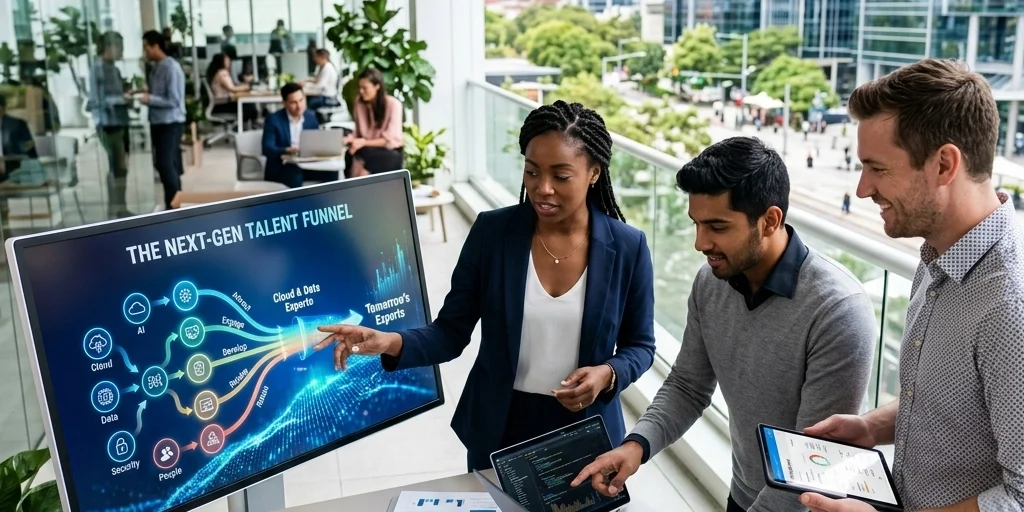
The global business landscape is currently navigating a period of unprecedented technological acceleration. As organizations migrate to sophisticated cloud environments and lean heavily on data-driven decision-making, a significant hurdle has emerged: the talent gap. While the demand for experts in Cloud, Artificial Intelligence (AI), and Data Analytics continues to skyrocket, the supply of industry-ready professionals is struggling to keep pace.
Traditional recruitment strategies, which often begin at the university level, are increasingly proving to be "too little, too late." To remain competitive, forward-thinking enterprises must look further upstream. The next-gen talent funnel is shifting from the college campus to the high school classroom. By engaging with students earlier, companies can cultivate a workforce that is not only technically proficient but also deeply aligned with their specific operational cultures and technological stacks.
The Reality of the Tech Talent Gap
Despite the proliferation of computer science degrees, many organizations report that recent graduates lack the "day-one" readiness required for complex cloud infrastructure or real-time data analysis. This is not necessarily a failure of the education system, but rather a reflection of how quickly these fields evolve. By the time a curriculum is approved and taught over four years, the technology has often moved several generations forward.
According to industry reports, nearly 70% of digital transformation initiatives fail due to a lack of skilled personnel. This shortage does not just delay projects; it increases operational costs and hampers innovation. To mitigate this risk, USA Entertainment Ventures LLC advises a shift toward proactive talent cultivation. You can learn more about how we help companies navigate these transitions on our services page.

Why High School is the New Frontier
Engaging talent at the high school level is no longer just a corporate social responsibility initiative; it is a strategic necessity. High school students are in a developmental stage characterized by high neuroplasticity and a natural fluency with digital tools. They are the "cloud-native" generation.
1. Early Skill Integration
Waiting until university to introduce complex concepts like distributed computing or machine learning misses a critical window. When students are introduced to these topics at 15 or 16, they build a foundational intuition that is difficult to replicate later in life. By providing high schoolers with access to professional-grade tools, companies help build a "muscle memory" for cloud architecture.
2. Branding and Loyalty
In a hyper-competitive job market, brand recognition starts early. A student who spends their junior year working on a project sponsored by a specific firm is far more likely to seek internships and full-time employment with that firm later. This "pre-ordering" of talent allows companies to secure the brightest minds before they even hit the radar of major tech recruiters on LinkedIn.
3. Diverse Perspectives
Early outreach allows organizations to reach a broader demographic. By providing resources and mentorship to local high schools, companies can identify and nurture talent from diverse backgrounds who might otherwise not have considered a career in data science or cloud engineering.
The Three Pillars of the Next-Gen Funnel
To build a successful early-stage talent funnel, organizations must focus on three core technological pillars: Cloud, AI, and Data Analytics. These are not siloed disciplines but are interconnected components of modern business operations.
Pillar 1: Cloud Computing as the Infrastructure
Cloud computing is the backbone of the modern economy. Students need to understand more than just how to use a web application; they need to understand how those applications are scaled and secured. Engaging students in projects involving serverless architecture or containerization helps them visualize the "plumbing" of the internet.
Pillar 2: AI Literacy and Augmentation
The conversation around AI is shifting from "Will it replace us?" to "How will we use it?" Next-gen talent must be literate in AI prompt engineering, ethical implementation, and model management. The goal is to train students to work alongside AI to augment their productivity.
Pillar 3: Data Analytics
Data is the new oil, but it is only valuable if it can be refined. High school programs that focus on data visualization and predictive modeling prepare students to turn raw numbers into actionable insights. This is a skill set that is immediately applicable across various industries, from logistics to sports media.

Implementation: Moving from Concept to Reality
Building a high school talent funnel requires a structured approach. It is not enough to simply give a guest lecture once a year. It requires an integrated ecosystem of learning and engagement.
The Multi-Year Progression Model
- Sophomore Year (Introduction): Focus on awareness. Use gamified learning and esports-related data to pique interest.
- Junior Year (Exploration): Introduce certifications and hands-on labs. This is where students begin to build their portfolios.
- Senior Year (Specialization): Capstone projects and micro-internships. Students should be working on simplified versions of real-world problems.
Skills-Based Assessment Over Credentials
The next-gen funnel prioritizes what a student can do over what they have studied. Companies should implement logic tests, coding challenges, and data visualization prompts to identify talent. A high school senior who can demonstrate a functional understanding of AWS Lambda or a sophisticated Python script may be a better long-term investment than a university graduate with no practical project experience.

The Role of Real-Time Data in Recruitment
Modern recruitment must be data-driven. By tracking student progress through various educational modules, companies can gain insights into who is likely to succeed in specific roles. For example, a student who excels in data visualization but struggles with backend logic might be a perfect candidate for a UI/UX or data analyst role.
This data-centric approach ensures that the funnel is constantly optimized. If a high percentage of students drop out of the program during a specific cloud-networking module, the curriculum can be adjusted in real-time to be more engaging or accessible.
Strategic Partnerships and Community Engagement
No organization can do this alone. Success depends on partnerships between private enterprise, educational institutions, and business consulting firms. At USA Entertainment Ventures LLC, we specialize in bridging the gap between innovative concepts and practical business implementation. Whether it is through projects like E-Sports Pod or specialized consulting, the goal is to create environments where talent can thrive.
By collaborating with local school boards, companies can ensure that their needs are reflected in the curriculum. This creates a win-win scenario: schools provide students with market-relevant skills, and businesses secure a steady stream of prepared talent.
The Long-Term ROI of Early Engagement
The return on investment for a high school talent funnel is measured in years, not months, but the benefits are compounding.
- Reduced Hiring Costs: Recruiting through established funnels is significantly cheaper than using external headhunters or competing in bidding wars for top-tier university graduates.
- Higher Retention Rates: Employees who have been nurtured by a company since their teenage years often demonstrate higher loyalty and a deeper understanding of the company's long-term vision.
- Innovation Infusion: Younger talent brings fresh perspectives and a native understanding of new technologies that can revitalize legacy departments.

Conclusion: Securing the Future Today
The "next-gen" talent funnel is not a future concept; it is a present necessity. The companies that will lead the markets of 2030 and 2040 are the ones that are walking into high school classrooms today. By investing in Cloud, AI, and Data literacy at the K-12 level, organizations are doing more than just filling job openings: they are securing the future of the digital economy.
As we look forward, the distinction between "tech companies" and "traditional companies" will continue to blur. Every business will be a data business, and every successful business will be one that took the initiative to cultivate its own expertise. To explore how your organization can begin building these critical bridges, visit our showcase to see how we approach innovation and growth.
The opportunity to shape the next generation of experts is here. The question is no longer if you should be in high schools, but how fast you can get there.





