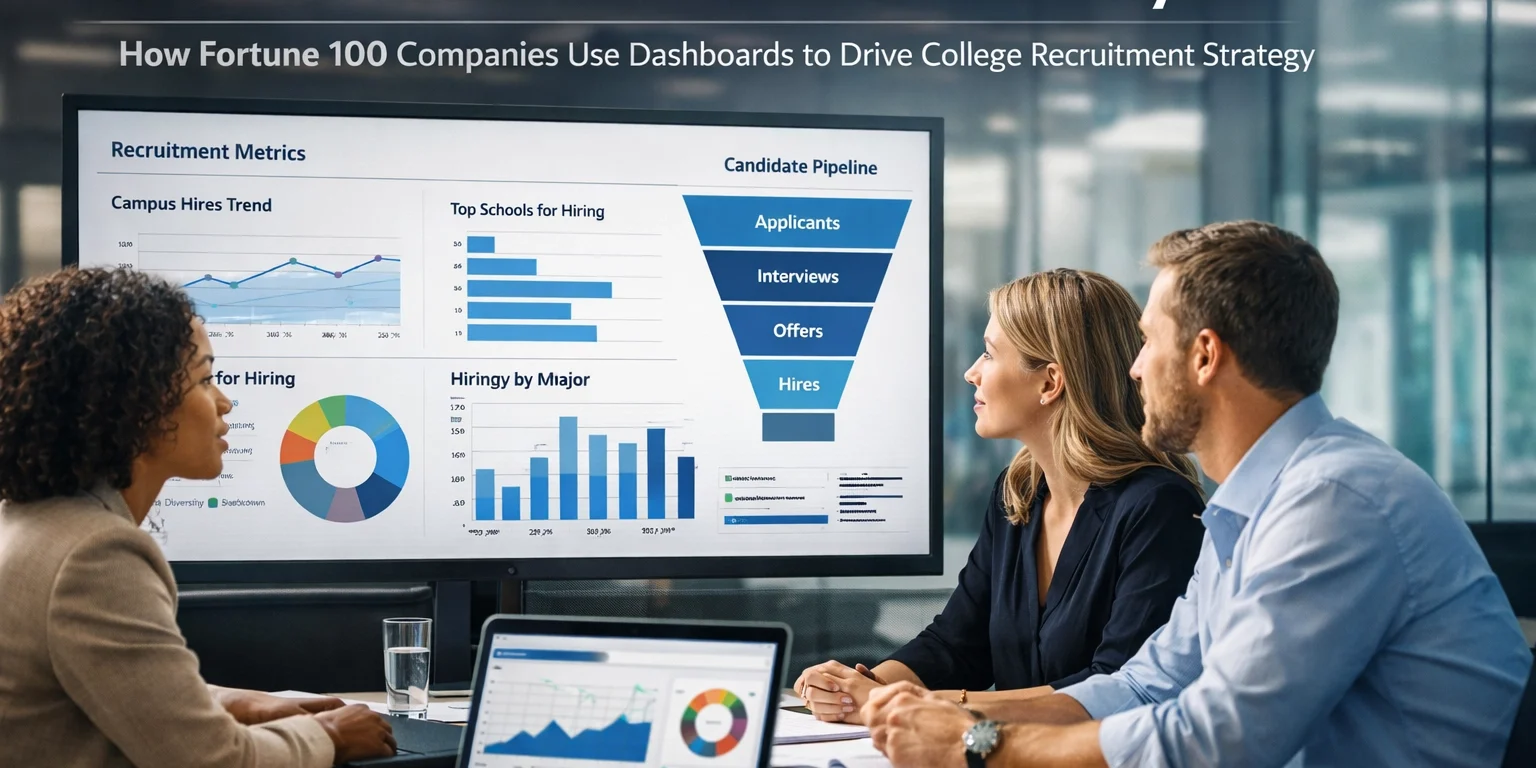
The landscape of college recruitment has fundamentally shifted. What once relied on campus career fairs and relationship-based hiring now operates through sophisticated data infrastructure that tracks everything from candidate quality to long-term retention outcomes. Fortune 100 companies are investing millions in workforce analytics platforms that transform recruitment from an art into a measurable science.
This transformation matters because the stakes have never been higher. Organizations face unprecedented competition for emerging talent, while educational institutions grapple with preparing students for a workforce that demands both technical capability and strategic thinking. The intersection of these challenges has created a new paradigm: data-driven recruitment strategy anchored in comprehensive analytics dashboards.
The Dashboard Revolution in Talent Acquisition
Workforce analytics dashboards serve as centralized command centers for recruitment operations. These visual interfaces aggregate key performance indicators across the entire talent acquisition pipeline, from initial candidate awareness through onboarding and early-career retention. According to recent industry analysis, recruiting dashboards typically track metrics including time-to-hire, cost-per-hire, candidate sources, application completion rates, and offer acceptance rates.

The power of these systems lies not merely in data collection but in pattern recognition. When properly configured, dashboards reveal which recruitment channels generate the highest-quality candidates, which job descriptions attract qualified applicants, and where candidates withdraw during the hiring process. This visibility transforms recruitment strategy from reactive to proactive.
Fortune 100 companies have taken this foundation and extended it significantly. Leading organizations now incorporate predictive analytics that forecast candidate success likelihood based on educational background, project experience, and skill assessments. They track diversity metrics in real-time, ensuring that talent pipelines reflect organizational commitments to inclusive hiring. They measure the quality of candidate experience through survey data and application abandonment rates, recognizing that the recruitment process itself serves as brand positioning.
Beyond Traditional Metrics: The Future Ready Framework
The next evolution in workforce analytics extends beyond conventional hiring metrics to encompass preparedness indicators that predict long-term organizational value. This Future Ready framework focuses on three critical dimensions: data literacy, media competency, and adaptability markers.
Data literacy has emerged as a foundational requirement across virtually every business function. Organizations are no longer seeking candidates who can merely interpret spreadsheets; they need professionals who understand data storytelling, recognize analytical bias, and can translate insights into strategic action. Dashboard tracking now includes assessments of statistical reasoning and data visualization capabilities during the recruitment process.

Media competency represents an increasingly vital dimension of workforce readiness. In an era where brand reputation can shift within hours based on social media dynamics, organizations need team members who understand digital communication ecosystems. This extends beyond marketing and communications roles into operations, finance, and technical functions where employees increasingly serve as organizational ambassadors.
The incorporation of media literacy outcomes into recruitment dashboards allows organizations to track which educational institutions produce graduates with sophisticated understanding of digital platforms, content creation, and audience engagement. These metrics matter because they predict a candidate's ability to navigate complex stakeholder environments and contribute to organizational storytelling.
NIL Education: A New Signal in College Recruitment
The emergence of Name, Image, and Likeness (NIL) opportunities in college athletics has created an unexpected laboratory for evaluating Future Ready competencies. Student-athletes navigating NIL arrangements are developing real-world experience in personal branding, contract negotiation, financial management, and media engagement: skills that translate directly to professional environments.
Forward-thinking organizations are incorporating NIL participation into their recruitment analytics frameworks. Dashboards now track candidates who have successfully managed NIL partnerships, viewing this experience as a proxy for entrepreneurial thinking and self-management capability. Students who have negotiated sponsorship deals, managed social media presence strategically, and balanced competitive athletics with brand building demonstrate practical skills that traditional academic metrics may not capture.
This creates new opportunities for educational institutions to position themselves as incubators for Future Ready professionals. Schools that provide comprehensive NIL education: including financial literacy, contract fundamentals, media strategy, and personal brand development: are producing graduates with documented experience in areas that Fortune 100 companies increasingly value.

What the Data Reveals About Educational Partnerships
Analysis of recruitment dashboard data reveals significant patterns about which educational partnerships deliver sustained value. Organizations tracking long-term employee performance metrics have identified that graduates from institutions emphasizing applied learning, cross-functional project experience, and professional skill development consistently outperform peers in early-career advancement metrics.
The most valuable educational partnerships share common characteristics. They provide students with access to real-world projects that require collaboration across disciplines. They incorporate structured reflection and iteration cycles that mirror professional environments. They emphasize communication skills alongside technical competency. And increasingly, they offer programming around digital citizenship, media literacy, and personal brand development.
Recruitment dashboards allow organizations to quantify these differences. When tracking candidate source effectiveness, companies can measure not just time-to-hire and initial performance ratings, but also retention rates at 12, 24, and 36 months, internal promotion velocity, and peer collaboration scores. This longitudinal data reveals which educational institutions truly prepare students for sustained professional growth.
Implementation Framework for Future Ready Schools
Educational institutions seeking to position themselves as Future Ready anchors should consider several strategic initiatives that align with how Fortune 100 companies are evaluating talent pipelines:
Integrated Analytics Programs: Develop curricula that embed data literacy across disciplines, ensuring that graduates can work effectively with dashboards, interpret metrics, and communicate insights regardless of their primary field of study.
Media Literacy Foundations: Create programming that helps students understand content ecosystems, platform dynamics, and strategic communication. This preparation extends beyond communications majors to encompass all students who will represent organizations in digital spaces.
Applied Learning Laboratories: Establish partnerships that provide students with project-based experience addressing actual business challenges. Document and assess these experiences in ways that translate clearly to recruitment dashboards.
NIL Education Frameworks: For institutions with athletic programs, develop comprehensive education around Name, Image, and Likeness opportunities that treat these arrangements as professional development laboratories. For institutions without athletics, create comparable entrepreneurial and personal branding programs.

Outcome Measurement Systems: Implement tracking mechanisms that document student capability development across Future Ready dimensions. Make this data accessible to recruiting partners in formats that integrate with their analytics platforms.
The Measurement Imperative
The shift toward dashboard-driven recruitment strategy creates both opportunity and obligation for educational institutions. Organizations investing heavily in workforce analytics expect to see measurable outcomes from their recruiting partnerships. Schools that can document student capability development across dimensions that matter to employers: data competency, media literacy, collaborative project experience, adaptive problem-solving: will differentiate themselves in competitive talent markets.
This measurement imperative does not require abandoning educational mission or values. Rather, it demands translating learning outcomes into language and metrics that align with how organizations evaluate workforce readiness. When schools can demonstrate that their graduates consistently achieve higher performance scores in early-career roles, advance more quickly into leadership positions, or demonstrate superior adaptability during organizational change, they establish themselves as preferred talent sources.
Looking Forward
The integration of workforce analytics dashboards into college recruitment strategy represents more than technological advancement. It signals a fundamental realignment of how organizations identify, evaluate, and develop emerging talent. Educational institutions that recognize this shift and position themselves accordingly will secure sustained competitive advantage.
The Future Ready framework: emphasizing data literacy, media competency, and applied learning: provides a roadmap for this positioning. As Fortune 100 companies continue refining their analytics capabilities and extending their dashboard tracking into new dimensions of candidate evaluation, schools that have already established programming around these competencies will see measurable returns in placement outcomes and recruiting partnership strength.
The opportunity exists now for forward-thinking institutions to become anchor partners in this evolving ecosystem, establishing themselves as sources of workforce-ready graduates who bring documented capabilities in the areas that drive organizational performance. Those who act decisively will shape the next decade of college recruitment strategy.