
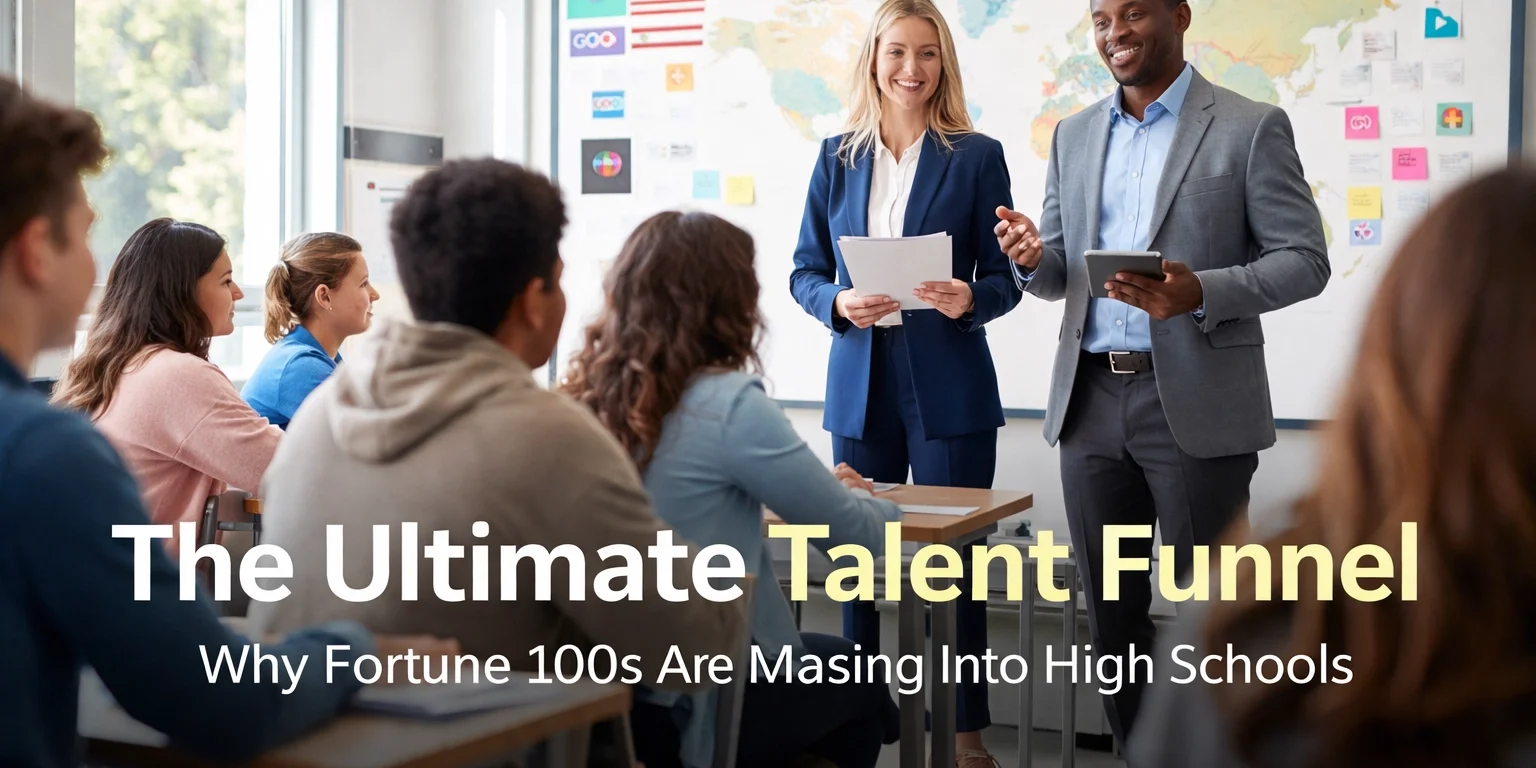
The talent war is shifting. And it's moving younger.
Fortune 100 companies are no longer waiting for college graduates to trickle into their recruiting pipelines. They're going straight to the source: high schools. According to the American Opportunity Index 2024 rankings, top employers offering the best career pathways for recent high school graduates are seeing remarkable results. Companies excelling at internal advancement promote employees 2.5 times more frequently than their competitors.
The question is no longer whether to engage younger talent. The question is how to build the infrastructure that makes it possible.
The Traditional Talent Pipeline Is Breaking
For decades, the corporate playbook looked the same. Post job listings. Recruit from universities. Compete for the same pool of graduates as everyone else. Hope for the best.
That model is failing.
The workforce gap in cloud computing, data analytics, AI, and cybersecurity grows wider every year. Meanwhile, companies fight over a shrinking pool of qualified candidates, driving up salaries and extending time-to-hire metrics to unsustainable levels.
Research shows that over a quarter of surveyed companies now recruit from a select list of schools, up from 17% in 2022. This shift reveals something important: organizations are becoming more strategic about where they find talent. But recruiting from elite universities only addresses part of the problem.
The real opportunity lies in building talent before it enters the traditional pipeline at all.

What If You Could Build Your Workforce From the Ground Up?
Consider this: instead of competing for graduates, what if your brand became synonymous with career readiness itself?
This is not about sponsorship. This is not about slapping a logo on a gym wall and hoping students remember your company name in five years.
This is about infrastructure. Physical presence. Curriculum integration. And a direct pathway from classroom to career.
The companies winning the next decade's talent war are not waiting for talent to find them. They are deploying education systems that create talent aligned with their specific workforce needs.
The vehicle for this deployment? Learning labs that combine competitive esports, cloud curriculum, data analytics training, AI literacy, and content creation: all housed in physical spaces inside U.S. high schools.
The Anatomy of a Next-Generation Talent Funnel
What does this actually look like in practice?
Picture a dedicated learning environment inside a high school. Not a traditional computer lab with rows of outdated machines. A fully equipped, branded workspace that functions as:
A competitive esports arena : Students engage through gaming, but the real education happens around it. Team collaboration, strategic thinking, and communication skills develop naturally through competition.
A cloud curriculum hub : Direct access to cloud certification programs, exposing students to the same platforms and tools they'll use in professional environments.
A streaming and content studio : Media literacy and content creation skills are no longer optional. Students learn production, broadcasting, and digital marketing through hands-on experience.
A data analytics dashboard : Real-time performance metrics teach students to read, interpret, and act on data: a foundational skill for nearly every modern career path.
A career pathways center : Direct connections to opportunities in cloud computing, AI development, game design, streaming, marketing, logistics, and cybersecurity.

Why Esports Opens the Door
Here's what most corporate decision-makers miss: esports is not the product. Esports is the permission slip.
Schools have limited bandwidth for external programs. They're protective of classroom time and skeptical of corporate involvement. Gaming, however, opens a door that traditional workforce development programs cannot.
Students are already engaged. Schools are already exploring esports as extracurricular activity. The infrastructure exists to expand it into something far more valuable.
When a Fortune 100 company powers an esports and cloud learning lab, they're not just sponsoring an after-school club. They're anchoring a national education infrastructure play that touches curriculum, career readiness, and workforce development simultaneously.
The American Opportunity Index data supports this approach. Companies in the top tier of the "First Jobs" metric are 4.3 times more likely to hire entry-level workers than other large firms. Building relationships with students before they graduate creates a natural talent pipeline that competitors simply cannot replicate.
What Fortune 100 Companies Actually Get
Let's be direct about the value proposition.
Workforce Pipeline : Students trained on your platforms, familiar with your brand, and prepared for your specific job requirements. By the time they're eligible for employment, the learning curve is already behind them.
Data and Analytics : Every interaction within these learning labs generates usable data. Engagement metrics, skill development tracking, and career interest mapping all feed back into workforce planning.
Brand Trust : Your logo becomes synonymous with education, opportunity, and community investment. Parents, educators, and students associate your company with "future ready" career development.
STEM and Career Readiness Alignment : Direct support for school STEM initiatives positions your organization as an education partner, not just an employer.
Cloud and Technology Usage : Students learning on your cloud platforms today become developers, engineers, and operators using those same platforms tomorrow.
Media and Content Amplification : Streaming and content creation built into every lab means organic, authentic exposure through channels young audiences actually watch.

The Physical Presence Advantage
Digital programs have their place. But physical infrastructure creates something digital cannot: permanence.
A learning lab inside a high school is a daily reminder of your company's commitment to that community. Students walk past it every day. Teachers integrate it into their curriculum. Parents see it at open houses and school events.
This is not a banner ad that disappears after a scroll. This is a branded space that becomes part of the school's identity.
And here's the strategic advantage: once deployed, these labs become difficult to replicate. A competitor cannot simply outbid you for attention. The physical infrastructure, the curriculum integration, and the community relationships create defensible market position that sponsorship alone cannot achieve.
Career Pathways That Matter
The career pathways embedded in these learning labs align directly with the roles Fortune 100 companies need to fill:
- Cloud Computing : The backbone of modern enterprise infrastructure
- Artificial Intelligence : The fastest-growing skill demand across industries
- Game Development : A $200+ billion industry seeking trained talent
- Streaming and Broadcasting : Content creation as a professional discipline
- Marketing and Brand Management : Digital-native skills for digital-first companies
- Logistics and Supply Chain Simulation : Operational excellence training through gamification
- Cybersecurity : Critical infrastructure protection requiring constant talent replenishment
Every one of these pathways connects directly to workforce needs that Fortune 100 companies are struggling to fill through traditional recruiting channels.
The Bottom Line
Education budgets move slowly. Brand budgets move faster. Workforce narratives drive both.
Companies that position themselves as education infrastructure partners: not just sponsors: gain access to talent pipelines that competitors cannot touch. They build brand trust that advertising cannot buy. They create workforce development systems that reduce recruiting costs and improve retention.
This is not about gaming. This is about building the next generation of your workforce while your competitors are still posting job listings and hoping for the best.
The question for Fortune 100 decision-makers is simple: do you want to compete for talent, or do you want to create it?
The infrastructure exists. The curriculum is ready. The schools are being selected now.
Learn more about how USA Entertainment Ventures builds workforce development infrastructure for Fortune 100 companies ready to anchor the next generation of talent pipelines.





