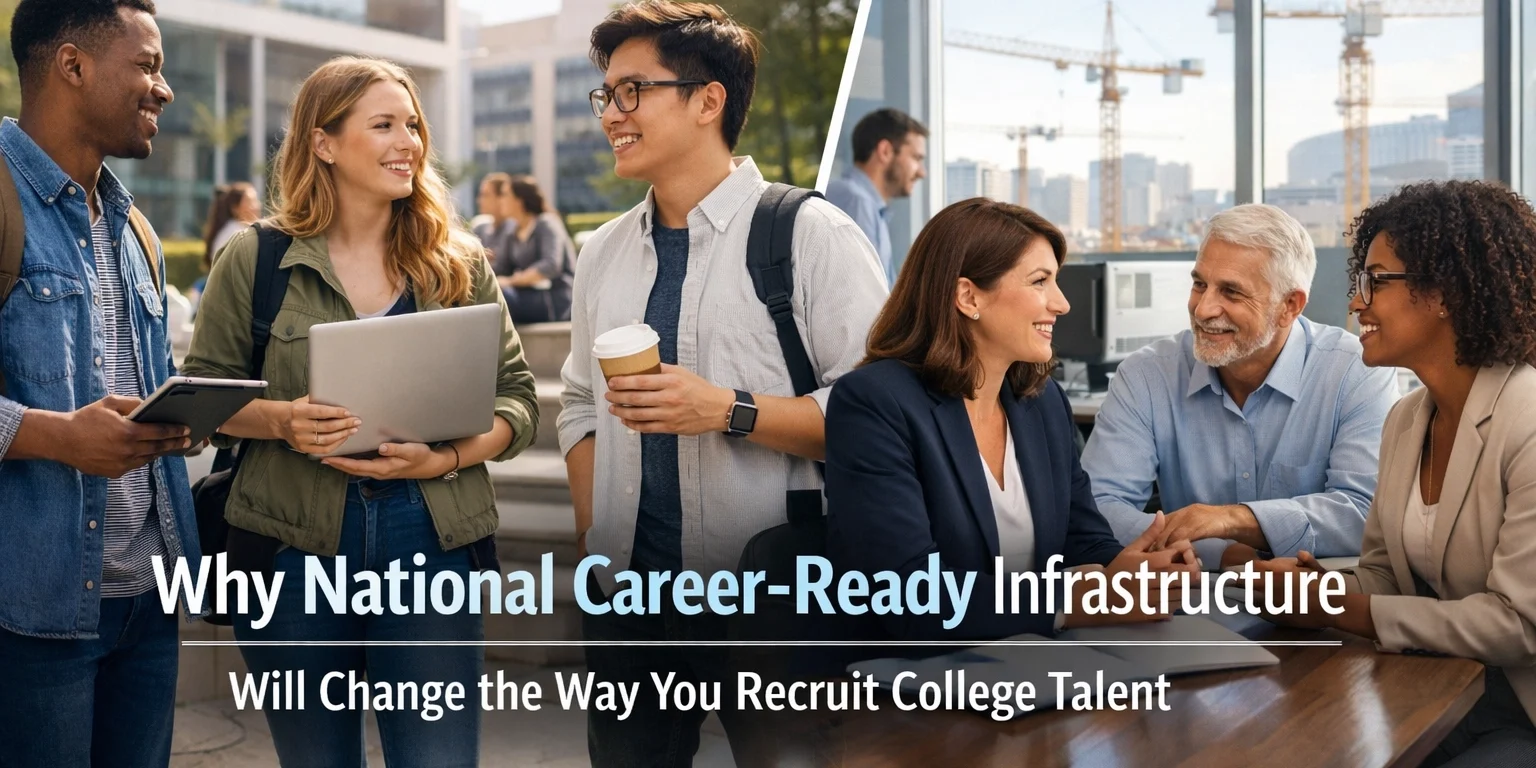
The competition for qualified college talent has reached unprecedented intensity. Fortune 100 companies invest millions annually in campus recruitment programs, yet many struggle with a fundamental disconnect: graduates often lack the specific competencies employers need on day one. Traditional degree programs provide theoretical knowledge, but the bridge between academic achievement and workplace readiness remains frustratingly incomplete.
A solution is emerging that promises to fundamentally restructure how organizations identify, assess, and recruit early-career talent. National career-ready infrastructure represents a coordinated system of standardized skills frameworks, verified credentials, and physical distribution networks designed to align educational outcomes with workforce demands at scale. This infrastructure doesn't merely optimize existing recruitment practices: it creates an entirely new paradigm for talent acquisition.
The Shared Competency Language Advantage
One of the most persistent challenges in college recruitment stems from semantic ambiguity. When a hiring manager requests candidates with "strong communication skills" or "analytical thinking capabilities," what precisely does that mean? Educational institutions interpret these requirements differently, and students graduate with varied understandings of what employers actually need.

The National Career Clusters Framework and NACE Career Readiness Competencies address this fundamental problem by establishing a common vocabulary across industries. According to NACE, this shared understanding emerged as a critical need when they launched their Career Readiness Initiative in 2015, specifically to provide "a shared understanding of what is needed to launch and develop a successful career."
This standardization eliminates costly misalignments. When your organization and a university partner both reference the same competency framework, you're discussing the same concrete skills. The ambiguity that traditionally required extensive screening, multiple interview rounds, and extended onboarding periods diminishes substantially. Your recruitment team can communicate precise requirements, educational institutions can align curricula accordingly, and candidates arrive with validated capabilities that match your stated needs.
The efficiency gains compound across your entire talent acquisition operation. Reduced time-to-hire translates directly to cost savings. More importantly, the quality of early-career hires improves when both parties operate from identical definitions of workplace readiness.
Esports as a Trojan Horse for Technical Literacy
The most innovative aspect of emerging career-ready infrastructure involves an unexpected vector: competitive gaming. While esports might seem tangential to workforce development, it functions as a highly effective entry point for building cloud computing and artificial intelligence literacy among college students.
Esports competitions require sophisticated technical infrastructure: cloud-based game hosting, real-time data analytics, streaming capabilities, and increasingly, AI-driven performance optimization tools. Students who engage with competitive gaming naturally develop familiarity with these technologies in a context they find compelling and intrinsically motivating.

This approach addresses a critical challenge facing Fortune 100 organizations: the AI and cloud skills gap. Traditional training programs often struggle to generate sustained engagement with technical concepts. Esports bypasses this resistance by embedding technical learning within an activity students already value. They're not enduring cloud computing training: they're optimizing their gaming infrastructure. They're not sitting through AI workshops: they're analyzing match performance data with machine learning tools.
The competencies developed through this pathway translate directly to enterprise environments. Understanding cloud resource allocation for game servers provides foundational knowledge applicable to business application hosting. Analyzing player performance metrics through AI tools builds data literacy essential for business intelligence roles. Managing distributed gaming infrastructure develops skills transferable to IT operations across any sector.
For recruiting organizations, this creates a talent pipeline of candidates who possess genuine technical fluency rather than merely theoretical knowledge from traditional coursework. These students have applied cloud and AI technologies to solve real problems in contexts that demanded measurable results.
The Physical Distribution Advantage
Digital infrastructure alone cannot achieve nationwide scale for workforce development. The most effective career-ready systems incorporate physical distribution networks that ensure equitable access regardless of geography or institutional resources.
Consider the challenge of reaching students at community colleges, regional universities, and technical schools across diverse markets. These institutions often lack the capital investment for cutting-edge technology infrastructure. Without physical distribution systems that provide standardized equipment, software access, and technical support, career readiness initiatives remain concentrated in well-funded metropolitan institutions, leaving vast talent pools underserved.
Physical distribution networks solve this scalability problem. By providing consistent access to career development tools, assessment platforms, and training resources across thousands of locations, these systems democratize opportunity while simultaneously expanding the addressable talent market for employers.
This geographic reach matters substantially for Fortune 100 recruitment strategies. Organizations increasingly recognize that talent exists beyond traditional target schools. A physical infrastructure that activates career readiness across broader institutional networks allows you to identify qualified candidates from previously inaccessible markets, reducing competition for talent concentrated at elite universities while diversifying your early-career pipelines.
The physical component also ensures consistency. Digital-only solutions struggle with variable internet access, device availability, and technical support across different communities. Physical infrastructure provides the stable foundation necessary for reliable, repeatable skills development and credential verification at scale.
Verified Credentials That Travel
Portable, evidence-based credentials represent perhaps the most immediately practical benefit of career-ready infrastructure for recruitment operations. Credentials like the ACT WorkKeys National Career Readiness Certificate allow candidates to demonstrate concrete proof of foundational workplace competencies before they ever enter your application system.

These verified credentials reduce the need for extensive pre-screening. When a candidate presents a nationally recognized certificate validating their capabilities in applied mathematics, graphic literacy, and workplace document interpretation, your recruitment team possesses third-party verification of specific skills. This reduces time spent on preliminary assessments and allows you to advance qualified candidates more rapidly through your hiring funnel.
The portability aspect creates additional value. Candidates carry these credentials across applications, reducing redundant testing across multiple organizations. From an efficiency standpoint, this shared verification infrastructure distributes assessment costs across the entire employment market rather than duplicating them within each company's recruitment process.
For organizations concerned about skills verification, nationally standardized credentials also mitigate fraud risk. Unlike self-reported capabilities or variable institutional assessments, recognized credentials undergo consistent validation processes that provide genuine quality assurance.
Data-Driven Hiring at Scale
Career-ready infrastructure enables evidence-based recruitment practices by supporting cross-state job analyses that identify validated knowledge, skills, and abilities for specific roles. This analytical capability allows your organization to base hiring decisions on demonstrated competencies rather than traditional credentials alone.
The data foundation supports several strategic advantages. First, it expands your addressable talent pool by identifying qualified candidates who might lack conventional pedigrees but possess the actual capabilities required for success. This skills-based approach reduces credential inflation pressures while accessing broader diversity across socioeconomic backgrounds.
Second, the data enables more precise workforce planning. When you can analyze competency distributions across educational institutions and geographic markets, you can identify where specific talent concentrations exist and adjust your recruitment strategies accordingly. This intelligence allows you to compete more effectively for capabilities in high demand while identifying underutilized talent pools others overlook.
Third, the infrastructure supports continuous improvement in your talent development programs. By tracking which specific competencies predict performance outcomes in your organization, you can refine both recruitment criteria and internal training investments based on empirical evidence rather than conventional wisdom.
The Coordinated Pipeline Advantage
National infrastructure creates systemic alignment across K-12, higher education, and employer sectors. This coordination ensures educational programs produce graduates with the exact competencies your organization needs, fundamentally improving the quality of your talent pipeline.
The traditional model operates with substantial lag time and information loss. By the time labor market signals reach educational institutions, curricula have already been set. Students graduate with skills aligned to outdated market demands, requiring extensive employer-funded retraining. This inefficiency imposes costs on both educational institutions and hiring organizations.
Career-ready infrastructure reduces this friction through continuous feedback loops. Employer competency requirements inform educational program design in near real-time. Students develop capabilities aligned with current market demands. Your recruitment team accesses candidates prepared for immediate contribution rather than extended onboarding.
The coordination advantage compounds as the system matures. Educational institutions gain confidence in competency frameworks that produce successful graduate outcomes. Students invest in skill development that demonstrably improves employment prospects. Employers access progressively better-prepared talent pipelines. The entire ecosystem becomes increasingly efficient.
Looking Forward
The national rollout of career-ready infrastructure represents more than incremental improvement to college recruitment. It establishes a fundamentally different operating model where standardized competency frameworks, innovative engagement mechanisms, physical distribution systems, and verified credentials combine to create transparent, efficient talent markets.
For Fortune 100 organizations, this infrastructure offers both immediate tactical advantages and strategic positioning for long-term talent competition. The organizations that recognize this shift early and adapt their recruitment strategies accordingly will access higher-quality talent pipelines while reducing time-to-hire and cost-per-hire metrics.
The infrastructure is scaling now. The question for executive leadership isn't whether this transformation will occur, but rather how quickly your organization will adapt its talent acquisition strategies to capitalize on the opportunities it creates.