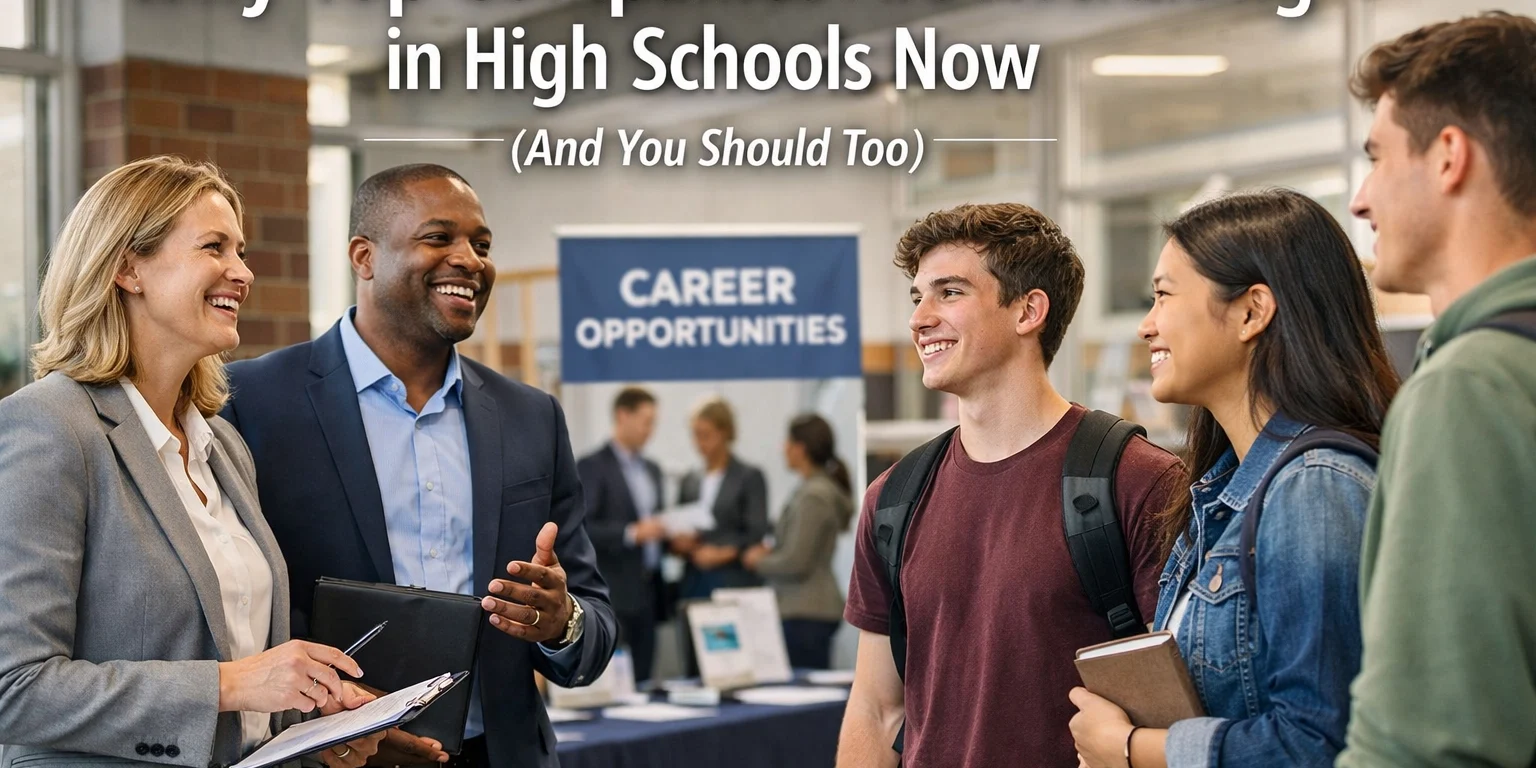
The competition for top talent has shifted to an unexpected arena: high school hallways. While most companies continue fighting over college graduates and experienced professionals, forward-thinking organizations have recognized a fundamental change in the workforce pipeline. They're not waiting for talent to come to them: they're building relationships with promising workers years before their competitors even know these individuals exist.
This isn't a charitable initiative or a public relations exercise. The data reveals a strategic advantage that's reshaping how America's largest employers approach talent acquisition and development.
The Educational Landscape Has Fundamentally Changed
Approximately 40% of high school graduates are choosing not to pursue college this year. These aren't students who lack ambition or capability. Many are making calculated decisions to build savings, gain work experience, or reassess whether a four-year degree aligns with their career goals and financial realities.
Simultaneously, one in three U.S. companies have eliminated bachelor's degree requirements from job postings. This represents a seismic shift in how organizations evaluate potential. Skills, aptitude, and work ethic are displacing credentials as primary hiring criteria. The message from the corporate world is clear: degrees aren't necessary for many roles that were traditionally gatekept by educational requirements.

This convergence creates an unprecedented opportunity. Talented young people are available and eager to work. Companies need skilled employees. The barrier between them: the assumption that college is the only viable path: has largely dissolved.
The Business Case: Internal Advancement Creates Better Leaders
The most compelling argument for high school recruitment isn't philosophical: it's mathematical. Employees with high school diplomas at top companies are up to 2.5 times more likely to receive promotions compared to similar employees at other major firms. This statistic reveals something profound about organizational culture and talent development.
Companies that recruit from high schools aren't simply filling entry-level positions. They're building management pipelines. Chipotle has demonstrated this principle at scale, aiming for a 90% internal promotion rate. Former cooks and cashiers now hold leadership positions throughout the organization. These leaders understand the business from the ground up because they've worked every position. They've earned credibility with frontline employees because they've shared those experiences.
Lowe's and Walgreens have implemented similar strategies with comparable success. The pattern is consistent: early recruitment combined with clear advancement pathways produces loyal, capable leaders who understand the business comprehensively.
The Competitive Advantage of Early Engagement
The top 50 large employers for high school graduates are up to 4.3 times more likely to hire recent high school graduates compared to other major U.S. firms. This disparity illustrates a strategic divide in the business community.
Companies that engage with high school talent early gain several distinct advantages. First, they identify promising workers before competitors do. A student who demonstrates strong work ethic, customer service skills, or technical aptitude at 18 can be developed over years rather than recruited at significant expense after college. Second, these employees often demonstrate greater loyalty. They associate their professional identity with the company that gave them their start. Third, the cost structure is dramatically more favorable than competing for experienced professionals or paying college recruitment expenses.
https://www.youtube.com/watch?v=l6J-0zileKE
Who's Leading This Transformation
Retailers dominate the landscape of high school recruitment, with 20 of the top 50 employers coming from the retail sector. But this isn't exclusively a retail phenomenon. Banks and insurance firms have recognized the same opportunity.
Beyond Chipotle, Lowe's, and Walgreens, companies like Best Buy, Starbucks, Gap, and PNC Financial are among the top employers offering clear pathways to advancement for high school graduates. Each has developed structured programs that transform entry-level positions into genuine career launching points.

The financial services sector's participation is particularly noteworthy. These organizations have traditionally required degrees for customer-facing and analytical roles. Their presence in high school recruitment signals that even traditionally credential-focused industries recognize that aptitude and training can substitute for formal education in many contexts.
Career Mobility: From Dead Ends to Highways
Research confirms that careers in retail and financial services have become strong pathways to upward mobility for high school graduates. These aren't dead-end jobs that keep workers trapped at minimum wage indefinitely. They're structured systems designed to identify capability and reward growth.
The transformation required intentional design. Companies created clear competency frameworks that define what advancement requires. They implemented training programs that develop those competencies systematically. They established cultures where internal promotion is expected rather than exceptional.
The result is that entry-level positions genuinely function as stepping stones rather than permanent stations. A cashier who demonstrates reliability and customer service excellence can move into shift leadership. A shift leader who shows operational competence and team management ability can advance to store management. A store manager who delivers results and develops people can progress into regional or corporate roles.
This isn't theoretical. The 2.5x promotion rate for high school graduates at leading companies compared to other firms proves the system works when implemented with commitment.
The Cloud, AI, and Data Analytics Dimension
While retail and financial services provide clear case studies, the most forward-thinking companies are extending high school recruitment into technical fields. Cloud computing, artificial intelligence, and data analytics: areas typically considered exclusive to college graduates: are becoming accessible to motivated high school graduates through structured training programs.

The skills gap in these fields is severe. Companies need technical talent faster than universities can produce it. Simultaneously, many technical skills are learnable through focused training programs that don't require four years of broad-based education. A motivated 18-year-old can become proficient in cloud infrastructure management, data visualization, or AI model training through intensive programs lasting months rather than years.
Companies that build these pipelines secure two advantages. First, they develop technical talent customized to their specific systems and needs rather than hiring generalists who require extensive onboarding. Second, they create loyalty among employees who recognize the extraordinary opportunity they've been given.
What This Means for Your Organization
The question isn't whether to recruit in high schools. The question is whether you can afford not to while competitors build talent advantages that will compound over years.
Implementation requires several elements. First, relationships with local high schools that create awareness of opportunities among students and counselors. Second, structured programs that provide clear advancement pathways rather than vague promises. Third, management cultures that value aptitude and growth over credentials. Fourth, training systems that systematically develop skills rather than assuming employees will figure things out independently.
The investment is significant but front-loaded. Once systems are established, they become self-reinforcing. Employees who advance through internal development become proof points that attract the next generation. Managers who came up through the ranks mentor newer employees effectively because they understand the journey. The culture shifts from credential-focused to capability-focused.
The Window Won't Stay Open Indefinitely
As more companies recognize this opportunity, competition for top high school talent will intensify. The organizations establishing these programs now will have developed systems, relationships, and reputations that create sustainable advantages. Those who wait will find themselves perpetually catching up to competitors who secured the best young talent years earlier.
The data is clear. The business case is proven. The only remaining question is whether your organization will lead this transformation or follow it.
Companies that recruit in high schools today aren't just filling current positions. They're building the leadership teams that will run their organizations in 2035 and beyond. That's not speculation: it's what the promotion data already demonstrates.
The next generation of talent is available now, eager to work, and capable of extraordinary growth. The companies that recognize this reality and act on it decisively will possess competitive advantages that competitors will struggle to replicate for years to come.