
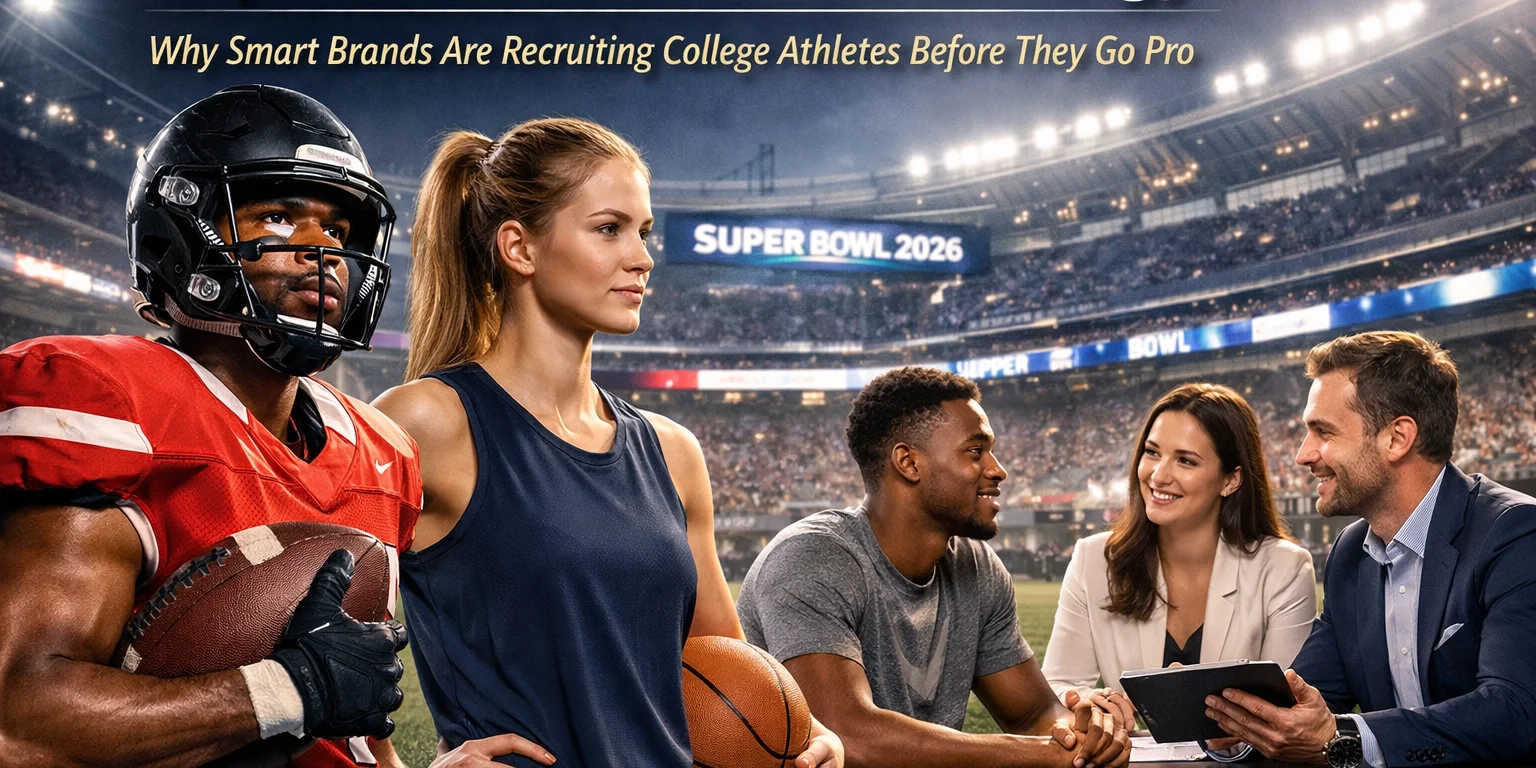
The Super Bowl has long represented the pinnacle of advertising opportunity: a singular moment when brands invest millions for thirty seconds of attention. Yet the most sophisticated Fortune 100 companies are fundamentally rethinking this approach for 2026. Rather than pouring resources exclusively into game-day commercials featuring established celebrity athletes, these organizations are implementing Name, Image, and Likeness (NIL) partnerships with college athletes as a strategic talent pipeline that extends well before and after the event itself.
This shift reflects a broader transformation in how major brands approach sports marketing. The traditional model: securing endorsements from professional athletes after they've achieved fame: is giving way to earlier engagement during the college years, when authentic relationships can be established and cultivated over time. For Fortune 100 brands planning Super Bowl campaigns, this represents not merely a cost-saving measure but a comprehensive strategic advantage across multiple dimensions.
The Economics of Authentic Engagement

The financial calculus behind NIL partnerships reveals compelling advantages for enterprise-level brands. College athletes command significantly deeper loyalty within specific geographic markets compared to national celebrity endorsers, often reaching more engaged consumers in key regions at a fraction of the cost. A starting quarterback at a major state university, for instance, may penetrate a regional market with greater effectiveness than a broad-reach national campaign featuring an established NFL star.
This localized influence matters particularly for brands with distributed operations or regional market priorities. Rather than pursuing only national reach through expensive Super Bowl television spots, companies implementing NIL strategies gain credibility in specific geographic markets and demographic segments where college athletics hold cultural significance. The investment required to secure these partnerships typically represents a small percentage of what a single thirty-second Super Bowl commercial demands, yet the sustained engagement often delivers superior return on investment when measured across the full campaign lifecycle.
Beyond cost efficiency, NIL partnerships address a fundamental challenge facing traditional advertising: authenticity. Audiences: particularly Generation Z consumers who will represent a growing portion of purchasing power: respond measurably better to authentic partnerships where athletes maintain their voice and integrate brands naturally into their existing content. The staged quality of traditional celebrity endorsements increasingly fails to resonate with younger demographics who prioritize transparency and genuine alignment between endorser and brand.
Extended Campaign Impact Beyond Game Day
https://www.youtube.com/watch?v=l6J-0zileKE
Traditional Super Bowl advertising suffers from a predictable limitation: impact declines sharply following the event. Brands invest heavily in production and media buys for that singular moment, only to watch engagement metrics drop precipitously in subsequent weeks. NIL partnerships counter this problem by extending campaign impact before, during, and after the Super Bowl through social media amplification and real-time commentary from athlete partners.
College athletes participating in NIL partnerships bring established social media followings and content creation capabilities that enable brands to maintain momentum across the entire campaign arc. In the weeks leading to the Super Bowl, these athletes can generate anticipation through behind-the-scenes content, predictions, and personal narratives. During the game itself, real-time social media reactions provide additional touchpoints. Following the event, post-game analysis and continuing content keep the brand conversation active well beyond the final whistle.
This sustained engagement model fundamentally changes the value proposition of Super Bowl marketing. Rather than concentrating resources into a single moment, brands distribute impact across an extended timeline, building cumulative awareness and reinforcing messages through multiple channels. The mathematics of reach and frequency: foundational principles of advertising effectiveness: favor this approach over isolated high-impact moments.

Building Long-Term Talent Infrastructure
Perhaps the most sophisticated application of NIL strategy treats these partnerships not as marketing expenses but as investments in workforce development. Forward-thinking brands are establishing esports pods, content studios, and innovation labs that transform fans into students, students into interns, and interns into employees. This approach views NIL sponsorships through the lens of talent acquisition rather than solely as advertising vehicles.
The strategic logic proves compelling. By engaging with college athletes during their university years, brands gain extended observation periods to evaluate potential future marketing hires. These relationships function as extended job interviews, allowing companies to assess work ethic, creativity, communication skills, and cultural fit long before formal employment discussions begin. Athletes who demonstrate strong performance in NIL partnerships may transition into full-time roles following graduation, bringing established brand knowledge and authentic enthusiasm that cannot be replicated through traditional hiring processes.
This talent pipeline strategy delivers multiple concurrent benefits. Brands simultaneously execute marketing campaigns, evaluate potential employees, and build relationships with individuals who may become influential in their respective industries regardless of whether they pursue professional athletic careers. Given that the vast majority of college athletes do not advance to professional leagues, this approach recognizes and capitalizes on the diverse career paths these individuals will follow.
Implementation Framework for Fortune 100 Brands

Success in NIL strategy requires treating college athletes as content partners rather than traditional endorsers. This distinction matters significantly in execution. Traditional endorsement deals typically provide brands with usage rights to an athlete's image in predetermined contexts. Content partnerships, by contrast, involve collaborative creation where athletes contribute genuine creative input and maintain authentic voice throughout the relationship.
Fortune 100 brands implementing NIL strategies should conduct thorough alignment assessments to ensure mutual fit between athlete and brand values. Forced or inauthentic partnerships generate immediate skepticism from audiences who have developed sophisticated abilities to detect manufactured relationships. The due diligence process should evaluate not only an athlete's on-field performance and social media following but also their communication style, values alignment, and long-term career aspirations.
Integration represents another critical success factor. NIL initiatives should connect directly to broader Super Bowl campaigns from the planning stage rather than functioning as isolated add-ons. When college athlete partners participate in campaign development, contribute to creative direction, and align their content with overarching brand messaging, the resulting campaigns achieve greater coherence and impact than fragmented efforts managed in separate silos.
The Competitive Advantage of Early Action
The current landscape presents particular opportunity for brands willing to move decisively. While NIL partnerships have gained rapid adoption since their legalization, many Fortune 100 companies continue to rely primarily on traditional endorsement models. This creates a window for early movers to establish relationships with high-potential college athletes before competition intensifies and partnership costs rise.
Athletes who develop strong relationships with brands during their college years often maintain those partnerships throughout their professional careers. For brands that successfully identify future stars while they remain in college, the return on investment can prove extraordinary. Even when athletes do not reach professional levels, the authentic relationships established during university years create brand advocates who influence purchasing decisions within their social networks and professional communities for decades.
Looking Toward Super Bowl 2026
As Fortune 100 brands finalize Super Bowl 2026 strategies, the evidence increasingly favors integrated approaches that combine traditional advertising with strategic NIL partnerships. The brands that will achieve greatest impact are those recognizing that the game itself represents just one moment in an extended campaign timeline, and that college athletes offer unique advantages in authentic engagement, localized market penetration, sustained impact, and long-term talent development.
The shift from purely transactional celebrity endorsements to developmental partnerships with college athletes reflects broader changes in how sophisticated brands approach marketing in an era of declining trust in traditional advertising. By investing earlier in athlete relationships, treating these partnerships as genuine collaborations, and recognizing the multiple strategic benefits beyond immediate sales impact, Fortune 100 companies position themselves not merely for Super Bowl success but for sustained competitive advantage in an evolving marketplace.
For brands ready to move beyond conventional approaches, the opportunity exists now to establish NIL strategies that will deliver returns well beyond 2026.





