
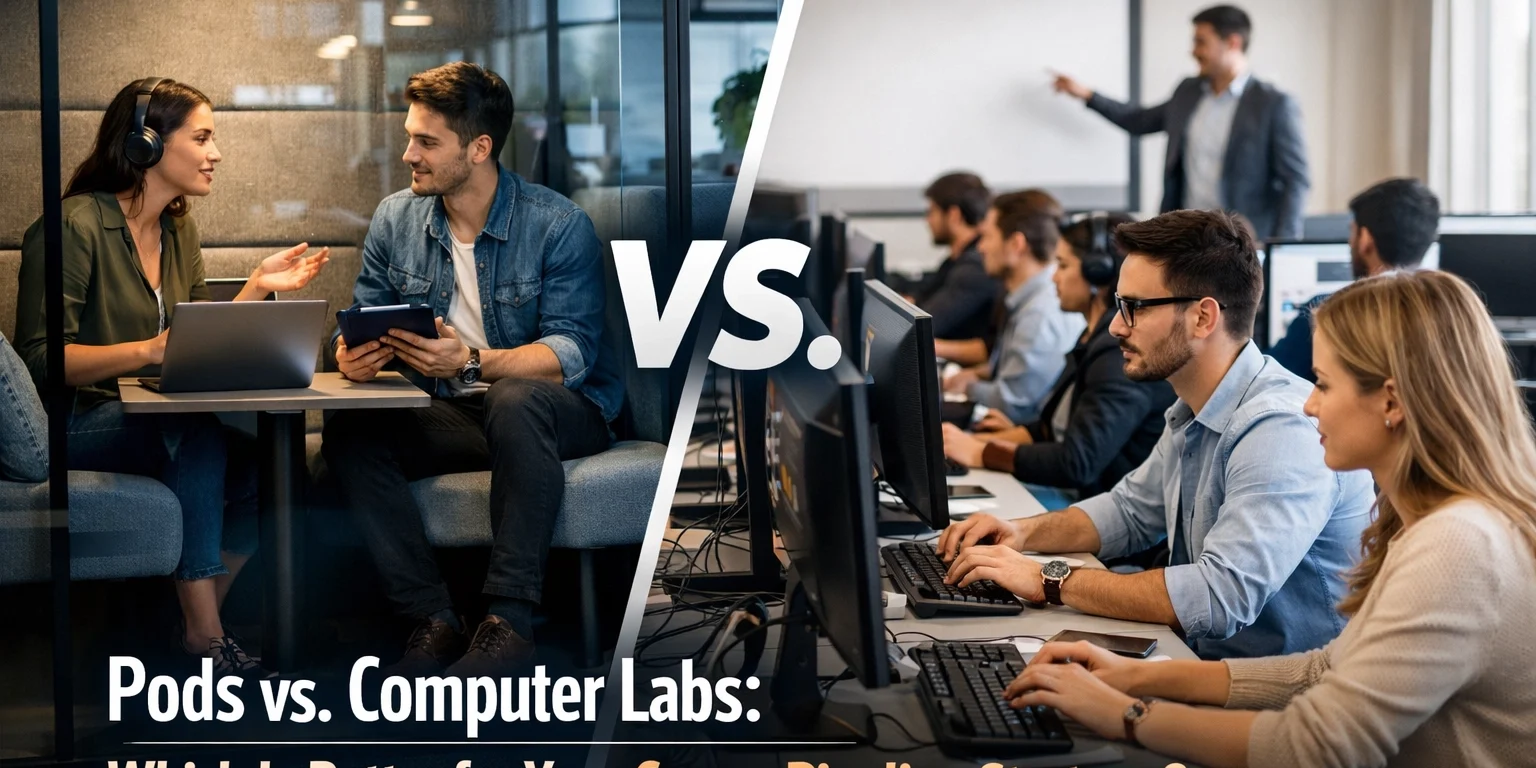
The physical spaces where learning happens matter more than most organizations realize. As workforce development programs scramble to prepare the next generation for careers in high-demand fields, a quiet revolution has been taking place in training facilities across the country. Traditional computer labs: rows of desktops, fluorescent lighting, and that distinctive hum of cooling fans: are giving way to something different. Something called "pods."
This shift isn't just about aesthetics or following the latest workplace trend. The infrastructure choices organizations make today directly impact the quality of their career pipeline tomorrow, particularly in fields like logistics, cybersecurity, and content creation where hands-on technical skills meet collaborative problem-solving.
Defining the Landscape
Before comparing these approaches, it's worth establishing what each model actually represents.
Traditional computer labs function as dedicated spaces filled with desktop workstations, typically arranged in rows or clusters. These environments emerged during the personal computing revolution and have served educational institutions and training centers for decades. They offer standardized hardware, controlled software environments, and centralized IT management. Students or trainees come to the lab, complete their work on assigned machines, and leave.

Pods represent a newer approach to workspace design that prioritizes flexibility, collaboration, and real-world working conditions. A pod typically consists of a semi-enclosed or modular workspace equipped with multiple device types, collaborative technology, and reconfigurable furniture. Rather than forty individual workstations in a single room, imagine eight pods of five people each, with each pod functioning as a mini-team environment complete with laptops, tablets, shared displays, and project-specific tools.
The distinction matters because modern career pathways: particularly in logistics, cybersecurity, and content creation: rarely involve solo work on isolated machines. They require team coordination, cross-functional communication, and the ability to adapt technology setups to project needs.
The Infrastructure Comparison
From a pure facilities perspective, computer labs offer undeniable advantages in certain contexts. Hardware standardization makes troubleshooting simpler. Desktop machines generally provide more processing power per dollar than mobile alternatives. Physical security becomes easier when equipment stays bolted to desks. For organizations with limited IT staff or tight budgets, these factors carry real weight.
However, standardization cuts both ways. A computer lab optimized for spreadsheet training may lack the specialized software needed for video editing. A cybersecurity lab configured for network monitoring exercises may not accommodate collaborative threat analysis sessions. The very rigidity that makes computer labs predictable also makes them less adaptable to evolving training needs.
Pods sacrifice some infrastructure simplicity in exchange for operational flexibility. The hardware mix might include laptops, tablets, and specialized devices depending on the training focus. Software environments can vary between pods without disrupting the entire facility. Most significantly, the physical arrangement encourages the kind of peer learning and team-based problem-solving that mirrors actual workplace dynamics.

Career Pathway Implications: Logistics
Consider the logistics sector, which increasingly demands professionals who understand both physical supply chains and the digital systems that orchestrate them. Modern logistics careers involve warehouse management systems, transportation optimization software, inventory tracking platforms, and real-time data analysis tools.
A traditional computer lab can certainly teach someone how to use specific logistics software. Students can complete modules on route planning or inventory management in isolation. But this approach misses a critical component of actual logistics work: coordination across departments and rapid problem-solving when systems conflict or data doesn't align.
Pods allow training scenarios that better reflect workplace reality. One pod might handle inbound shipment processing while another manages outbound logistics, with both needing to communicate and resolve conflicts when warehouse capacity becomes constrained. The logistics professional of tomorrow needs to operate software proficiently, but they also need to collaborate across teams, interpret conflicting data sources, and adapt when technology doesn't behave as expected. Pod-based training naturally incorporates these competencies.
Career Pathway Implications: Cybersecurity
The cybersecurity field presents an interesting case for this infrastructure debate. Much cybersecurity training historically occurred in specialized labs where students worked on isolated networks, practicing attack and defense techniques without risking production systems.
This model continues to have value. Security professionals need deep technical skills that often require focused, individual practice. Setting up virtual networks, analyzing malware, and understanding encryption protocols demand concentration and specialized tools.

Yet the cybersecurity landscape has evolved dramatically. Modern security operations centers function as collaborative environments where analysts work together to identify threats, coordinate responses, and communicate findings to non-technical stakeholders. A security analyst who can brilliantly detect intrusions but cannot explain the risk to business leaders or coordinate with the infrastructure team during incident response possesses incomplete skills.
Pods enable a hybrid approach. Each pod might contain the technical tools needed for security work: virtualization platforms, monitoring dashboards, forensic software: while the pod structure facilitates the communication and collaboration that characterize real security operations. Training exercises can involve pod-to-pod coordination, simulating how different security teams interact during a significant incident.
The most effective cybersecurity career pipeline might actually involve both models: individual lab time for developing core technical skills, and pod-based training for applying those skills in collaborative, realistic scenarios.
Career Pathway Implications: Content Creation
Content creation represents perhaps the clearest argument for pod-based infrastructure. Whether the focus is video production, digital marketing, graphic design, or multimedia journalism, modern content creation is fundamentally collaborative.
Traditional computer labs often house powerful workstations capable of rendering video or processing high-resolution images. For organizations training content creators, these labs represent significant capital investments. However, the typical lab structure: individual workstations in rows: actively works against how content creation actually happens in professional environments.
Content creation involves creative collaboration, rapid iteration, and frequent review sessions. A video producer needs to show rough cuts to teammates and incorporate feedback. A graphic designer working on a campaign needs input from copywriters and strategists. A social media team needs to review scheduled content together before publication.
Pods naturally accommodate this workflow. Shared displays allow teams to review work together. The semi-enclosed structure provides some acoustic separation so multiple projects can proceed simultaneously without excessive interference. The flexibility to rearrange technology setups means today's video editing station becomes tomorrow's podcast recording setup without requiring facility renovation.
For career pipeline development in content creation, pods don't just provide appropriate infrastructure: they socialize trainees into the collaborative, iterative nature of professional content work.
The Practical Considerations
Infrastructure decisions ultimately come down to resources, goals, and constraints. Computer labs typically require higher upfront capital investment but lower ongoing operational complexity. Pods may cost less initially (especially when leveraging mobile devices rather than high-end desktops) but demand more sophisticated facility management and potentially more IT support to maintain diverse technology configurations.
Space utilization differs significantly. A computer lab efficiently packs workstations into available square footage, maximizing the student-to-space ratio. Pods deliberately sacrifice some density to create collaborative areas, resulting in fewer simultaneous users per square foot but potentially higher learning effectiveness per user.

The question of which model better serves career pipeline strategy depends substantially on the specific careers in question and the organizational context. Programs focused on developing narrow technical skills in standardized environments may find computer labs perfectly adequate. Programs aiming to prepare professionals for collaborative, dynamic work environments will likely find pods more aligned with their objectives.
Looking Forward
Workforce development doesn't exist in a vacuum. The infrastructure choices organizations make today shape the professional capabilities of tomorrow's workforce. As industries continue evolving toward more collaborative, flexible, and technology-diverse work arrangements, training environments that mirror these conditions provide clearer pathways into actual careers.
Neither pods nor computer labs represent a universal solution. The most sophisticated career pipeline strategies likely incorporate both models strategically. Core technical skills development might occur in traditional lab settings where standardization enables efficient instruction. Applied, collaborative skill building might transition to pod environments where teamwork and adaptability receive equal emphasis alongside technical proficiency.
The organizations succeeding at career pipeline development aren't simply choosing between pods and computer labs based on cost or convenience. They're thoughtfully aligning their physical infrastructure with the actual competencies their target industries demand, recognizing that where learning happens influences what learning sticks.
For fields like logistics, cybersecurity, and content creation: where technical expertise must combine with collaboration, communication, and adaptability: the shift toward pod-based training represents more than a facilities upgrade. It represents a fundamental recognition that preparing people for modern careers requires more than teaching them to operate software in isolation. It requires preparing them for the messy, collaborative, dynamic reality of professional work.





