
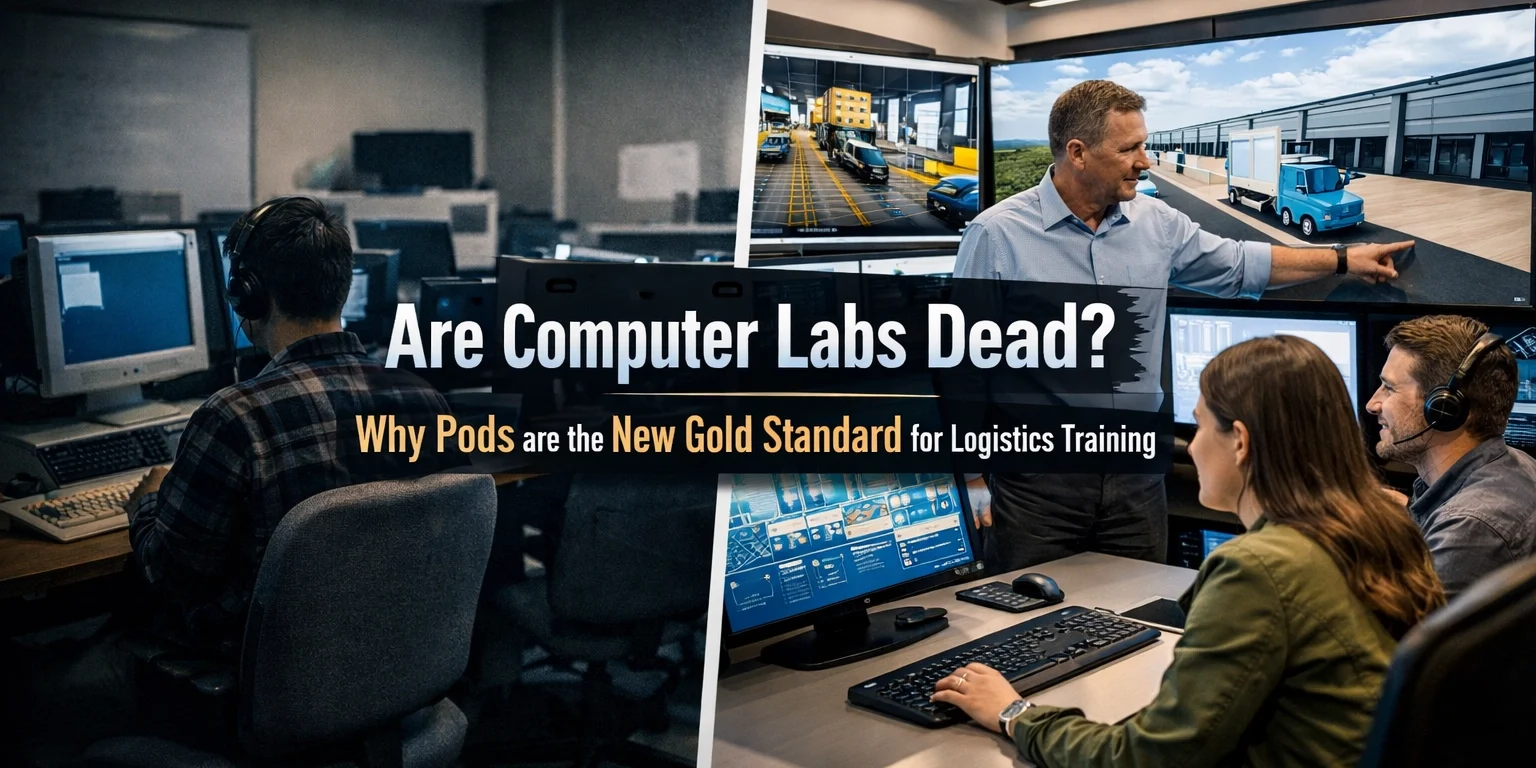
Remember the traditional computer lab? That windowless room filled with rows of beige monitors, the faint smell of ozone, and the constant clicking of keyboards that sounded like a swarm of very productive locusts? If you grew up in the late 90s or early 2000s, that was the pinnacle of "high tech."
But here’s the cold, hard truth: the traditional computer lab is basically a museum piece at this point. It’s the flip phone of educational infrastructure. In a world where logistics, cybersecurity, and content creation move at the speed of a fiber-optic cable, the old "sit in a row and look forward" model isn't just outdated, it’s actually holding us back.
At USA Entertainment Ventures LLC, we spend a lot of time thinking about how business consulting and training need to evolve. Our CEO, Dan Kost, always says that if you aren't training for the real world, you're just wasting everyone's time. And in the real world, nobody works in a "computer lab" anymore. They work in Pods.
The Death of the Cubicle Farm
The old-school computer lab was designed for isolation. It was built for one person, one machine, and one task. That might work if you’re learning how to use a spreadsheet for the first time, but it fails miserably when you’re trying to navigate the complexities of modern logistics or high-stakes cybersecurity.
Modern industries don’t operate in silos. They operate in ecosystems. When a shipment is delayed in the Port of Long Beach, a logistics manager doesn't just sit there staring at one screen. They are on a tablet checking weather patterns, a laptop analyzing supply chain data, and a smartphone coordinating with a driver, all while shouting across a desk to a teammate who is handling the warehouse inventory.
This is where the Pod comes in.

What Exactly is a Pod? (And Why Should You Care?)
A "Pod" isn't just a fancy name for a group of desks. It’s a deliberate, physical infrastructure shift. Instead of rows of desks facing a teacher or a whiteboard, a Pod is a cluster, usually four to six workstations, designed for collaborative, multi-device work.
Think of it as a "war room" for the modern professional.
In a Pod environment, the physical barriers are gone. Trainees are encouraged to work across multiple screens and devices simultaneously. This mirrors the "real-world workflow replication" that the industry is begging for. We aren't just teaching people how to use software; we’re teaching them how to coordinate a symphony of data and human interaction.
Logistics: The Pod’s Natural Habitat
If there is one industry that has benefited from the death of the computer lab, it’s logistics. Supply chain management is no longer just about moving boxes from Point A to Point B. It’s about data management, real-time problem solving, and constant communication.
Research shows that Pod-based training allows students to simulate the experience of coordinating shipments while monitoring warehouse operations and responding to customer inquiries in tandem. You can’t do that in a traditional lab. In a Pod, one student might be the "Dispatcher," another the "Inventory Specialist," and another the "Client Liaison." They work in a tight circle, reacting to live data simulations that mimic the chaos of a real shipping hub.
This kind of immersive training is exactly what we discuss in our services section. We’re moving away from theoretical learning and toward functional excellence.
Why Logistics Needs the "War Room" Vibe:
- Multi-Device Proficiency: Logistics pros use everything from handheld scanners to giant "dashboard" monitors. Pods provide the space to use them all at once.
- Collaborative Crisis Management: When a "bottleneck" is introduced in a simulation, a Pod of four students has to talk to each other to fix it. In a lab, they just stare at their own screens.
- Visualization: Pods often feature central "war room" displays where teams can visualize the entire supply chain, making the abstract data feel tangible.

Cybersecurity: From Solitary Hackers to Tactical Teams
The same logic applies to cybersecurity. The trope of the lone hacker in a dark basement is a myth, or at least, it’s not how the "good guys" operate. Modern cybersecurity is a team sport.
When a company is under a DDoS attack or a ransomware threat, the response team (often called a Security Operations Center, or SOC) works in a collaborative Pod. One person tracks the entry point, another monitors the firewall, and another handles the internal communication to stakeholders.
Training for this in a computer lab is like training for a basketball game by practicing free throws in an empty gym. It’s a start, but it doesn't prepare you for the pressure of the game. Pods create that high-pressure, high-communication environment that cybersecurity experts actually face every day.
Content Creation: The New Studio Model
Let’s talk about content creation. Whether it’s video editing, podcasting, or social media management, the "lab" model is dead here, too. Content creation today is about cross-platform synergy.
A content creator might be editing a video on a desktop while monitoring live analytics on a tablet and engaging with a community on a mobile device. Pods allow for these "mini-studios" to exist within a larger training facility. It encourages the "content house" vibe where creators can bounce ideas off one another, share assets instantly via local networks, and collaborate on a single campaign in real-time.
For those looking into career opportunities in the digital space, learning in a Pod environment puts you lightyears ahead of someone who learned in a 1995-style computer lab.

Scalability and the Rural Advantage
One of the biggest arguments for Pods isn't just the "cool factor", it’s the logistics of training itself (meta, right?).
Traditional computer labs are expensive and rigid. You need a specific room, specific wiring, and specific hardware that usually becomes obsolete in three years. Pods, however, are built for the cloud era. Because most of the heavy lifting is done via virtual environments or cloud-based software, the physical "Pod" can be set up almost anywhere.
This is a game-changer for rural workforce development. You don't need a multi-million dollar "tech center" to train the next generation of logistics experts. You need a well-designed Pod system and a solid internet connection. This flexibility allows organizations to train workers across multiple cities without the massive infrastructure costs of the past. It’s efficient, it’s lean, and it’s smart business.
Is the Computer Lab Actually Dead?
Okay, maybe "dead" is a strong word. There will always be a place for foundational skills. If you're teaching an 80-year-old how to use email or helping a community without any device access get their first taste of the digital world, a traditional lab works just fine.
But for professional training? For the careers of 2026 and beyond? The lab is a dinosaur.
The move toward Pod-based training isn't just a trend; it's a response to how the world actually works. We are no longer training individuals to be cogs in a machine. We are training teams to be the engine.

Actionable Takeaways for Your Organization
If you’re still running a traditional computer lab for your employee training or educational program, it might be time for a renovation. Here’s how to start:
- Rearrange the Furniture: Seriously, it starts there. Break the rows. Create clusters of four.
- Focus on "The Second Screen": Encourage the use of tablets and mobile devices alongside the main workstation.
- Invest in Simulation Software: Move away from "click here" tutorials and toward "solve this" simulations that require group input.
- Embrace the Cloud: Stop worrying about having the most powerful PC at every desk. Focus on the connectivity that allows your Pods to access virtual training environments.
The transition from labs to Pods is more than just a change in floor plan: it's a change in mindset. It’s about moving from "I learn" to "We solve." And in the world of logistics and business consulting, that's the only shift that matters.
If you want to see how we are helping businesses navigate these changes, feel free to check out our about page or dive into our portfolio. The future of training is here, and it doesn't look anything like a classroom.
It looks like a Pod.
Stay agile, stay collaborative, and for heaven's sake, stop sitting in rows.
: Dan Kost, CEO
USA Entertainment Ventures LLC





