
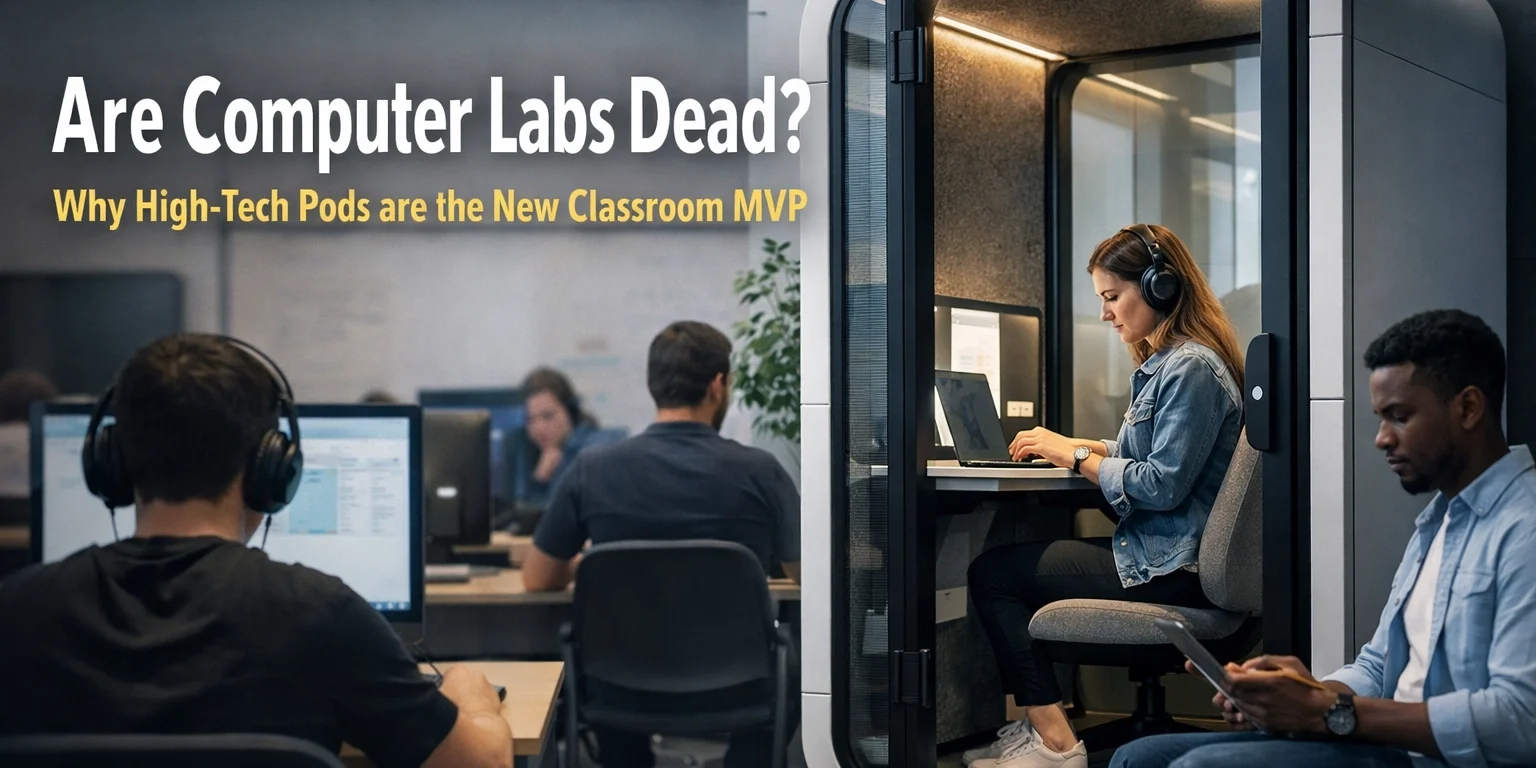
Remember the classic computer lab? That windowless room filled with the hum of thirty identical towers, the faint smell of ozone, and those glowing blue "Educational Use Only" screens? For decades, it was the crown jewel of school infrastructure. But as we move deeper into 2026, those traditional rows of generic PCs are starting to look as dated as a floppy disk.
The reality is that technology has moved faster than the furniture. Today, every student has a laptop, a tablet, or at least a smartphone that can out-process the supercomputers of yesteryear. The "generic" lab is dying. In its place, a new MVP has entered the arena: the High-Tech Pod.
At USA Entertainment Ventures LLC, we’ve been watching this shift closely. It isn't just about changing the chairs; it's about a fundamental shift in how we prepare for careers in logistics, cybersecurity, and content creation.
The Evolution: From Generic Desks to Specialized Pods
The traditional computer lab was designed for "computing" as a general activity, typing papers, searching the early web, or learning how to not delete the C: drive. But in the modern professional landscape, "computing" isn't a single job. It’s the baseline for every job.
"The old-school lab was a one-size-fits-all solution in a world that now demands bespoke skills," says Dan Kost, CEO of USA Entertainment Ventures LLC. "You don’t train a fighter pilot in a Cessna, and you shouldn't train a cybersecurity expert on a machine that’s also used for basic word processing."
High-tech pods are modular, purpose-built environments. Instead of a room full of the same machines, a "Pod" is a specialized station designed to mimic a specific industry. Think of it as a micro-office that provides the exact hardware, software, and physical layout needed for a professional career path.

Career Pathway #1: The Digital Shield (Cybersecurity)
Cybersecurity isn't just a growing field; it’s a national necessity. However, teaching it in a standard computer lab is a nightmare for IT departments. To truly learn penetration testing or incident response, students need to be able to "break" things without taking down the entire school’s Wi-Fi.
Cybersecurity pods provide isolated network environments. These are "sandbox" setups where students can launch simulated attacks and build defensive firewalls in a controlled space.
Why the Pod Model Works for Security:
- Isolated Infrastructure: Prevents malware from escaping into the main network.
- Professional Monitoring: Stations often include multi-monitor setups to track network traffic in real-time.
- Collaboration Zones: Pods are often arranged in "Red Team" and "Blue Team" clusters to encourage competitive, hands-on learning.
For students looking for career opportunities in tech, these pods offer the kind of "battle-tested" experience that a standard classroom simply can't replicate.
Career Pathway #2: The Content Creation Revolution
We’ve moved past the era where "content creation" was a hobby. It is now a multi-billion dollar industry spanning marketing, entertainment, and education. A traditional lab, with its fluorescent lights and open-room acoustics, is the worst place to record a podcast or edit a 4K video.
Content creation pods are the new "film schools in a box." They integrate professional-grade lighting, sound-dampening materials, and high-end GPUs.
Key Components of a Creation Pod:
- Acoustic Treatment: Small, modular walls that block out the hallway noise.
- High-End Peripherals: Professional microphones, 4K cameras, and color-accurate monitors.
- Streaming Readiness: Integrated hardware encoders for students to practice live broadcasting.
By providing these spaces, institutions aren't just teaching "media"; they are giving students the tools to build their own brands and businesses, a core philosophy we value at our agency.

Career Pathway #3: The Invisible Backbone (Logistics & Supply Chain)
Logistics is often the unsung hero of the modern economy. In a world of "Prime" delivery and global trade, the logistics professional is a data scientist, a strategist, and a crisis manager all in one.
A logistics pod doesn’t look like a computer desk; it looks like a command center. These pods focus on supply chain simulations, AI-driven routing software, and real-time inventory tracking. Using specialized pods, students can manage a simulated global fleet, navigating through port closures and weather delays in an environment that feels like a real-world dispatch center.
The Business Case: Why Pods Win on the Balance Sheet
If you’re a school administrator or a business consultant, you might be thinking, "This sounds expensive."
Actually, the data suggests the opposite. Recent industry research indicates that organizations implementing pod-based infrastructure can see cost savings between 50 and 75 percent compared to maintaining traditional, large-scale computer labs.
How is that possible?
- Reduced Overhead: You don't need to cool and power a massive room 24/7. Pods can be powered up only when in use.
- Modular Upgrades: If the cybersecurity hardware becomes obsolete, you only upgrade the cybersecurity pod, not the entire 40-seat lab.
- Efficiency: Traditional labs often have a 30% utilization rate. Pods, being specialized, often see much higher engagement because they are tied to specific, high-demand services.
"It’s about ROI, Return on Instruction," Dan Kost explains. "When you align the physical space with the career outcome, the completion rates skyrocket. Students aren't just sitting in a chair; they’re sitting in their future career."

Transitioning from "The Lab" to "The Pod"
The shift doesn't have to happen overnight. Most forward-thinking institutions are adopting a hybrid model. As old equipment reaches its end-of-life, instead of buying 30 new generic desktops, they are carving out space for three or four specialized pods.
Actionable Steps for Institutions:
- Audit Current Usage: Are students actually using the lab for specialized work, or just to check email between classes? (If it's the latter, they can do that on their phones).
- Identify Local Industry Needs: If your region has a burgeoning tech sector, prioritize cybersecurity pods. If you're near a shipping hub, focus on logistics.
- Think Modular: Look for pod designs that can be moved or reconfigured. The world changes fast; your furniture should too.
For more information on how we view the intersection of technology and business, feel free to visit our about-us page.
The Human Element: Collaboration Over Isolation
Perhaps the biggest win for the pod model isn't the tech, it's the people. Traditional labs encouraged silence and isolation. You sat in a row, looked at your screen, and ignored your neighbor.
Pods are inherently social. They feature huddle spaces, shared displays, and collaborative seating. This mirrors the modern workplace, where solving a complex problem in cybersecurity or logistics requires a team effort. We see this daily in our digital ventures; the best ideas rarely happen in a vacuum.

Final Thoughts: The MVP of 2026
Are computer labs dead? The old version, the "digital typing pool", is certainly on life support. But its successor is more exciting, more efficient, and infinitely more effective.
By embracing high-tech pods, we are moving away from teaching "how to use a computer" and toward teaching "how to lead an industry." Whether it's defending a network, creating a viral masterpiece, or moving the world's cargo, the pod is where the real work happens.
If you have questions about how these trends might affect your business or educational institution, we invite you to check out our Q&A or reach out via our contact page.
The future of the classroom isn't a row of desks. It’s a specialized, high-octane environment that puts the student in the driver's seat of their own career. Welcome to the era of the Pod.
For more insights into business consulting and the entertainment industry, stay tuned to the USA Entertainment Ventures LLC blog. For legal information regarding our content, please see our terms-and-conditions and privacy-policy.





