
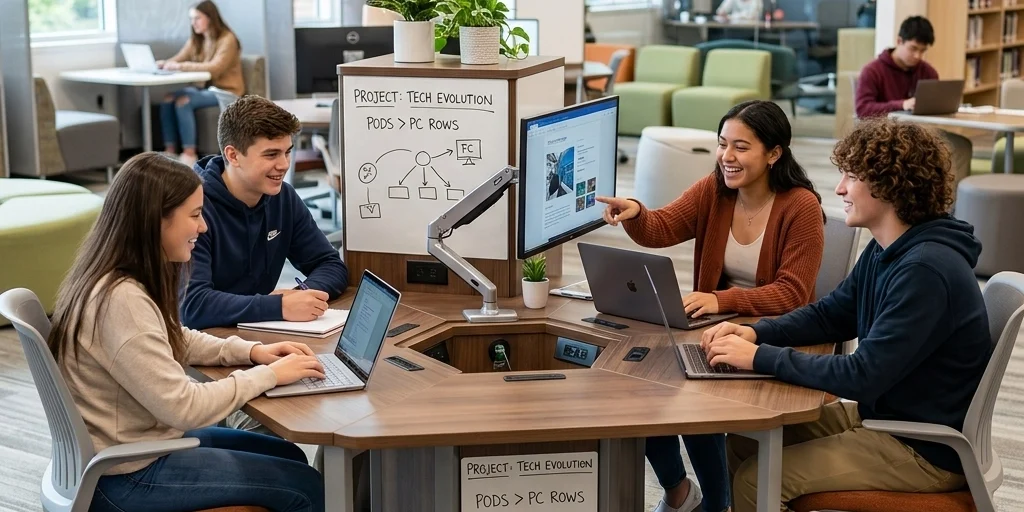
If you grew up anytime between 1990 and 2015, the "Computer Lab" was a sacred place. It was a windowless room that smelled faintly of ozone, static electricity, and floor wax. It featured rows of beige (and later, sleek black) towers, glowing monitors, and that one kid in the back who always managed to bypass the school firewall to play Bloons Tower Defense.
But walk into a modern school today, and you might notice something weird: the traditional computer lab is looking a little… ghost-town-ish. The rows of PCs are gathering dust, or worse, they’ve been replaced by a "Collaborative Maker Space" that looks more like a Google office than a classroom.
Are computer labs dead? Well, not exactly. They’re just evolving into something much cooler: Pods.
The Great Extinction of the Beige Box
Let’s be real, the traditional computer lab was built on a foundation of "limited access." We went there because that was the only place with the internet and the software we needed. But today, the digital landscape has shifted. According to recent data, roughly 95% of students now carry their own laptops or tablets. With "Bring Your Own Device" (BYOD) policies becoming the standard, the need for a dedicated room full of identical desktops has plummeted.
Cloud-based software licensing has also dealt a heavy blow to the old-school lab. Why trek across campus to use a specific machine when you can run AutoCAD or Adobe Creative Cloud from your own laptop in the cafeteria? The COVID-19 pandemic was the final nail in the coffin, proving that education doesn't need a physical "lab" to keep the gears turning.
However, schools are realizing that while everyone has a laptop, not everyone has the right environment for high-level work. You can’t build a drone, defend a mock server from a cyber-attack, or edit a 4K documentary while sitting at a wobbly cafeteria table. Enter the specialized "Pod."

What Exactly is a "Pod"?
If the computer lab was a library, the Pod is a laboratory. Instead of 30 computers lined up like soldiers, a Pod is a modular, high-tech hub designed for a specific career pathway. It’s physical infrastructure built for collaboration, not isolation.
Instead of one giant room, schools are carving out smaller, specialized spaces equipped with high-end hardware that personal laptops just can't match. We’re talking specialized GPUs, VR headsets, 3D printers, and industrial-grade networking equipment. At USA Entertainment Ventures LLC, we see this shift as a massive leap forward in how we prepare the next generation for the "real world."
Let’s dive into the three biggest career pathways that are driving this "Pod" revolution.
1. The Logistics of the Future: Moving More Than Just Boxes
When people hear "logistics," they often think of a guy driving a forklift in a warehouse. While forklifts are cool, modern logistics is a high-tech game of 3D chess. Modern schools are building "Logistics Pods" that simulate global supply chains.
These spaces aren't just about computers; they’re about physical infrastructure. Students in these pods are learning how to manage complex systems using IoT (Internet of Things) devices, automated sorting sensors, and real-time data tracking. They are learning how to move goods across the globe, or maybe just across a smart city, using the most efficient routes possible.
Careers in logistics are exploding, especially as e-commerce continues to dominate the economy. By training in a Pod rather than a generic lab, students get hands-on experience with the specific hardware used by companies like Amazon or FedEx. It’s about understanding the physical flow of goods, and you can’t learn that by just staring at a spreadsheet in a row of 30 people.
2. Cybersecurity: The Digital Frontline
You can’t teach cybersecurity in a standard computer lab. Well, you can, but it’s like teaching swimming in a parking lot. True cybersecurity education requires a controlled, "sandboxed" environment where students can actually launch and defend against malware without accidentally taking down the entire school’s Wi-Fi.
"Cyber Pods" are designed to be high-security hubs. They often feature "Red Team/Blue Team" setups where one group of students tries to "hack" a localized server while the other group defends it. This requires specialized server racks, hardware firewalls, and specific networking configurations that a standard lab just doesn't offer.
In these Pods, students aren't just "using computers"; they are learning the infrastructure of the internet. They’re diving into the "guts" of the machine. As data breaches become more common, the demand for "Cyber Warriors" is at an all-time high. A student who has spent four years in a dedicated Cyber Pod is infinitely more employable than one who just took a multiple-choice test on a Chromebook.

3. Content Creation: From "Influencer" to Industry Pro
We’ve all seen the jokes about kids wanting to be YouTubers when they grow up. But here’s the thing: content creation is a multi-billion dollar industry. It’s not just about dancing on TikTok; it’s about high-end video production, sound engineering, and digital storytelling.
"Content Pods" are the new "AV Clubs," but on steroids. They are equipped with soundproofing, professional-grade lighting, 8K cameras, and high-performance workstations capable of rendering complex 3D animations.
This is where the physical infrastructure matters most. You can't record a clean podcast in a room with 29 other kids typing. You need a Pod. These spaces allow students to explore career paths in film, advertising, and corporate communications. Projects like Zoo Imagery highlight the importance of high-quality visual assets in the modern business world. By giving students access to these Pods, schools are turning "hobbies" into professional skill sets.
Why This Matters for Business (and Your Wallet)
From a business consulting perspective, the lens we often use here at USA Entertainment Ventures LLC, the shift to Pods is just smart economics.
Traditional labs are a "bad ROI." They require massive capital expenditures every three to five years to refresh 30+ machines that might only be used for an hour a day. Pods, however, are modular. You can invest heavily in five high-end "Video Pods" and ten "Cyber Pods," and those spaces will be used 100% of the time by students who are actually passionate about those fields.
It’s about quality over quantity. In the old days, the goal was digital literacy, teaching everyone how to use a mouse. Today, digital literacy is a given. The new goal is digital mastery.
The Human Element: Collaboration Over Isolation
Perhaps the biggest reason computer labs are dying is that they were fundamentally anti-social. They were designed for students to sit in front of a screen, eyes forward, not talking to their neighbors.
The modern workplace doesn't work like that. Whether you’re in business consulting, logistics, or tech, you’re working in teams. Pods are designed for this. They feature round tables, shared monitors for screen-mirroring, and whiteboard walls. They encourage students to look at each other, solve problems together, and communicate, skills that are just as important as knowing how to code.
Looking Ahead: The Future of School Infrastructure
As we look toward the 2030s, the "computer lab" will likely become a relic of the past, right next to the overhead projector and the chalkboard. But the need for specialized physical space isn't going anywhere. In fact, as technology becomes more complex, the need for these high-tech "home bases" will only grow.
Schools that embrace the Pod model aren't just buying new furniture; they are redesigning their entire approach to career readiness. They are moving away from the "factory model" of education and toward a "studio model" that reflects the modern economy.

So, are computer labs dead? If you mean the rows of dusty PCs in a windowless basement, then yes: and honestly, good riddance. But if you mean the idea of a dedicated space where students can push the boundaries of technology, then the "lab" is more alive than ever. It’s just smaller, faster, and a lot more collaborative.
If you’re a school administrator or a business leader looking to navigate this transition, it might be time to rethink your physical infrastructure. After all, the future isn't happening in rows: it's happening in Pods.
To learn more about how infrastructure and business consulting intersect, check out our portfolio of projects or explore our full sitemap for more insights on the evolving landscape of American business and entertainment.





