
If you close your eyes and think of a "computer lab," what do you see? If you’re of a certain vintage, you probably see rows of beige towers, flickering CRT monitors, and that weirdly specific smell of ozone and industrial carpet. It was a place of pilgrimage where we went to "type up" a paper or, if the teacher wasn’t looking, play a pixelated game of Oregon Trail.
Fast forward to 2026, and that vision is essentially a museum exhibit. The traditional computer lab is on life support, and honestly? It’s time to let it go.
With the rise of "Bring Your Own Device" (BYOD) policies, where roughly 95% of students and professionals now carry a laptop more powerful than the Apollo 11 guidance computer, the need for a room full of static PCs has plummeted. In fact, campus reports have shown that traditional labs often sit at less than 40% capacity. But we still need physical infrastructure to get work done. We just don’t need the "lab."
Enter: The Pod.
The Ghost of Lab Days Past
The death of the computer lab wasn’t a sudden murder; it was a slow, logical fading away. Three things killed it: mobility, the cloud, and the pandemic.
When software moved to the cloud, the "specialized" computer became less special. You don't need a $5,000 workstation to run basic spreadsheets anymore; you just need a browser and a decent Wi-Fi signal. Then, 2020 happened. The world realized that if we could work from our kitchen tables, we certainly didn't need to be tethered to a specific desk in a windowless room in the basement of the Science Building.
However, as the "general use" lab died, a new problem emerged. We became a society of creators, and creating high-level content requires more than just a thin laptop and a dream. It requires specialized environments.

What the Heck is a Pod, Anyway?
If a computer lab is a public library, a Pod is a private executive suite.
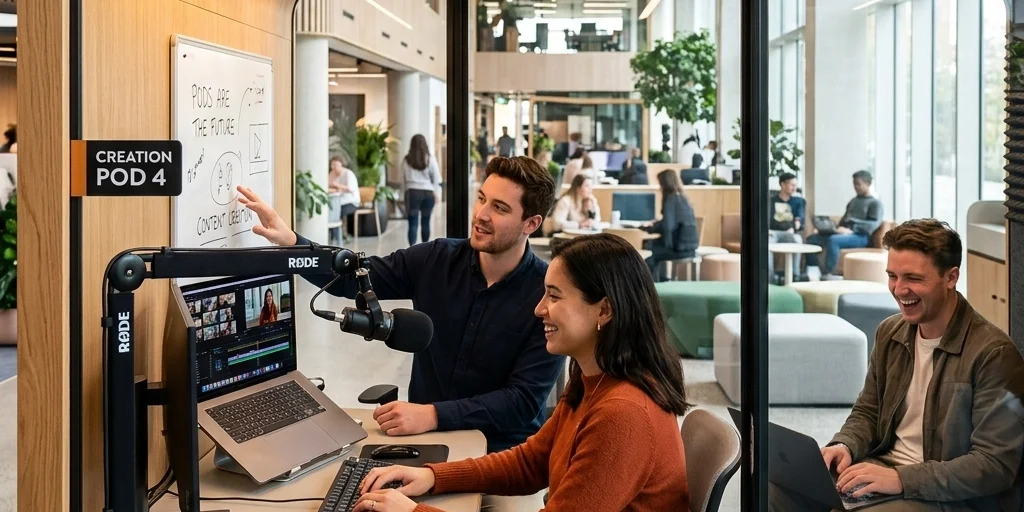
Modern Pods are self-contained, modular, and tech-integrated units designed for high-performance tasks. They aren't just "desks with walls." They are acoustic-treated, climate-controlled, and hardware-optimized spaces that can be dropped into a lobby, a warehouse, or a school hallway.
At USA Entertainment Ventures LLC, we’ve watched the shift in business consulting go from "How do we fit 50 people in a room?" to "How do we give 5 people the specialized tools they need to generate $5 million in value?" The answer is almost always infrastructure that supports specific career pathways.
Content Creation: The New Gold Rush
The most obvious use for the modern Pod is content creation. We’re not just talking about teenagers dancing on TikTok (though, hey, that’s a billion-dollar industry too). We’re talking about high-end video editing, 3D rendering, and podcasting.
A traditional computer lab is a nightmare for a content creator. It’s loud, the lighting is terrible, and everyone can see your screen. A Content Pod, however, is a sanctuary.
Why Content Creators Need Pods:
- Acoustics: You can’t record a professional voiceover or a podcast episode in a room with 30 other people clicking mice. Pods provide the sound isolation necessary for "pro-grade" audio.
- Processing Power: While cloud computing is great, rendering 4K or 8K video still benefits from localized, high-end GPUs. Pods can be outfitted with "beast-mode" hardware that handles the heavy lifting while your laptop stays cool.
- Lighting and Privacy: For streamers and video presenters, a Pod offers a controlled "studio" look that a cubicle simply can't match.
As the creator economy continues to explode, the institutions that provide this infrastructure are the ones that will attract top talent. Whether you're looking at Zoomedia News or 360 Sports Media, the demand for high-quality output is non-negotiable.
Cybersecurity: The Pod as a Digital Vault
Beyond the glitz of content creation lies a more serious, and incredibly lucrative, career pathway: Cybersecurity.
In a world where data breaches are a "when," not an "if," training the next generation of digital defenders is a priority. But you can't exactly run a "Live Fire" ethical hacking exercise on a standard school or corporate network without the IT department having a collective heart attack.
Modern Pods serve as isolated "cells." They can be set up on their own air-gapped networks, allowing students and professionals to simulate cyber-attacks, test vulnerabilities, and manage high-stakes security logistics in a controlled environment.
This isn't just about learning to code; it’s about the physical logistics of security. Having a dedicated Pod for cybersecurity means you can have a "Command Center" feel, which is essential for the psychology of the job. It’s hard to feel like a high-stakes security analyst when you're sitting next to someone trying to figure out how to un-jam a printer.

Logistics: Commanding the Flow
When people hear "logistics," they often think of trucks and warehouses. And while that’s true, modern logistics is actually a data game. It’s about managing the flow of information, people, and goods across the globe in real-time.
A Logistics Pod acts as a tactical hub. Imagine a logistics coordinator for a company like Mobile Hwy Ads. They need to track fleet movements, analyze traffic data, and manage advertising schedules simultaneously.
A laptop on a coffee shop Wi-Fi isn't going to cut it. They need multiple displays, redundant power, and a distraction-free zone to manage the "chaos" of real-time supply chains. The Pod provides a "bridge" (in the Star Trek sense) where a single operator can oversee complex systems without the overhead of a massive office.
The Economic Argument: Space is Money
Let’s talk brass tacks. Why should a business or a school switch from a lab to Pods? It comes down to ROI and Space Efficiency.
A traditional lab requires a dedicated room. That room needs HVAC, specialized wiring, and constant cleaning. If only five people are using it, you’re paying to heat and cool a lot of empty air.
Pods are modular. You can place two Pods in a corner that was previously "dead space" and suddenly have two high-revenue production studios. If you move offices or remodel a school, you don’t have to tear out walls and wiring: you just unplug the Pod and move it.
Furthermore, the hardware refresh cycle is easier. Instead of updating 40 mediocre PCs every five years, you can update two high-end Pods every two years. This ensures that the people doing the most intensive work: your content creators, your security techs, your logistics experts: always have the best tools available.

The Social Factor: From "Quiet Please" to Collaboration
One of the biggest complaints about the old computer lab was its anti-social nature. It was a place where you sat in a row, stared at a screen, and were told to "shhh" if you whispered to your neighbor.
Modern Pods, ironically, are more social because they are specialized. You might have a "Duo Pod" designed specifically for two people to collaborate on a video edit or a "Quad Pod" for a small cybersecurity team to run a sprint.
By moving the "quiet work" into Pods, the rest of the facility can become a social, collaborative hub. It’s the "Coffee Shop" model of the modern workspace: you hang out in the open areas to brainstorm and network, and you "duck into the Pod" when it’s time to actually execute the vision.
Final Thoughts: The Future is Modular
The computer lab isn’t "dead" in the sense that it has disappeared; it has simply evolved. It has broken apart from a single, centralized room into a network of specialized, high-performance Pods.
Whether you are building a career in Sports Media, diving into the intricacies of cybersecurity, or managing the logistics of a global enterprise, the "desk and a chair" model is no longer enough.
We are entering an era of "Activity-Based Working." The infrastructure must match the task. At USA Entertainment Ventures LLC, we believe that the transition to Pod-based infrastructure is the single smartest move an institution can make to prepare for the 2030s.
So, the next time you see an empty computer lab gathering dust, don't be sad. Just imagine what that space could look like with a few sleek, neon-lit, 8K-capable Pods. The future of content creation isn't just about the software: it's about where you sit when you press "Record."
Are you ready to upgrade your infrastructure? Check out our business consulting services to see how we’re shaping the future of work and entertainment. Let’s build something better than a row of beige boxes.





