
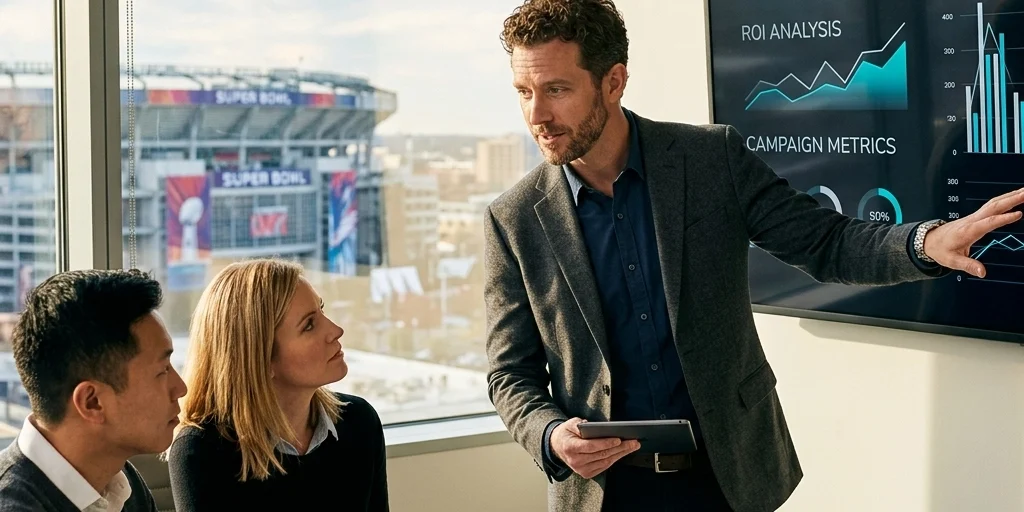
The dust has settled on Super Bowl LX, and while the scores are in the record books, the real winners aren't just the athletes on the field. In the high-stakes world of sports media, the 2026 Super Bowl represented a fundamental shift in how brands communicate with audiences. If you think the "win" was simply airing a funny 30-second commercial to 100 million people, you’re missing the most profitable part of the playbook.
At USA Entertainment Ventures LLC, we’ve been tracking these shifts closely. As we look back at the data from February, a clear pattern emerges: the most successful brands didn't just buy airtime; they built digital ecosystems. Under the leadership of our CEO, Dan Kost, we’ve consistently advocated for a "simple but deep" approach to marketing, and 2026 proved that complexity in the backend leads to simplicity in the user experience.
The $8 Million Entrance Fee: Why the "Spot" is Just the Beginning
By the time kickoff happened in 2026, the price for a 30-second advertisement had climbed to a staggering $8 million. To the casual observer, this seems like an astronomical risk. However, industry insiders know a secret that many experts don't want to broadcast: the primary value of a Super Bowl ad is no longer the immediate "reach" of the broadcast.
The real secret is the Retargeting Pool. When a brand airs a high-impact spot, they aren't just looking for a 30-second laugh. They are using that moment to tag over 100 million viewers with digital identifiers and cookies. This creates a precision marketing database that allows brands to follow up with highly specific ads for the next six months. The Super Bowl is essentially the world’s largest lead-generation event.

The Three-Phase Framework for Winning
The winners of 2026 followed a strict three-phase strategy that started weeks before the first whistle and continued long after the trophy was hoisted.
1. The Pre-Game Build (January 15 – February 7)
The most effective campaigns began nearly a month in advance. Experts utilized "teaser" content and digital out-of-home (OOH) displays to build narrative momentum. This phase was about establishing a "frequency of message." By the time the actual Super Bowl ad aired, viewers already felt a connection to the story. Data shows that brands utilizing a pre-game build saw a 56-64% increase in view rates compared to those who relied solely on the game-day spot.
2. Game-Day Multi-Screen Dominance
In 2026, over 80% of viewers were using a "second screen": usually a smartphone: while watching the game. The brands that won didn't fight for attention; they synced with it. Through a process called Contextual Syncing, AI-driven algorithms pushed related content, discount codes, and interactive AR experiences to social feeds at the exact moment the TV commercial aired. This ensured that even if a viewer looked down at their phone, the brand was already there waiting for them.
3. Post-Game Saturation (February 9 – February 15)
The conversation doesn't end on Sunday night. The week following the game is a goldmine for engagement. Successful brands extended their messaging through continued digital placements and social interactions, capitalizing on the cultural highlights and "water cooler" moments.

The Super Bowl Playbook: Sports Media's Advertising Strategy
To understand the technical side of how these media buys are structured, it's helpful to look at the broader landscape of sports media. Watch the video below to see how the industry's top minds approach the "Big Game" strategy.
https://www.youtube.com/watch?v=l6J-0zileKE
AI Personalization: The Secret Weapon
One of the most guarded secrets of the 2026 season was the use of AI-driven personalization. While the national television audience saw a "general" version of a commercial, streaming viewers on platforms like Peacock or Paramount+ were served "variable data" versions.
This means that while the celebrity spokesperson remained the same, the background, the product variety, and the call-to-action were tailored to the viewer's specific demographic. A viewer in a rural area might see a truck ad featuring a rugged landscape, while an urban viewer saw the same truck in a city setting. This "one size fits millions" approach maximizes the ROI of an $8 million investment by making the content feel local and personal.
Authentic Content vs. Celebrity Hype
For years, the Super Bowl was about which brand could hire the biggest movie star. While celebrities still played a role in 2026, the focus shifted toward authentic storytelling.
Take the example of Carl’s Jr. and their partnership with influencer Alix Earle. Instead of a traditional, over-produced commercial, they focused on behind-the-scenes, "lo-fi" content that felt genuine to the audience. This strategy resulted in a 91% follower growth and a 47% engagement rate: metrics that often outperform traditional celebrity endorsements. This proves that business owners don't need the biggest budget; they need the most resonant message.

Proximity Marketing and the "Brand Bubble"
In the host city, the advertising strategy went beyond digital screens. Brands "blanketed" the city with digital billboards that integrated mobile proximity messaging.
When a fan walked past a specific digital billboard, their smartphone would receive a GPS-triggered notification that complemented what they were seeing on the screen. This created a localized "brand bubble," making the company seem omnipresent. This level of technology integration is no longer a futuristic concept: it is the current standard for high-tier events.
Data-Driven Results: The Numbers Behind the Magic
To justify an $8 million spend, the metrics must be airtight. In 2026, we saw some of the most efficient cost-per-click (CPC) and view rates in history:
- Influencer-driven campaigns achieved up to 70% CPLC (Cost Per Lead/Click) efficiency on Meta platforms.
- Skippable digital campaigns maintained a 64-70% view rate throughout the month of February.
- Contextual targeting around NFL and sports-related content saw a 30% higher conversion rate than general interest targeting.

Actionable Takeaways for Your Business
You might not have an $8 million budget, but you can use the same principles that the giants used in Super Bowl 2026 to grow your own brand:
- Don't Post and Ghost: Whether it’s a social media ad or a local event, create a three-phase plan (Pre, During, Post).
- Focus on the Second Screen: Assume your customer is distracted. How can you meet them on their phone while they are engaged with something else?
- Leverage Retargeting: The first interaction is just the handshake. Use digital tools to follow up with people who have shown interest in your content.
- Prioritize Authenticity: You don't need a Hollywood production. Clear, simple, and honest communication often wins over high-glitz marketing.
Looking Forward
As we move toward 2027 and beyond, the line between media and reality will continue to blur. The lessons of Super Bowl 2026 tell us that the future of advertising isn't about shouting louder; it's about being smarter. It’s about using data to provide value and using technology to create a seamless connection with the consumer.
At USA Entertainment Ventures LLC, we believe that every business has the potential to execute a "Super Bowl quality" strategy on a scale that works for them. By focusing on simple, effective communication and leveraging the latest in media technology, you can turn every marketing moment into a long-term win.
For more insights into the intersection of business, entertainment, and strategy, explore our latest news or check out our specialized consulting services in events and international business management. The game has changed( are you ready to play?)





