
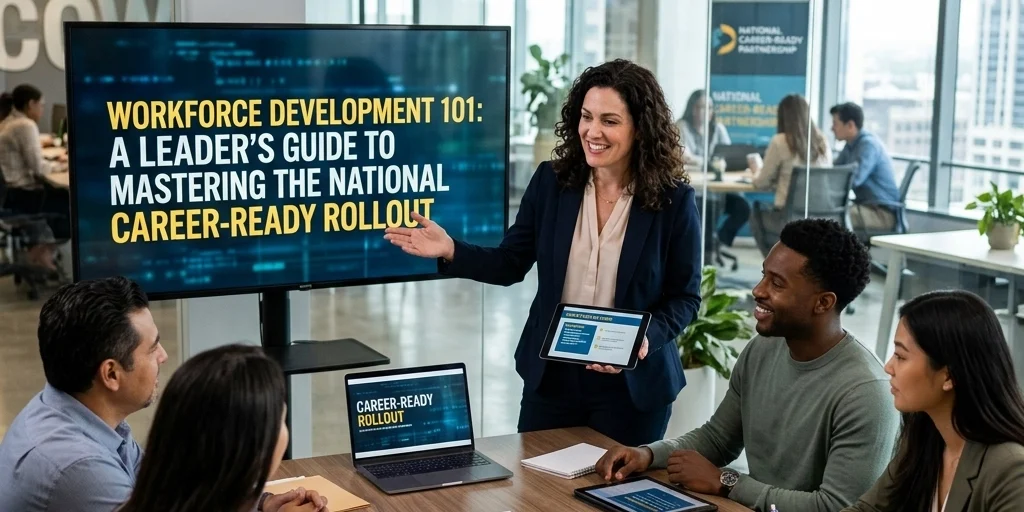
In the current global economic landscape, the traditional pipelines for talent acquisition are undergoing a seismic shift. For Fortune 100 executives, the challenge is no longer just finding employees; it is the urgent need to architect a sustainable, national infrastructure for career readiness. The gap between academic output and industrial requirements has widened, leaving a vacuum that only a sophisticated, integrated approach to workforce development can fill.
The "National Career-Ready Rollout" represents more than a series of training programs; it is a comprehensive strategy to deploy physical and digital infrastructure across the country to ensure the American workforce is prepared for the demands of the fourth industrial revolution. From AI literacy to cloud computing and high-stakes logistics, the blueprint for the next decade of American productivity is being drawn today.
The Infrastructure of Opportunity: A Physical Distribution Model
Most discussions regarding workforce development focus heavily on software: online courses, digital certifications, and virtual modules. However, true career readiness requires a physical footprint. To scale a national rollout, we must view workforce development through the lens of a distribution system.
Just as a supply chain moves goods from a manufacturer to a consumer, a career-ready infrastructure must move knowledge and practical skills from centers of excellence to local communities. This requires a robust physical network of training hubs, mobile learning units, and "smart" facilities that mirror the environments of modern industry. At USA Entertainment Ventures LLC, we recognize that the integration of digital tools with physical assets is the only way to achieve the scale necessary for national impact.
By treating workforce development as a logistics challenge, leaders can leverage existing distribution networks and manufacturing hubs to deliver high-level technical training to underserved regions. This "physicality of learning" ensures that workers are not just reading about technology but are operating the hardware and systems that drive the modern economy.

The "Trojan Horse": Esports as a Gateway to Cloud and AI Literacy
One of the most innovative components of the national rollout is the strategic use of competitive gaming, or esports, as a "Trojan Horse" for technical literacy. To the casual observer, esports is a form of entertainment; to the strategic leader, it is a high-performance laboratory for cloud computing, low-latency networking, and artificial intelligence.
The infrastructure required to support elite esports: dedicated servers, edge computing, complex data analytics, and real-time broadcast integration: is identical to the infrastructure powering modern corporate data centers. By engaging the next generation through a medium they already embrace, we are creating a seamless entry point into the most critical sectors of the economy.
- Cloud Computing: Managing a global esports tournament requires an intimate understanding of cloud architecture and server management.
- AI Literacy: Competitive players and coaches increasingly use AI-driven analytics to optimize performance, providing early exposure to data-driven decision-making.
- Hardware Maintenance: High-end gaming rigs require the same troubleshooting and maintenance skills as industrial server blades.
This strategy effectively lowers the barrier to entry for complex technical fields. When a young adult learns to optimize a network for a competition, they are inadvertently training for a career in network administration or cybersecurity. For executives, this means the future talent pool is already developing high-value skills in their leisure time; the goal of the national rollout is to formalize and certify that expertise.
Scaling the National Career-Ready Infrastructure
Mastering the rollout requires a multifaceted approach that spans multiple industries. It is not enough to focus on a single sector; the goal is a cross-functional ecosystem where human resources strategies align with technological advancements.
1. Standardized Competency Metrics
The rollout relies on a shift from degree-based hiring to competency-based hiring. The National Career Readiness Certificate (NCRC) and similar credentials provide a portable, data-backed proof of skill that holds value across state lines and industry sectors. For a Fortune 100 company, this standardization reduces the risk of "bad hires" and streamlines the onboarding process.
2. The Integration of Logistics and Education
The trucking and logistics sector plays a pivotal role in this rollout. Mobile training labs: outfitted with the latest in VR/AR training technology and AI-driven simulators: can be deployed to any location, bringing the classroom to the workforce rather than requiring the workforce to relocate to the classroom. This agile distribution of education is essential for reaching rural and industrial heartlands.

3. Public-Private Partnerships
No single entity can solve the talent gap. The national rollout is fueled by collaboration between government agencies and private sector leaders. These partnerships ensure that the skills being taught are those that are actually in demand, preventing the "skills mismatch" that has plagued workforce initiatives in the past.
The Strategic Role of Business Consulting in Workforce Evolution
Implementing these large-scale changes requires sophisticated business consulting. Leaders must navigate the complexities of organizational change, technology adoption, and capital allocation. This is where strategic oversight becomes critical.
At the executive level, the focus should be on the ROI of readiness. A career-ready workforce reduces turnover, lowers training costs, and increases the speed of innovation. By investing in the national infrastructure today, companies are essentially "future-proofing" their operations against the labor shortages and technical shifts of tomorrow.
Furthermore, the media and advertising components of this rollout cannot be ignored. To attract the best talent, companies must use modern communication strategies to rebrand technical and vocational roles as high-status, high-tech career paths. This is particularly relevant in sectors like sports advertising, where the crossover between competition and career preparation is most visible.
Data-Driven Decisions: The Research Behind the Rollout
Our approach is grounded in comprehensive research. Studies consistently show that companies that adopt early-stage workforce development initiatives see a 15-20% increase in operational efficiency within the first three years. This is driven by a workforce that is not only technically proficient but also highly adaptable to new technologies as they emerge.
The national rollout emphasizes "lifelong learning" infrastructure. The goal is to move away from the "one-and-done" education model and toward a continuous feedback loop where workers can regularly upgrade their skills in response to real-time market data. This ensures that the American workforce remains the most competitive in the world, regardless of how fast the technological landscape changes.

Future-Focused: The Path Forward
As we look toward the end of the decade, the success of the National Career-Ready Rollout will be measured by our ability to integrate these disparate systems into a unified whole. It is a massive undertaking, but for the leaders of the nation’s largest enterprises, it is a necessary one.
The transition from a traditional economy to one powered by cloud, AI, and sophisticated logistics is already underway. By leveraging the "Trojan Horse" of esports, the efficiency of physical distribution networks, and the rigor of standardized competency metrics, we can ensure that every worker has the opportunity to be "career-ready."
For more information on how to integrate these strategies into your corporate framework, explore our project portfolio or learn more about our work in digital transformation. The future of the American workforce is being built now, and the leaders who master this rollout will be the ones who define the next century of global business.

Actionable Takeaways for Executives:
- Audit Your Technical Pipeline: Evaluate how your current talent acquisition strategy leverages non-traditional skills, such as those found in the esports ecosystem.
- Invest in Physical Training Assets: Look beyond software and consider how mobile or local physical hubs can improve training outcomes.
- Prioritize Competency Standards: Adopt nationally recognized credentials to ensure your workforce meets a standardized level of excellence.
- Engage in Cross-Sector Collaboration: Work with government and consulting partners to align your internal training with national infrastructure goals.
The National Career-Ready Rollout is a call to action. It is an invitation to lead, to innovate, and to build a workforce that is not just ready for the jobs of today, but prepared for the challenges of tomorrow. At USA Entertainment Ventures LLC, we are committed to being the catalysts for this change, ensuring that American enterprise remains synonymous with excellence and opportunity.





