
If you grew up anytime between the mid-80s and the early 2010s, you likely have a very specific sensory memory of the "computer lab." It was a room that smelled faintly of ozone and industrial carpet, filled with rows of beige towers or glowing iMacs, all facing a single whiteboard where a teacher struggled to explain how to properly save a document to a floppy disk (or later, a thumb drive). It was a factory-style layout for a factory-style era of learning.
But walk into a modern university or a cutting-edge corporate training center today, and you might find that the "lab" has vanished. In its place is something sleeker, more modular, and infinitely more effective: The Pod.
At USA Entertainment Ventures LLC, we spend a lot of time looking at how physical infrastructure dictates human performance. Whether we are consulting on entertainment management or modern business workflows, one thing is clear: the environment determines the output. The traditional computer lab is on life support, and for the next generation of cybersecurity pros, logistics experts, and content creators, the "Pod" is the new center of the universe.
The Eulogy for the Row-and-File Lab
Why are computer labs dying? It wasn’t a sudden murder; it was a slow, logical evolution. According to recent IT data, approximately 95% of students and young professionals now carry their own laptops or high-powered tablets. This "Bring Your Own Device" (BYOD) culture effectively turned every backpack into a mobile computer lab.
Furthermore, the rise of cloud-based software licensing (SaaS) and home-use licensing means that the specialized, $5,000 workstations that used to be tethered to a specific desk in a specific room are no longer a necessity for most. When you can run a full Adobe Creative Suite or a virtual machine environment from a browser, the physical "anchor" of the old-school lab becomes a literal ball and chain.
The COVID-19 pandemic acted as the final catalyst. When campuses and offices shut down, the world realized that productivity didn’t require being bolted to a specific desk. Remote access solutions became the standard, and when people finally returned to physical spaces, they realized they didn't want the "factory model" anymore. They wanted a "studio model."

Enter the Pod: Not Just a Layout, But a Philosophy
So, what exactly is a "Pod"? Unlike the traditional lab, where students or employees sit in rows facing a wall or the back of someone else's head, pods are modular, collaborative hubs.
A typical pod consists of a round or hexagonal table equipped with shared monitors, integrated power hubs, and often, "screen-mirroring" technology that allows any person at the table to throw their screen onto a central display. The walls are usually replaced by mobile whiteboards or glass surfaces that can be written on.
This design shifts the focus from passive consumption (looking at a teacher) to active collaboration (looking at each other). This isn't just about aesthetics; it's about preparing people for the way modern work actually happens.
Why Cybersecurity Pros are Moving In
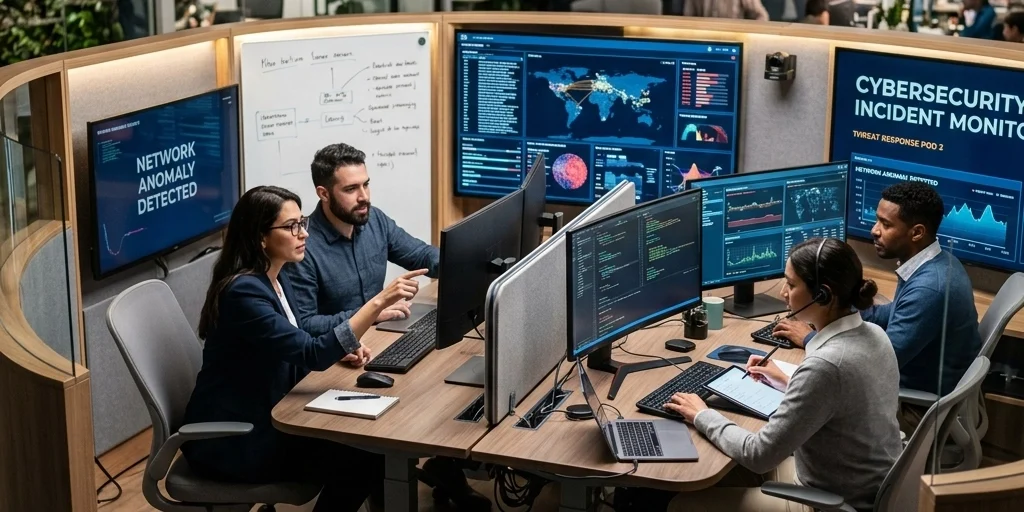
If there is one field where the "Pod" model is absolutely essential, it is cybersecurity. The image of a cybersecurity professional as a lone wolf in a dark basement wearing a hoodie is a Hollywood myth. Real-world cybersecurity is a team sport.
When a major data breach occurs or a "Red Team vs. Blue Team" simulation is underway, communication is the primary weapon. Traditional computer labs fail here because they are anti-social by design. You can’t effectively coordinate a defense strategy against a simulated ransomware attack if you have to stand up and walk down an aisle to show your teammate a line of code.
In a Pod environment:
- Real-time Threat Intelligence Sharing: Analysts sit face-to-face. When one spots an anomaly, they can instantly share their screen with the rest of the pod for a collective "sanity check."
- Simulation Agility: Pods allow for the creation of "war rooms." This mimics the Security Operations Center (SOC) environments found in major corporations.
- Soft Skills Development: Cybersecurity is 50% technical and 50% communication. Pods force pros to articulate their findings and collaborate under pressure: skills that are impossible to build in a silent, row-based lab.
For those looking into career pathways in this sector, understanding that the job is collaborative is key. We often guide clients at https://usaentertainmentventures.com toward understanding that technical talent needs the right environment to flourish.

Logistics and the Architecture of Efficiency
The transition to pods isn’t just for the "hackers." The logistics industry: an often-overlooked backbone of the global economy: is undergoing a similar transformation.
Modern logistics is no longer about just moving boxes; it’s about managing massive streams of data in real-time. Whether it's tracking a fleet of autonomous trucks or managing a global supply chain during a crisis, the work requires a "command center" approach.
Pods function as miniature command centers. They allow logistics coordinators to monitor different segments of the supply chain simultaneously while remaining in constant physical proximity to their team. In a world where a 15-minute delay in communication can cost a company millions in shipping fees, the proximity afforded by a pod layout isn't just a "nice to have": it’s a financial necessity.
The Content Creation Hub: Beyond the Desktop
We see the same trend in content creation. The days of a single editor sitting in a dark room for fourteen hours are fading. Today’s content: be it for social media, streaming, or large-scale entertainment ventures: is highly iterative and collaborative.
A pod for content creators might include a high-end rendering station shared by a small team, a dedicated area for "dailies" (reviewing the day's footage), and a space for collaborative brainstorming. This "studio model" encourages the cross-pollination of ideas. An editor, a colorist, and a sound designer sitting in a pod can produce a finished product significantly faster than three people working in isolated cubicles.
For more information on how we view the intersection of entertainment and business infrastructure, you can explore our portfolio and insights at https://usaentertainmentventures.com/logosliderwp/zoomedia.

The Digital Divide and the Remaining Need for Labs
While we are bullish on the "Pod" revolution, we have to acknowledge the elephant in the room: the digital divide.
Traditional labs still serve a vital purpose for those who don't have access to high-speed internet or high-powered hardware at home. For these individuals, a dedicated lab is a lifeline. However, even these "equity-focused" labs are beginning to adopt pod-like structures. Instead of providing rows of PCs, they provide "docking pods" where users can bring a low-cost laptop and plug into a high-performance ecosystem.
The goal isn't necessarily to eliminate the "room with computers," but to eliminate the "room where people work in silos."
Looking Forward: The Future is Modular
As we look toward the future of work and education, the "Pod" is just the beginning. We are moving toward environments that are "hyper-flexible." Imagine a room where the furniture is on tracks, the walls are screens, and the layout can change from a cybersecurity war room to a logistics command center in under five minutes.
For businesses, the takeaway is simple: stop investing in furniture that forces your employees to look away from each other. For professionals, the takeaway is equally clear: your value isn't just in how well you can use a computer, but in how well you can use a computer while interacting with your team.
The computer lab isn't dead: it's just evolved. It shed its beige skin, broke out of its rows, and became a hub for the most exciting careers of the 21st century.
At USA Entertainment Ventures LLC, we believe in this evolution. We believe that by creating spaces that favor collaboration over isolation, we are not just building better offices; we are building a more resilient, creative, and secure future.
To see more about how we’re helping businesses adapt to these shifts, check out our latest updates and resources at https://usaentertainmentventures.com/page-sitemap.xml.

About the Author:
Dan Kost is the CEO of USA Entertainment Ventures LLC. With decades of experience in business consulting and entertainment management, he focuses on the intersection of physical infrastructure and human potential. He believes that the best way to predict the future is to build the environment where it will happen.





