
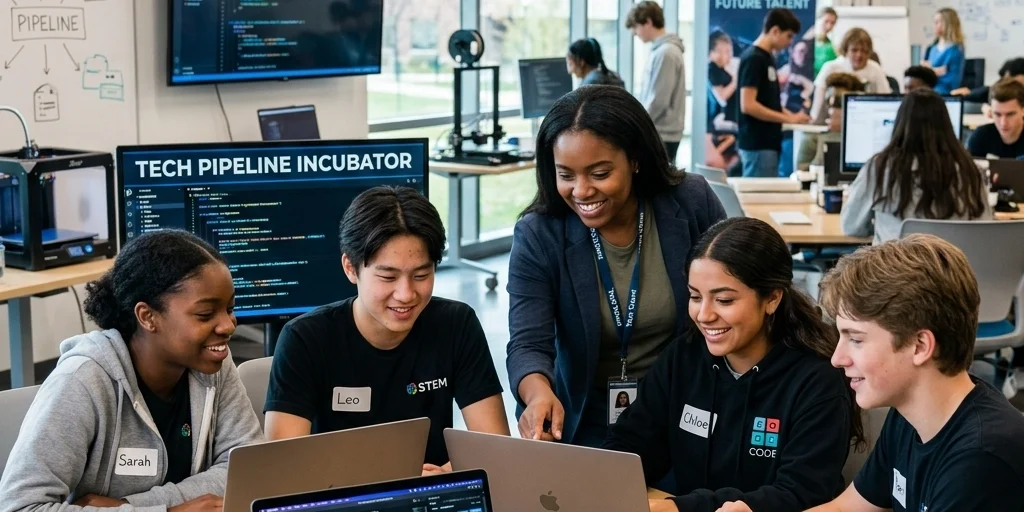
The global landscape of talent acquisition is undergoing a fundamental shift. For decades, the standard procedure for technology companies was to wait at the end of the university "conveyor belt," competing for a limited pool of computer science graduates. However, as we move further into 2026, it has become clear that this reactive approach is no longer sufficient. The demand for specialized skills in Cloud Computing, Artificial Intelligence (AI), and Data Analytics has far outpaced the traditional supply.
To secure a sustainable future, businesses must move their recruitment efforts further upstream. The next-gen talent funnel no longer begins at the college career fair; it begins in the high school classroom. Building an early pipeline is not just a philanthropic gesture: it is a strategic business necessity.
The Great Talent Squeeze
The technology sector is currently facing what many experts call "The Great Talent Squeeze." While the number of tech roles continues to grow exponentially, the number of qualified applicants is not keeping pace. This is particularly true in emerging fields. AI and Data Analytics are no longer "fringe" departments; they are the core infrastructure of modern business.
When companies wait until students are 21 or 22 years old to engage them, they are fighting for the same 5% of top-tier graduates as every other Fortune 500 company. This drives up acquisition costs and leads to high turnover as candidates are constantly lured away by slightly higher offers. By shifting the focus to high schools, companies can build brand loyalty and technical awareness years before a student even fills out a college application.

Understanding the Talent Funnel: Awareness, Engagement, Recruitment
Effective talent development can be broken down into three distinct phases. Research into early-talent development suggests that most employers fail because they focus almost exclusively on the final stage: recruitment.
- Awareness: This is the phase where a student first learns that a career path exists. Many high schoolers have heard of "tech," but they may not understand what a Cloud Architect or a Data Ethicist actually does. If they don't see it, they can't be it.
- Engagement: This involves hands-on interaction. Whether through workshops, job shadowing, or mentorship, engagement allows a student to apply what they are learning in school to a real-world business context.
- Recruitment: This is the final step where a student enters an internship or an entry-level role.
High schools are the critical venue for the Awareness and Engagement phases. According to industry data, students who are exposed to professional environments before the age of 18 are significantly more likely to pursue those fields in higher education and their subsequent careers. By the time a student reaches college, their career trajectory is often already set. If your company wasn't part of the "Awareness" phase, you are already behind.
Why High Schools are the Ideal Tech Hub
High schools represent the last opportunity to shape career decisions before students enter the specialized world of higher education or the professional workforce. There are several reasons why they are the ideal hub for tech talent:
1. Hands-on Learning and CTE
Modern high schools have moved beyond traditional rote memorization. Career and Technical Education (CTE) programs are now more robust than ever. These programs provide students with technical skills that are often more current than what is found in university curricula, which can take years to update. High school students are often more agile and open to learning the latest iterations of AI frameworks or Cloud deployment strategies.
2. Diversifying the Pipeline
Wait-and-see recruitment models often result in a lack of diversity. Students from under-resourced communities may not have the professional networks to find their way into tech roles through traditional means. By establishing a presence in local high schools, businesses can reach a broader, more diverse group of students, providing them with the career-ready infrastructure necessary to succeed.
3. Lowering Long-term Costs
The cost of training a high school intern or supporting a school program is a fraction of the cost of a headhunter fee or a lost productivity gap caused by a vacant senior role. Early pipeline building is an investment that pays dividends in the form of a prepared, loyal workforce that understands your company culture from day one.

The Core Pillars: Cloud, AI, and Data Analytics
When engaging with high schools, the focus should remain on foundational technologies that will define the next decade of business.
- Cloud Computing: The world is moving away from on-premise hardware. Students need to understand the logic of distributed systems. High school programs that offer certifications in major cloud platforms give students a massive head start.
- Artificial Intelligence: AI is the most transformative technology of our era. Companies need talent that doesn't just "use" AI, but understands how to prompt, manage, and audit it. Introducing high schoolers to the ethics and mechanics of AI ensures they enter the workforce with a critical eye.
- Data Analytics: Every business decision is now data-driven. Teaching students how to interpret data, identify trends, and visualize information is essential. These are not just "tech" skills; they are fundamental literacy skills for the 2020s.
Practical Steps for Companies to Engage
Many organizations want to help but don't know where to start. Engaging with high schools does not require a massive budget, but it does require consistency and a long-term mindset.
Guest Speaking and Mentorship
The simplest way to start is by sending your current engineers, data scientists, and cloud architects into schools. A one-hour presentation can be the spark that changes a student’s life. When students see "real people" doing these jobs, the industry feels accessible rather than intimidating.
Internship and Shadowing Programs
High school internships are becoming increasingly popular. These are not about having a student fetch coffee; they are about providing real-world exposure. Even a week-long "job shadow" program can provide a student with enough insight to commit to a tech major in college.
Curriculum Support
Many teachers are eager to bring industry standards into the classroom but lack the resources. Providing schools with access to the same tools your team uses: whether that’s cloud credits or data visualization software: ensures that the students are learning relevant skills.

The Strategic Continuity of the Pipeline
It is helpful to think of the talent pipeline as a bridge. While elementary and middle schools focus on building curiosity and a general interest in STEM, high schools are where that interest is converted into concrete workforce readiness.
If your organization is looking to scale, you must consider the "Awareness Problem." If a student never hears about your industry, never meets a professional in your field, and never sees themselves in that work, they are unlikely to pursue it. High schools provide the venue where you can systematically build this awareness.
Moving Toward a Sustainable Workforce
The traditional "hire-and-fire" or "wait-and-recruit" models are reaching their expiration date. They are expensive, inefficient, and fail to address the root cause of the talent shortage. The solution lies in proactive business consulting and strategic community engagement.
By investing in high school pipelines today, companies are doing more than just filling future roles. They are contributing to a more robust economy, providing opportunities for the next generation, and ensuring that the technological advancements of the future are led by a diverse and well-prepared workforce.
The companies that will lead in 2030 are the ones that are walking into high school classrooms in 2026. They aren't looking for who is ready to work today; they are looking for who they can help prepare for tomorrow. Early pipeline building isn't just a strategy: it's a commitment to the future of work.
Actionable Takeaways for Leadership
- Audit Your Entry Points: Look at your current junior-level hires. Where did they come from? If 100% are from the same three universities, your pipeline is at risk.
- Partner Locally: Identify high schools within your company's geographic footprint. Reach out to the CTE coordinators or STEM department heads.
- Focus on Skills, Not Just Degrees: Evaluate whether certain roles in your organization could be filled by individuals with high-quality technical certifications rather than four-year degrees.
- Measure Long-term ROI: Track the retention rates and performance of hires who engaged with your brand early versus those hired through traditional recruitment.
The transition from reactive hiring to proactive pipeline building requires a shift in mindset. However, the data is clear: the earlier you engage, the stronger your workforce will be. High schools are no longer just for basic education; they are the most important talent hubs in the modern economy.





