
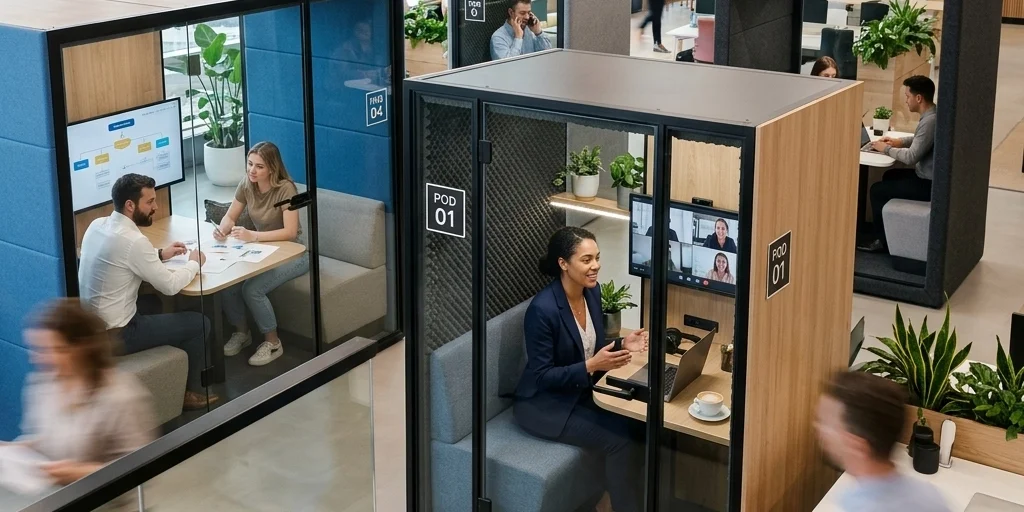
Remember the computer labs of the 1990s? Rows of bulky beige monitors, the rhythmic hum of cooling fans, and the unmistakable scent of ozone and carpet cleaner. For a generation, that was the "digital workplace." But as we navigate the mid-2020s, the physical landscape of work has undergone a radical transformation. The beige monitors are gone, replaced by something far more sleek, modular, and frankly, much cooler: The Pod.
At USA Entertainment Ventures LLC, we spend a lot of time thinking about how physical infrastructure dictates economic opportunity. If you want to understand where the workforce is heading by 2026 and beyond, you have to look inside the box. Or rather, the Pod.
What Exactly is a Pod? (And No, It’s Not for Coffee)
When we talk about "Pods" in the modern professional context, we aren't talking about laundry detergent or something you pop into an espresso machine. We are talking about self-contained, acoustic-controlled, technology-integrated physical units. They are the evolution of the "computer lab," designed for a world that is mobile, decentralized, and highly specialized.
Think of a Pod as a "Career in a Box." Whether it is a single-person focus booth or a multi-person collaborative suite, these structures provide the career-ready infrastructure that modern professionals need to actually get things done without the distraction of a coworker's loud lunch or a sudden office ping-pong tournament.
The Anatomy of a Modern Pod
A high-end professional pod isn't just a glass closet. It’s a feat of engineering that typically involves:
- Acoustic Insulation: Multi-layered soundproofing to keep the world out (and your secrets in).
- Climate Control: Integrated HEPA filtration and silent ventilation.
- Smart Lighting: Biophilic lighting setups that adjust based on the time of day to prevent eye strain.
- Universal Connectivity: High-speed fiber integration, USB-C power delivery, and often, satellite-link redundancy.

Why the "Pod" is the New Computer Lab
In the old days, you went to the computer lab because that’s where the "power" was. You needed the lab's mainframe or its T1 line. Today, the power is in your pocket, but the environment is the scarce resource.
The new "computer lab" isn't a room filled with computers; it’s a distribution of Pods across a campus, a city, or even a retail space. This shift is creating entirely new career pathways. If you’re looking to future-proof your career, you shouldn't just be looking at software; you should be looking at the logistics, security, and content created within these physical units.
Career Pathway #1: The Logistics of the Modular World
You can’t just "download" a physical workspace. One of the most significant career opportunities in the next five years lies in the physical distribution and management of these units.
Logistics in the Pod era isn't just about driving a truck. It’s about Infrastructure Deployment Management. Companies are no longer signing 20-year leases on massive office buildings. Instead, they are deploying fleets of Pods to where their workers actually live. This requires:
- Modular Assembly Experts: Professionals who understand the structural integrity and rapid deployment of modular tech.
- Smart Asset Management: Using IoT to track the health, air quality, and usage patterns of Pods across a global network.
- Strategic Placement Consulting: Deciding where to drop these "workforce anchors" to maximize productivity and minimize commute times.
As our CEO Dan Kost often says, the future belongs to those who can bridge the gap between digital dreams and physical reality. You can find out more about how we approach these logistics on our Services page.
Career Pathway #2: Cybersecurity and the Physical "Safe Room"
We often think of cybersecurity as something that happens entirely in the cloud. However, as deepfakes and sophisticated social engineering become more prevalent, the physical environment where you access data becomes a security vulnerability.
Enter the Hardened Pod. In the new digital workplace, Pods serve as the ultimate "Zero Trust" environment.
- Biometric Entry: Pods that only unlock when they recognize your retina or fingerprint.
- Signal Shielding: Faraday-cage technology integrated into the Pod walls to prevent electronic eavesdropping (TEMPEST protection).
- Local Data Scrubbing: Physical nodes that ensure no data leaves the Pod's local hardware unless it's encrypted and authorized.
For cybersecurity professionals, the Pod represents a new frontier: Physical-Digital Convergence. Ensuring that a remote worker in a Pod in a shopping mall is as secure as a banker in a vault is a high-stakes career path that is only growing.

Career Pathway #3: Content Creation and the "Studio-in-a-Box"
Perhaps the most visible use of Pods is in the creator economy. We’ve all seen the "podcast booths" in airport terminals or co-working spaces. But by 2026, this has evolved far beyond just recording a quick interview.
Pods have become the standardized "set" for the global workforce. Whether you are an educator, a digital marketer, or a corporate trainer, the Pod provides a controlled environment for high-fidelity content creation.
- Lighting Specialists: Designing the perfect "three-point" setup within a 4×4 space.
- Acoustic Engineers: Ensuring that even in a noisy environment, your audio sounds like a professional studio.
- Virtual Reality Integration: Using Pods as the physical boundary for VR/AR workspaces, providing haptic feedback and safe movement zones.
This isn't just for influencers. Every modern professional is now, to some extent, a content creator. If your video calls look like you're filming from a cave, you're at a competitive disadvantage. The Pod levels the playing field.
Building the Future: USA Entertainment Ventures LLC’s Perspective
At USA Entertainment Ventures LLC, we see Pods as more than just furniture. We see them as a fundamental component of Business Consulting for the modern age. When we consult with clients, we don't just talk about their digital strategy; we talk about their physical footprint.
If your organization is still trying to force people into open-plan offices, you’re essentially asking them to work in a 1920s factory while trying to solve 2026 problems. Transitioning to a Pod-based infrastructure allows for:
- Scalability: Need more office space? Add a Pod. Moving locations? Take the Pod with you.
- Employee Retention: Providing a "private sanctuary" is one of the highest-rated benefits in the modern workforce.
- Sustainability: Modular Pods are significantly more eco-friendly than traditional office renovations, often using recycled materials and drawing less power for climate control.

Actionable Steps: How to Transition
If you're a business owner or a professional looking to dive into this world, here is how you can start:
- Audit Your Noise: Identify the tasks in your day that require "Deep Work." If you don't have a dedicated acoustic space for them, a Pod is your next logical investment.
- Look for Modular Opportunities: Before signing a long-term lease, explore the cost-benefit of modular infrastructure. Check out our Showcase to see how physical distribution is changing the game.
- Train for the Physical-Digital Gap: If you’re in IT or HR, start learning about the logistics of "decentralized physical assets." It’s a skill set that will be in high demand.
Conclusion: The Box is Your Launchpad
The digital workplace is no longer a "place" you go, it’s an environment you inhabit. The Pod represents the ultimate synthesis of our need for privacy and our requirement for hyper-connectivity. It is the new computer lab, the new private office, and the new production studio all rolled into one.
Success in the modern era isn't about thinking outside the box; it's about realizing that the right box, the right Pod, can be the launchpad for your entire career.
Are you ready to rethink your infrastructure? Whether you're curious about the logistics of deployment or need a roadmap for your business's physical future, we’re here to help. Contact us today to start the conversation.
Disclaimer: The information provided in this post is for educational and consulting purposes and does not constitute a specific endorsement of any single manufacturer. For more details, please see our Disclaimer.





