
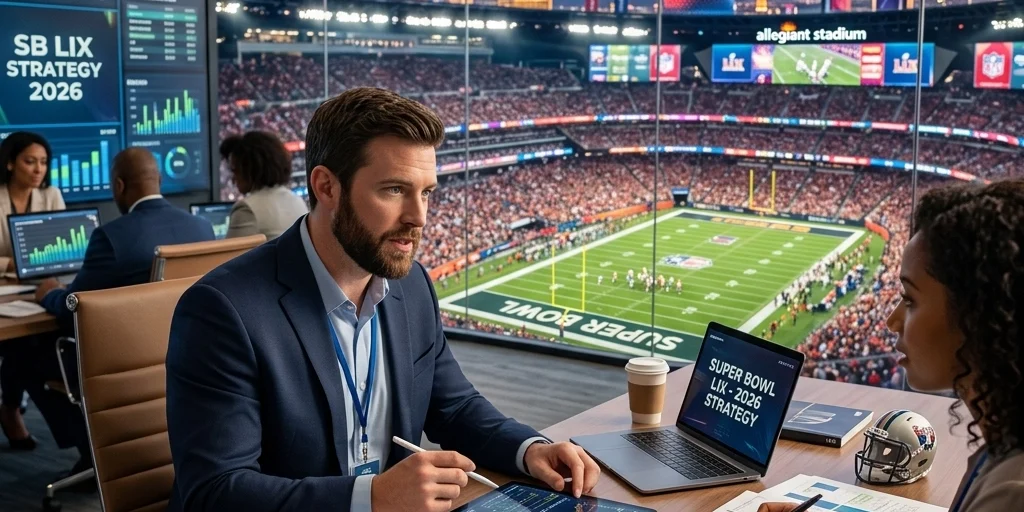
As we move through the second quarter of 2026, the marketing landscape is still vibrating from the aftershocks of Super Bowl LX. For businesses and brands, the "Big Game" is no longer just a single Sunday in February; it has evolved into a year-round masterclass in attention management, digital integration, and narrative equity. At USA Entertainment Ventures LLC, we’ve watched the traditional playbook get shredded and rewritten.
Whether you are looking back at what worked earlier this year or planning your offensive for the 2026-2027 season, understanding the mechanics of a modern sports media strategy is essential. Success in this arena isn't just about who has the biggest budget: it’s about who has the smartest framework.
The Three-Phase Strategic Framework
In the world of business consulting, we often see companies pour their entire budget into a single "hail mary" moment. However, the data from 2026 shows that the most successful campaigns followed a rigorous three-phase approach. This framework ensures that your brand isn't just a flash in the pan but a sustained topic of conversation.
Phase 1: The Pre-Game Build (January – Early February)
The momentum for a successful Super Bowl strategy begins long before kickoff. In 2026, we saw a massive shift toward "Narrative Equity." Brands began partnering with elite athletes during the playoff run to create "Road to the Championship" content series.
By building a "warm" audience in January, these brands significantly lowered their customer acquisition costs (CAC). When the actual game arrived, the audience was already invested in the story. On digital platforms, launching pre-game campaigns early allowed businesses to take advantage of lower costs per click (CPCs) before the market became saturated in mid-February.
Phase 2: Game Day Agility
Game day is about second-screen dominance. While traditional television commercials remain a staple, the real battle in 2026 was fought on mobile devices. As viewers check their phones during commercial breaks or halftime, they are looking for real-time reactions.

Successful execution on game day requires a "war room" mentality: being ready to react to viral moments, controversial calls, or spectacular plays in real-time. This agility allows a brand to feel "human" and connected to the cultural zeitgeist, rather than just another corporate entity pushing a product.
Phase 3: Post-Game Saturation
The week following the Super Bowl is often the most overlooked opportunity for conversion. In 2026, the winners were the ones who didn't stop the clock at the final whistle. They used the "Post-Game Saturation" phase to retarget anyone who engaged with their ads, turning peak engagement into tangible customer relationships. This is where the long-tail ROI is truly found.
The Power of Sports Media and Advertising Strategy
To truly understand how these phases come together, you have to look at the underlying media strategy. We’ve curated a deep dive into the "Super Bowl Playbook" that explores how sports media has shifted its advertising tactics to accommodate a more fragmented audience.
Check out this detailed breakdown of the strategy in action:
https://www.youtube.com/watch?v=l6J-0zileKE
This video highlights why infrastructure matters: not just in physical distribution, but in how digital content is delivered to the end user. At USA Entertainment Ventures LLC, we believe that career-ready infrastructure is the backbone of any successful large-scale marketing campaign.
The Rise of NIL and Athlete Influencers
Perhaps the biggest trend of 2026 has been the total integration of Name, Image, and Likeness (NIL) into professional-level marketing. We are no longer just looking at celebrity endorsements; we are looking at athlete-driven content engines.
Athletes are now their own media houses. A brand that partners with an athlete doesn't just get a face for a billboard; they get access to a loyal, highly engaged community. In 2026, athletes shared behind-the-scenes footage, personal workout routines, and real-time game reactions that outperformed polished TV spots in terms of direct engagement.
By using athlete-specific promo codes and tracked links, brands were able to measure direct ROI with surgical precision. This level of data-driven marketing has made the sports media landscape more transparent and accountable than ever before.

Platform-Specific Tactics for 2026
You cannot treat every social media platform the same. The "spray and pray" method of content distribution is dead. To succeed in 2026, your strategy must be tailored to the specific behavior of each platform’s users.
- YouTube: This remains the king of long-form context. In the three weeks leading up to the Big Game, YouTube campaigns targeting NFL-specific content saw view rates between 56% and 64%. During the game window, skippable campaigns reached as high as 70%. YouTube is where fans go for analysis and deep dives.
- Meta (Instagram & Facebook): These platforms are the home of User-Generated Content (UGC). Campaigns that utilized influencers to create relatable, non-polished content saw a 70% increase in cost-per-lead efficiency.
- TikTok: This is the viral engine. TikTok is where "moments" are born. If your brand didn't have a plan for real-time TikTok reactions in 2026, you likely missed out on the youngest and most energetic segment of the audience.
Targeting the Modern Fan: Hardcore vs. Casual
A common mistake in Super Bowl strategy is treating the audience as a monolith. In reality, you are talking to two very different groups:
- The Hardcore Fan: They are interested in stats, fantasy football, and deep tactical analysis. They are reached through 360 Sports Media channels and niche sports publications.
- The Casual Viewer: They are there for the spectacle, the food, and the halftime show. They are reached through sports-adjacent marketing: think food bundles, watch-party deals, and lifestyle branding.
Balancing your message to appeal to both: without diluting your brand: is the hallmark of a professional business consulting approach.

Why Infrastructure and Distribution Matter
It’s easy to get caught up in the "glamour" of advertising, but as Dan Kost often points out, if you can’t deliver on the promise, the marketing is worthless. This is why we emphasize the importance of mobile highway ads and physical distribution networks.
If your Super Bowl ad drives a million people to a website that crashes, or promises a product that isn't in stock, you haven't succeeded; you've failed at scale. In 2026, the most successful brands were those that had their logistics and digital infrastructure ready to handle the surge. They viewed their studio capabilities and distribution chains as equal partners to their creative teams.
Looking Ahead: The Future of the Strategy
As we look toward the remainder of 2026 and into 2027, the lessons of the Super Bowl are clear. The wall between "entertainment" and "advertising" has completely collapsed. To succeed, businesses must think like media companies.
We are moving into an era where present and future-focused language must be backed by data and objective results. The optimism of 2026 is rooted in the fact that technology: from AI-driven targeting to real-time analytics: has made it possible for even mid-sized ventures to compete on a global stage if they have the right strategy.

Summary of Actionable Takeaways
To recap, if you want to dominate the sports media landscape in 2026 and beyond, focus on these key pillars:
- Plan in Phases: Don't put everything into a single day. Build narrative equity in the weeks prior and capitalize on the "hangover" week for conversions.
- Leverage NIL: Partner with athletes who can act as authentic bridges to your target audience.
- Segment Your Audience: Tailor your creative content to speak differently to the "die-hard" fan and the "party" viewer.
- Optimize Your Tech: Ensure your infrastructure is "career-ready" and capable of handling high-velocity traffic.
At USA Entertainment Ventures LLC, we specialize in helping businesses navigate these complex waters. The world of sports media is fast, loud, and constantly changing: but with a simple, solid strategy, your brand can be the one everyone is talking about on Monday morning.

The Super Bowl may be the biggest game of the year, but in the world of business, the season never really ends. It’s time to start thinking about your next move. Are you ready to play?





