
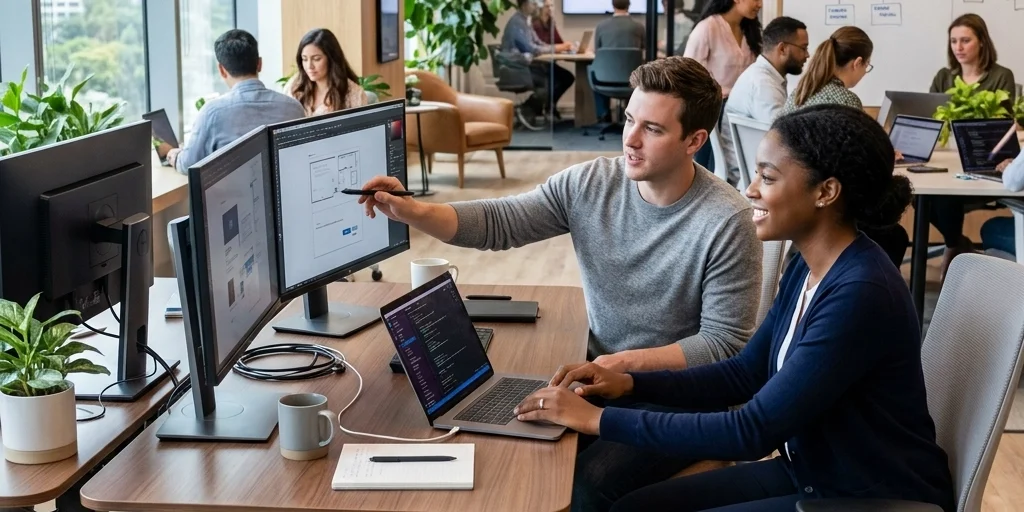
Remember the traditional computer lab? That windowless room in the basement of a school or office building, filled with rows of beige monitors, tangled nests of Ethernet cables, and the faint, persistent smell of ozone and old carpet? For a long time, that was the peak of technological infrastructure. If you wanted to do anything "high-tech," you had to go to the lab.
Fast forward to 2026, and those labs are looking more like digital graveyards than hubs of innovation. The "rows of PCs" model is officially on life support, and frankly, it’s about time we pulled the plug. Today, the vanguard of high-tech talent isn't looking for a seat in a row; they’re looking for a Pod.
At USA Entertainment Ventures LLC, we’ve seen the shift firsthand. Businesses are moving away from massive, static installations toward modular, flexible infrastructure. It's not just a trend: it's a necessity for anyone looking to break into the modern workforce.
The Death of the "Box" Room
Why are traditional labs dying? It’s not just because the hardware gets dusty. It’s about utility and ROI. Recent data shows that traditional computer labs in many institutions sit idle for up to 60% of the day. In an era where real estate is at a premium, having a dedicated room that is only used part-time is a massive financial drain.
Furthermore, the "Bring Your Own Device" (BYOD) revolution has changed the game. By 2026, the average professional carries more computing power in their backpack than a mid-range lab desktop from five years ago. People don't need a room full of computers; they need a specialized environment that enhances what they are already doing.
Enter the Pod.

A Pod isn't just a desk; it’s a self-contained, high-performance environment designed for specific tasks. Unlike the one-size-fits-all computer lab, Pods are modular. They are the "HQ" for talent because they provide the three things a laptop can’t: specialized hardware, physical security, and a focused "vibe."
Logistics: The Moving Tech Hub
When people think of "high-tech talent," they often jump straight to coding. But in 2026, one of the most tech-heavy career paths is actually in logistics. We aren't just talking about driving trucks; we're talking about the massive digital infrastructure that keeps the global supply chain moving.
Modern logistics requires real-time data processing, fleet management, and AI-driven routing. A traditional computer lab can’t handle the specialized requirements of a logistics command center. However, a Logistics Pod can be equipped with multi-screen setups, dedicated satellite links, and tactile interfaces that allow a coordinator to manage a fleet of autonomous vehicles across three continents simultaneously.
For those looking into career opportunities, logistics is no longer a "blue-collar" job: it’s a "new-collar" career where the Pod is your cockpit. These spaces provide the infrastructure necessary to train talent in managing the complex moving parts of our modern economy.
Cybersecurity: The Digital Frontline
If logistics is the heart of the modern economy, cybersecurity is the immune system. The traditional computer lab is a nightmare for cybersecurity training. Why? Because a lab is inherently an open environment.
Cybersecurity professionals need "War Room" environments. They need Pods that can be isolated from the main network for "sandbox" testing of malware. They need environments where they can simulate high-pressure attacks without the distractions of a shared lab space.
A Cybersecurity Pod serves as a high-tech fortress. It’s where the next generation of digital defenders learns to hunt threats. By moving these activities into specialized Pods, companies can ensure that their talent is working on the most up-to-date hardware without compromising the security of the broader corporate digital infrastructure.
Industry experts often say that "security is a mindset," but in 2026, it’s also an infrastructure. You can't train elite defenders in a room designed for basic word processing.
Content Creation: The New Gold Rush
Perhaps the most visible shift from labs to Pods is in the world of content creation. In the early 2000s, "content creation" meant sitting in a lab and struggling with a slow version of Photoshop. Today, it’s a multi-billion dollar industry that includes 4K streaming, 3D rendering, and AI-assisted video production.
The modern Content Pod is a mini-production studio. It features soundproofing, professional-grade lighting, high-fidelity microphones, and GPUs that can render complex animations in minutes rather than days.
This is where the creative talent of tomorrow is being forged. Whether it's for internal corporate training or global entertainment brands, the ability to produce high-quality media is a core business skill. You can explore how we showcase these types of innovations in our showcase section.
Traditional labs are too loud, too bright, and too underpowered for a professional creator. The Pod, however, provides a sanctuary where the "magic" happens. It’s brand-neutral, highly efficient, and built for the speed of modern media.
Why Businesses are Making the Switch
From a business consulting perspective, the move to Pod-based infrastructure is a no-brainer. It’s about scalability. If you need to increase your cybersecurity team, you don't need to build a new wing of the building; you just drop in two more Pods.
If you want to see how this fits into a broader business strategy, checking out our services page can give you an idea of how we approach infrastructure and talent management.
Here are the key takeaways for why Pods are winning:
- Flexibility: Pods can be moved, upgraded, or repurposed without a major construction project.
- Specialization: Each Pod is tailored to a specific career path, whether it's logistics or content.
- Efficiency: They maximize the use of space and energy, only providing the high-spec power where it is actually needed.
- Retention: High-tech talent wants to work in environments that reflect the cutting-edge nature of their work. A Pod feels like the future; a lab feels like the past.

The Future is Modular
As we look toward the rest of 2026 and beyond, the trend toward decentralization is only going to accelerate. The "HQ" is no longer a specific building: it’s the specialized infrastructure that allows talent to do their best work.
Traditional computer labs served us well for a few decades, but they were built for an era where technology was scarce and immobile. Now that technology is everywhere, our physical spaces need to catch up.
Whether you are an aspiring logistics expert, a cybersecurity specialist, or a creative visionary, your future isn't in a row of desks. It’s in a Pod.
If you’re curious about how your organization can transition into this new era of high-tech infrastructure, feel free to reach out through our contact page. We’re always ready to talk about what’s next.
The computer lab isn't just dead; it’s been upgraded. Welcome to the era of the Pod. It’s cleaner, faster, and a whole lot cooler.
For more information on our company philosophy and how we view the intersection of entertainment and business, visit our about us section. The future is coming fast: make sure you have the right HQ to meet it.





