
If you grew up in the late 90s or early 2000s, you likely remember the "computer lab" as a sacred, slightly damp-smelling ritual. It was a room filled with the rhythmic hum of beige towers, the clacking of mechanical keyboards, and a distinct lack of sunlight. You went there to type a bibliography for a history paper or, more likely, to play Oregon Trail until the librarian told you to leave.
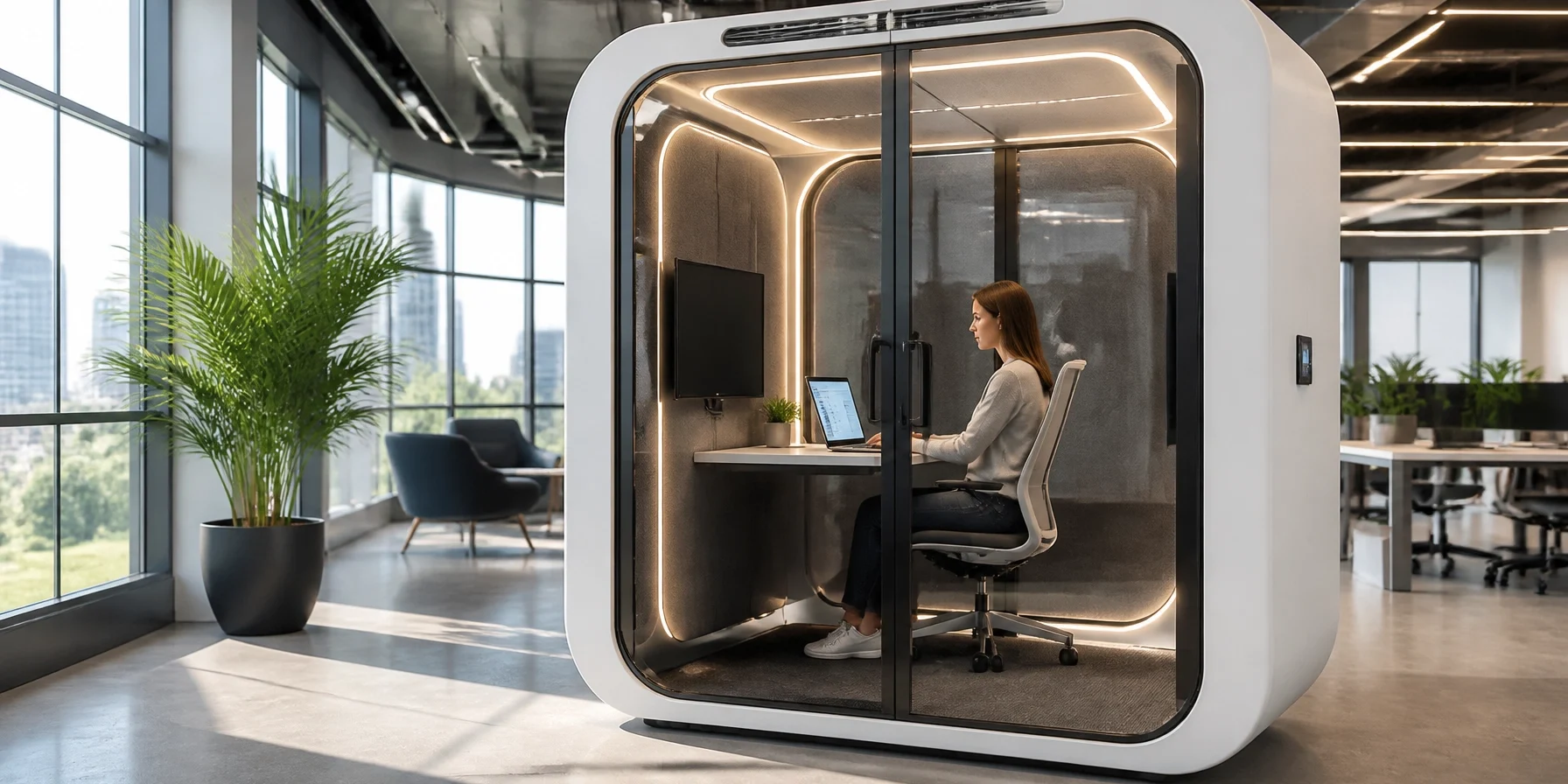
But take a walk through a modern university campus or a corporate headquarters in 2026, and you’ll notice something strange. The massive rooms full of rows of desktops are gone. In their place? Sleek, glass-walled enclosures that look more like escape pods from a sci-fi film than a place to study.
The traditional computer lab isn't just dying; it has been completely reimagined. As we move further into a decentralized, mobile-first world, the physical infrastructure of work and study has shifted from "shared hardware" to "private focus." At USA Entertainment Ventures LLC, we’ve watched this transition closely. We are no longer asking if people have access to a computer; we are asking if they have the space to use it effectively.
The Great Migration: From Desktops to Pods
The death of the computer lab wasn't a sudden event. It was a slow migration that began with the rise of 1:1 computing. By the mid-2010s, Chromebooks and tablets had become ubiquitous in schools, and laptops became the standard-issue tool for every office worker. When everyone carries a supercomputer in their backpack, the need for a dedicated room full of hardware vanishes.
However, the "dark room" study habit didn't disappear, it just changed its requirements. Research shows that while students and professionals no longer need shared computers, they have a desperate, growing need for shared infrastructure. Open-plan offices and bustling campus libraries are great for collaboration, but they are disastrous for deep work.

Enter the "Pod." These units are the evolution of the computer lab. They provide what a laptop cannot: soundproofing, high-speed hardwired connectivity, and ergonomic privacy. Whether it's a specialized E-Sports Pod or a minimalist focus booth, these structures are the new nodes of the modern workforce.
According to industry data, the "office pod" market has seen a compound annual growth rate of over 12% as companies realize that privacy is the ultimate luxury in a loud world. As Dr. Cal Newport, author of Deep Work, famously noted, "To produce at your peak level you need to work for extended periods with full concentration on a single task free from distraction." The pod is the physical manifestation of that necessity.
Career Pathways: Where the Infrastructure Meets the Industry
Why does this shift in physical infrastructure matter? Because it directly reflects the booming career sectors of the mid-2020s. We aren't just sitting in pods to browse the web; we are using them to manage complex global systems.
1. Logistics and the Digital Supply Chain
In 2026, logistics is no longer just about moving boxes from Point A to Point B. It is a data-driven science. The modern logistics professional often works from a centralized hub, or a pod, overseeing autonomous fleets and AI-driven inventory systems. The "lab" has become a command center.
The integration of physical logistics with digital management requires a unique space where focus is paramount. Errors in a global supply chain can cost millions in minutes; having a dedicated, tech-integrated pod allows for the "flow state" necessary to manage these high-stakes environments.
2. The Cybersecurity Frontline
As logistics becomes more digitized, it also becomes more vulnerable. This has created an unprecedented demand for Industrial SOC Analysts and OT Security Engineers. These professionals don't work in open cubicles where their screens are visible to everyone. They need secure, private environments to monitor threats against critical infrastructure.
The transition from traditional IT to cybersecurity is one of the most viable pathways for career changers today. By 2026, specialists in cloud and AI security are commanding higher salaries than generalists, and the "pod" serves as their private digital fortress.

The Rise of the Professional Creator
While some are defending the perimeter of our digital world, others are building the culture within it. Content creation has moved past the "influencer" stereotype and into a sophisticated, multi-platform career model.
Today’s creators are educators, industry experts, and B2B strategists. They aren't filming in their bedrooms with a shaky camera; they are using high-end, compact studios. For many, a specialized "Creator Pod" is the answer. These units come pre-equipped with acoustic treatment, ring lights, and 4K-ready setups.

At USA Entertainment Ventures, we recognize that consulting in the creative and media space requires an understanding of both the art and the architecture. The ability to hop into a pod and produce a professional-grade video for a client in 20 minutes is no longer a "nice-to-have", it is a competitive requirement.
Bridging the Gap: The DOD Skill Bridge and Beyond
Transitioning into these high-tech, focus-heavy roles can be daunting, especially for those coming from non-traditional backgrounds. One of the most effective ways we’ve seen people enter these fields, logistics, cybersecurity, and management, is through the DOD Skill Bridge program.
This program allows transitioning service members to gain valuable civilian work experience through internships and apprenticeships during their last 180 days of service. For a veteran transitioning into a role like a Supply Chain Cybersecurity Expert, the Skill Bridge offers a structured path to translate military discipline into technical expertise.

USA Entertainment Ventures LLC is proud to support this transition. We understand that the future of the American workforce isn't just about new gadgets; it’s about giving talented people the right environment and the right opportunities to succeed. Whether you are coming from the military or looking to pivot from a legacy industry, the goal remains the same: find your "pod," focus your skills, and master the new digital landscape.
Conclusion: The Dark Room is Now a Bright Future
So, are computer labs dead? In their old form, yes. We’ve traded the rows of dusty desktops for flexible, private, and powerful "pods" that move with us. We don't "go to the computer" anymore; the computer: and the environment required to use it: now comes to us.
As we look toward 2027 and beyond, the trend is clear. Success in the modern economy belongs to those who can master the art of focus in an age of distraction. Whether you’re securing a logistics network, creating value-dense content, or transitioning through a program like Skill Bridge, your "lab" is wherever you can close the door, block out the noise, and get to work.
The dark rooms of the 90s are gone, but the spirit of innovation that lived within them has never been brighter.





