
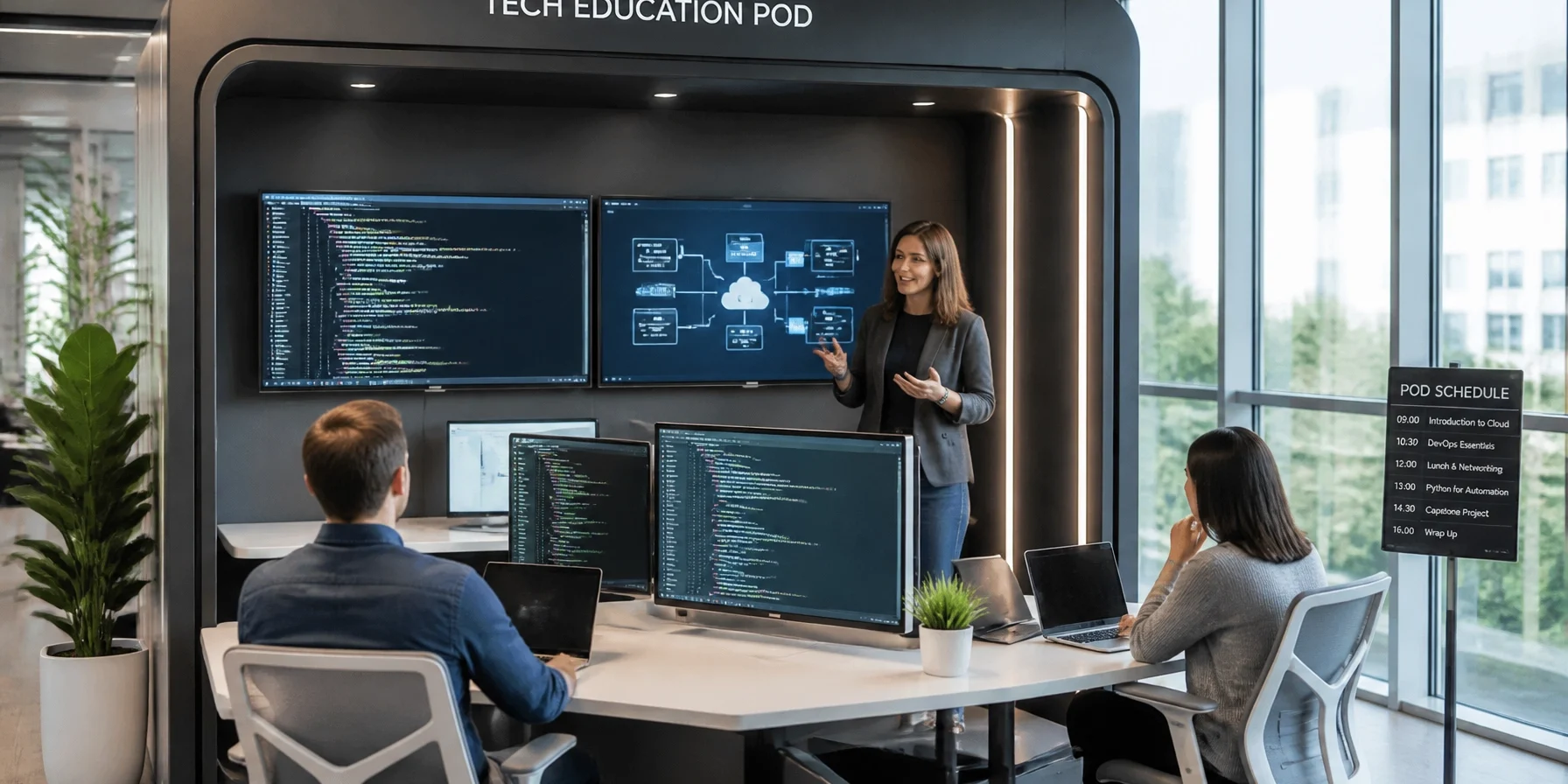
Walk into an old-school computer lab and you may find rows of identical desktops, tangled cables, fluorescent lighting, and a sign reminding students not to change the wallpaper. It is familiar, functional, and increasingly out of step with how modern work actually happens.
Today’s technology careers are rarely built around one person sitting silently at one computer. Logistics teams coordinate shipments and inventory. Cybersecurity teams monitor threats together. Content creators plan, record, edit, and publish across several platforms. The workplace is collaborative, specialized, and constantly changing.
That is why pod-based spaces are becoming an important alternative to traditional computer labs.
What Is a Technology Pod?
A technology pod is a small, purpose-built learning area designed around a particular task, career pathway, or project. It may include several workstations, shared displays, specialized software, sound control, secure networking, recording equipment, or other tools related to the subject being taught.
Unlike a traditional computer lab, a pod is not simply a room full of computers. It is a miniature workplace.
A cybersecurity pod might support network monitoring and ethical hacking simulations. A logistics pod could use supply-chain software, dashboards, and shipment-planning tools. A content-creation pod might function as a compact studio with cameras, microphones, lighting, and editing systems.
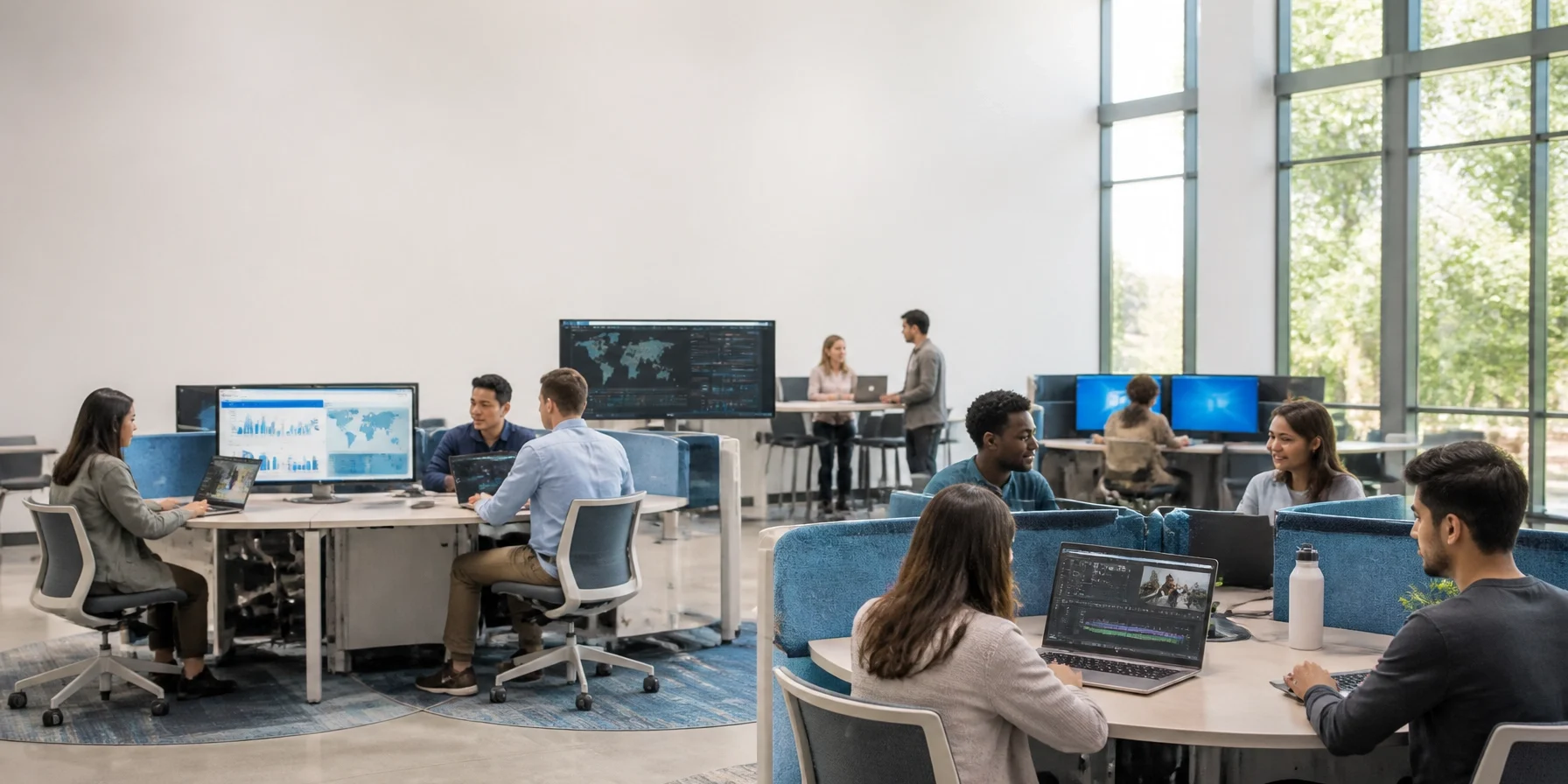
The equipment matters, but the layout matters just as much. Pods encourage students to face one another, share screens, discuss decisions, and solve problems together. In other words, they make it harder to hide behind a monitor and easier to learn from the person sitting next to you.

Why Traditional Labs Are Showing Their Age
Traditional labs were designed for general-purpose computing. That model worked well when the primary goal was teaching word processing, spreadsheets, typing, or basic programming.
Modern career education has broader goals. Students need technical knowledge, but they also need communication, teamwork, decision-making, and project-management skills. Employers expect entry-level workers to contribute to a team, not simply complete isolated computer exercises.
Career and Technical Education space-planning guidance increasingly emphasizes flexible, collaborative environments that connect classroom activities to real workplaces. The K–12 Blueprint for CTE Learning Spaces, for example, highlights the value of adaptable layouts and industry-aligned environments.
Pods support that approach in several practical ways:
- They encourage collaboration. Students can work in small teams, assign roles, compare findings, and present solutions.
- They support specialized instruction. A room can include different pods for logistics, cybersecurity, media, data analysis, and other pathways.
- They are easier to update. Schools can upgrade one pod at a time instead of rebuilding an entire lab.
- They improve flexibility. The same space can support instruction, simulations, career demonstrations, and project work.
- They make learning more visible. Shared displays allow teachers to review progress without circling the room like a detective searching for the one unplugged keyboard.
Research also supports the broader learning model behind pods. A widely cited meta-analysis in Proceedings of the National Academy of Sciences found that active learning improved student performance compared with traditional lecture-based instruction. The researchers wrote that “active learning increases student performance in science, engineering, and mathematics.” Pods are not a magic solution, but their design makes active learning easier to organize.
Pods Create Career Pathways
Logistics: Turning Data Into Movement
A logistics pod can simulate the decisions made inside a warehouse, transportation company, or distribution center. Students might analyze inventory levels, plan routes, track shipments, or respond to delays.
The lesson is not just about entering data into software. It is about understanding how one decision affects an entire network. If a shipment is delayed in one location, what happens to production, customers, staffing, and cost?
Students can work as planners, analysts, dispatchers, and managers. They learn that logistics is both a technology field and a people field. Clear communication may be just as important as a well-designed dashboard.
Cybersecurity: Practice Without Breaking the School Network
Cybersecurity education requires realistic practice, but schools cannot allow students to experiment on live institutional systems. A dedicated pod can provide a controlled environment, sometimes called a sandbox, where learners can examine vulnerabilities and respond to simulated attacks without putting real networks at risk.
Students can take part in red-team and blue-team exercises. One group attempts to identify weaknesses while another monitors systems and responds. These activities introduce technical skills such as threat detection and network analysis, while also teaching calm decision-making under pressure.
The result is closer to professional cybersecurity work than a worksheet asking students to define “phishing.” Definitions have their place. So does learning what happens when the simulated alarm starts flashing.
Content Creation: From Consumer to Producer
Content-creation pods can help students move from watching digital media to producing it. A compact studio may include cameras, microphones, lighting, green screens, editing computers, and acoustic treatment.
Students can develop podcasts, instructional videos, interviews, social media campaigns, livestreams, or short documentaries. They learn scripting, production planning, visual storytelling, editing, copyright awareness, and audience analysis.
These skills connect to careers in media, communications, marketing, public affairs, and digital production. They also support nearly every modern organization, because businesses increasingly need people who can explain ideas clearly through video, audio, graphics, and written content.

The Physical Space Becomes Part of the Curriculum
One of the most important advantages of pods is that the room itself can teach workplace habits.
A logistics pod can display real-time information and require coordinated decisions. A cybersecurity pod can establish rules for access, documentation, and incident response. A content pod can mirror a production schedule from concept to final edit.
This physical connection helps students understand that technology is not an isolated subject. It is part of a larger process involving customers, operations, security, communication, and accountability.
Examples such as Cal Poly’s Educational Technology Lab show how institutions are converting conventional labs into hands-on environments where educators and learners can explore multiple technologies in collaborative settings.
How Schools Can Start Small
Replacing a traditional computer lab does not have to mean demolishing walls or purchasing every new device at once. A practical transition can begin with three steps:
- Identify local career needs. Talk with employers, workforce agencies, and instructors to determine which skills are most relevant.
- Choose one pilot pathway. Start with a logistics, cybersecurity, or content-creation pod and measure participation, project quality, and skill growth.
- Design around projects. Select equipment and software based on what students need to accomplish, not simply what looks impressive in a catalog.
Schools can then expand gradually, using evidence from the pilot to guide future investment.
Pods will not make traditional computer labs disappear overnight. Some general computing instruction will still require shared workstations. However, the direction is clear: technology education is moving toward flexible, specialized, project-based spaces that resemble the work students are preparing to enter.
The future computer lab may look less like a row of machines and more like a collection of small, active workplaces. That shift gives students more than access to technology. It gives them a place to practice using it with purpose.
For organizations interested in building stronger education-to-workforce connections, USA Entertainment Ventures has also explored practical approaches in building the next-generation talent funnel. Physical infrastructure is one part of that effort. The larger goal is to help learners see a clear path from classroom projects to meaningful careers.





