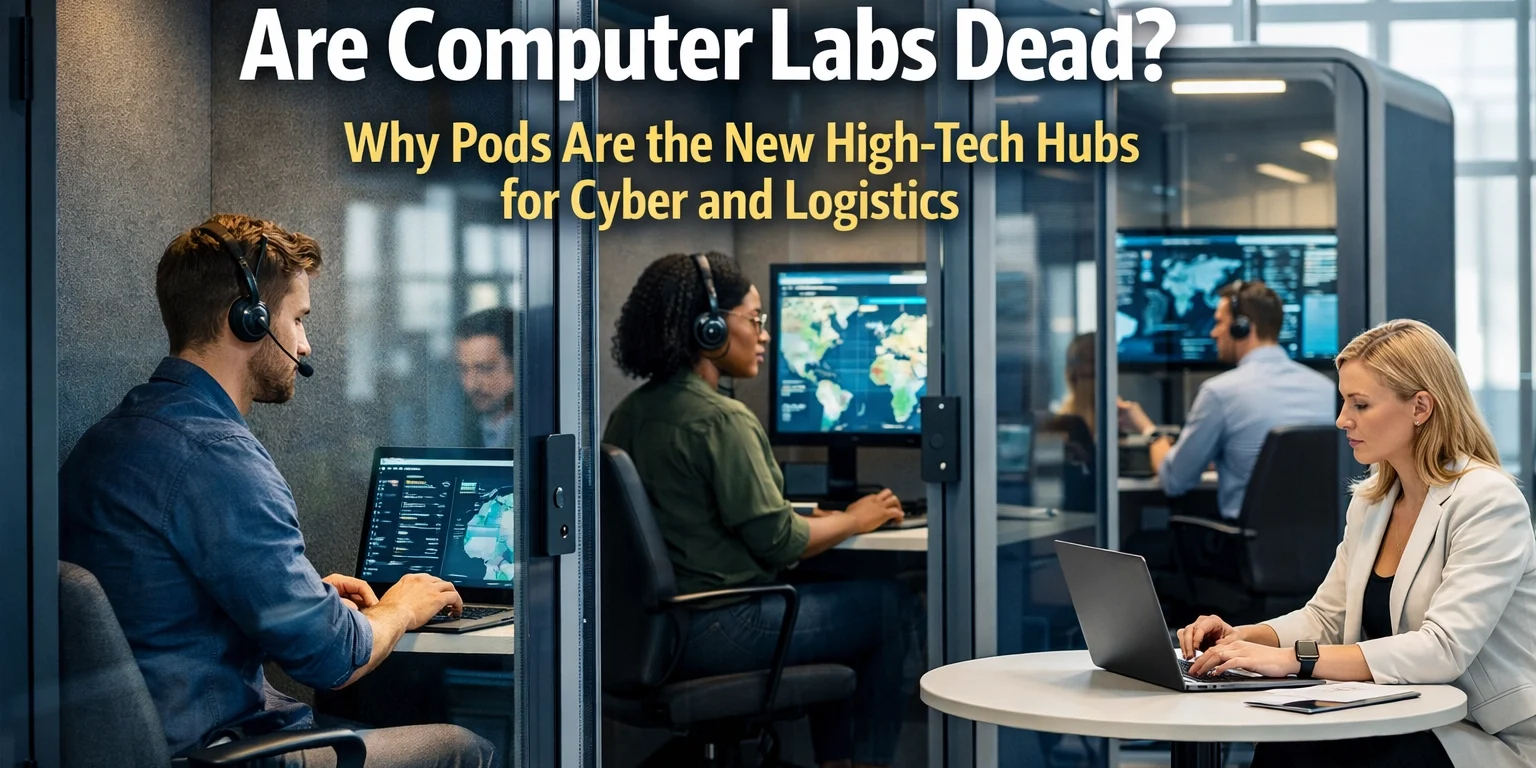
Remember the traditional computer lab? That fluorescent-lit room filled with rows of beige towers, tangled VGA cables, and the faint, dusty smell of ozone? If you grew up in the 90s or early 2000s, the computer lab was the "high-tech" inner sanctum where you learned to type without looking at your fingers or played The Oregon Trail until a virtual ox died.
Fast forward to March 2026, and those rows of workstations are looking more like museum exhibits than modern training grounds. The world has moved on, and it’s moving fast. We’re no longer just "using computers"; we’re orchestrating global supply chains, defending digital borders against state-sponsored hackers, and building multi-million dollar media empires from our bedrooms.
The traditional lab: static, solitary, and stiff: is officially on life support. Taking its place is the Pod. These aren't just fancy desks; they are high-tech hubs designed for the way we actually work and learn today.
At USA Entertainment Ventures LLC, we’ve seen the shift firsthand. Whether it’s in business consulting or infrastructure development, the "Pod" is the new gold standard for career pathways in logistics, cybersecurity, and content creation.
The Death of the Row: Why "The Lab" Failed
The problem with old-school computer labs was their geometry. They were built for instruction, not collaboration. You sat in a row, stared at the back of someone’s head, and followed a teacher’s mouse clicks on a projector. It was a factory model of learning for a digital world that stopped being a factory decades ago.
In 2026, the skills that get you hired aren't just about knowing where the "Save" button is. They are about "soft skills" like communication and "hard skills" like multi-device synchronization. Research shows that students in pod-arranged environments experience significantly more student-to-student and student-to-teacher interactions. When you’re clustered in a pod, you’re not an island; you’re part of a crew.

Cybersecurity: Training for the Digital Battlefield
If you want to get into cybersecurity, you have to realize it’s a team sport. It’s "Red Team" (the hackers) versus "Blue Team" (the defenders). You can't simulate a high-stakes data breach while sitting in a linear row of desks like you're taking a 10th-grade spelling bee.
Modern cybersecurity training happens in virtual lab environments: sophisticated pod systems that allow for hands-on penetration testing and critical infrastructure security. In a pod, a group of trainees can huddle around screens, one monitoring the firewall, another tracking a suspicious IP, and a third coordinating the response.
This collaborative, multi-device workflow is essential. Cybersecurity professionals in 2026 are often managing tablets for alerts, laptops for coding, and secondary monitors for network visualization. The Pod setup mirrors this real-world "War Room" atmosphere. It’s about engagement and knowledge retention. When you’re in the thick of a simulated attack with your team, you don't just learn the theory: you develop the muscle memory to survive a real one.
Logistics: The Nerve Center of Global Trade
Logistics used to be seen as "trucks and warehouses." Today, it’s data, data, and more data. A logistics specialist in 2026 is essentially a high-tech air traffic controller for freight.
Pod environments fundamentally mirror real-world logistics workflows in ways traditional labs simply cannot. Imagine a training scenario where one person in the pod acts as the "Dispatcher," another as the "Inventory Specialist," and a third as the "Client Liaison." They aren't just sitting near each other; they are working across a suite of interconnected devices.
One trainee might be tracking a shipment on a tablet, while another analyzes warehouse throughput on a desktop, and the third uses a smartphone to simulate real-time communication with a driver. This is exactly how a shipping hub operates. At USA Entertainment Ventures LLC, we focus on projects like EV Across America and Mobile HWY Ads, where the intersection of technology and physical transport is paramount. Training the next generation of logistics wizards requires an environment that handles this complexity.

Content Creation: The Modern Media Studio
Let’s talk about the career path no one saw coming twenty years ago: professional content creation. Whether it’s podcasting, streaming, or high-end video production, "Content Creator" is a top-tier career choice in 2026.
A traditional computer lab is a nightmare for a creator. It’s loud, there’s zero privacy, and the acoustics are terrible. Enter the Content Pod. These are specialized hubs: often sound-dampened and equipped with high-fidelity microphones, 4K cameras, and multi-monitor editing stations.
Our work with projects like ZooMediaUS and E-Sports Pod highlights this trend. An E-Sports pod isn't just for gaming; it’s a high-performance workspace where players, coaches, and broadcasters collaborate in real-time. It’s a specialized environment that fosters the specific needs of digital media: high processing power, ergonomic comfort, and collaborative proximity.
Scalability: High Tech Without the High Overhead
One of the biggest arguments for the transition from labs to pods is scalability. Building a dedicated, fixed-location computer lab is expensive. You need a massive room, heavy-duty cooling, and enough electrical work to power a small village. If you want to train people in three different cities, you have to build three different labs.
Pods, however, are the ultimate "plug-and-play" solution. Because so much of today’s processing happens in the cloud or through virtual environments, the physical infrastructure can be much leaner. A pod can be set up in a community center, a small office, or even a converted shipping container (something we know a thing or two about at Pure Box Water).
This flexibility allows workforce development programs to reach low-income or rural communities that could never afford a full-scale, traditional computer lab. It democratizes access to high-tech training. If you have a pod and a solid internet connection, you have a world-class training center.

The Hybrid Approach: Giving the Lab a New Job
Now, are computer labs completely dead? Not quite. They still have a seat at the table, but their job description has changed.
The most successful workforce development programs in 2026 are adopting a hybrid strategy. They maintain smaller, traditional labs for "foundational literacy": teaching people how to use basic hardware or providing access to those who don’t have devices at home. But for the advanced stuff: the cybersecurity simulations, the logistics coordination, and the media production: they move the students into pods.
It’s about using the right tool for the job. You don't use a sledgehammer to hang a picture frame, and you don't use a 1995-style computer lab to teach 2026-style cyber defense.
Actionable Takeaways for Businesses and Educators
If you are a business owner or an educator looking to upgrade your training infrastructure, here’s how to start the transition from "The Lab" to "The Pod":
- Assess the Workflow: Does your team work in silos or in groups? If collaboration is key to the job, your training environment should reflect that.
- Focus on Multi-Device Integration: Don't just provide a desktop. Ensure your pods can accommodate tablets, smartphones, and secondary screens.
- Invest in "Virtual" Over "Physical": Spend less on the physical towers and more on the cloud-based virtual environments that allow for realistic simulations.
- Prioritize Acoustics and Ergonomics: If you’re building pods for content creation or intensive logistics monitoring, comfort and sound control are not "perks": they are requirements.
- Think "Mobile": Look into modular pod designs that can be moved or scaled as your needs change.
The Future is Pod-Shaped
At USA Entertainment Ventures LLC, we are always looking toward the horizon. CEO Dan Kost has always emphasized that staying ahead of the curve isn't just about having the newest gadgets; it's about understanding how those gadgets change the way we interact as humans.
The shift from computer labs to pods is a perfect example of this. It's a move away from the "factory" and toward the "hub." It’s an acknowledgment that the most valuable skills in the modern economy: problem-solving, teamwork, and technical agility: don't happen in a straight line. They happen in a circle, in a group, and in a pod.
The computer lab isn't just dying; it’s evolving. And frankly, we couldn't be more excited to see what the next generation of logistics wizards, cyber defenders, and content creators does with their new hubs.
The rows are gone. The pods are here. Welcome to the future of work.