
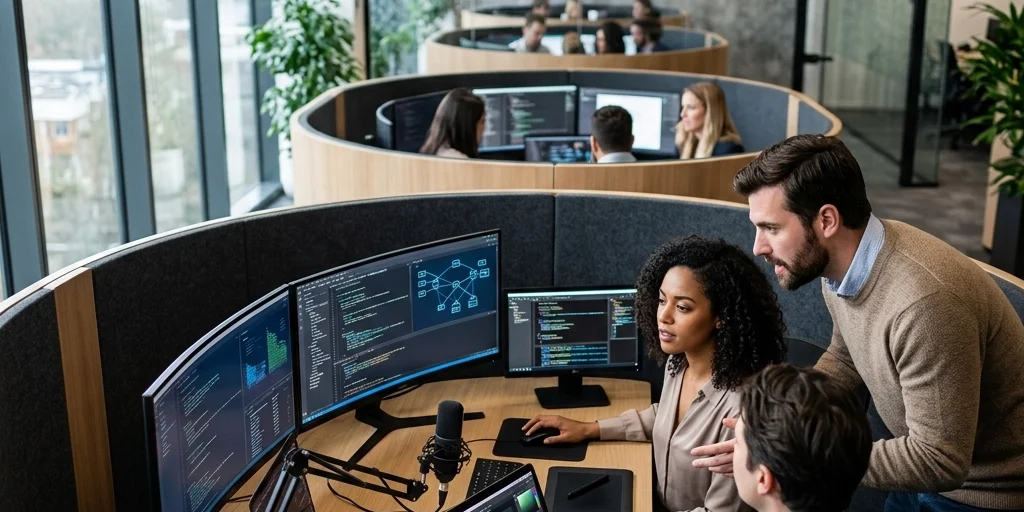
If you close your eyes and think of a "computer lab," what do you see? For most of us, it’s a dimly lit room with rows of beige towers, the faint hum of thirty cooling fans struggling for dear life, and that one printer that’s been jammed since 2012. It was a place of isolation, where you stared at a flickering CRT or a budget LCD while the person next to you did exactly the same thing.
Fast forward to April 2026, and that vision isn't just outdated: it’s economically extinct.
As of this year, traditional university and corporate computer labs are operating at less than 40% capacity. The "Bring Your Own Device" (BYOD) revolution has won. When 95% of students and professionals are walking around with high-powered laptops or tablets in their bags, the idea of sitting in a fixed row of identical desktops feels as archaic as using a rotary phone.
But here’s the twist: we need specialized tech spaces more than ever. We just don't need "labs" anymore. We need Pods.
The 40% Problem: Why the Old Model Failed
The traditional computer lab died because it tried to be everything to everyone and ended up being "just okay" for no one. In the business consulting world, we call this a resource sink. Schools and offices have been pouring money into hardware refresh cycles every three years, only to have those machines sit idle for 60% of the day.
The enemies of the traditional lab were three-fold:
- Cost: Maintaining 50 identical workstations is a nightmare for the bottom line.
- Inflexibility: You can’t easily turn a rows-and-columns computer lab into a collaborative war room.
- Hardware Parity: If your personal laptop is faster than the lab computer, why would you ever use the lab?
This is where the e-sports pod and specialized modular units come into play. We are moving away from general-purpose rooms and toward high-tech, modular hubs designed for specific career pathways.
Enter the Pod: The Modular Revolution
A "Pod" isn't just a fancy name for a small room. In the context of 2026 infrastructure, a Pod is a modular, high-tech environment tailored to a specific industry. Whether it’s for cybersecurity, logistics, or content creation, these units are the new HQ for modern careers.
The defining characteristic of the Pod era is specialization. As industry experts have noted, a logistics Pod looks nothing like a creative Pod. They are built with specific goals in mind, featuring industrial-grade networking, specialized GPUs, and collaborative layouts that a row of desks simply can't offer.

Cybersecurity: The High-Stakes Sandbox
If you're looking into a career in cybersecurity, the environment matters. You aren't just "checking emails." You are running simulations, stress-testing networks, and managing high-stakes data.
In a traditional lab, the networking is often locked down and generic. In a dedicated Cybersecurity Pod, the infrastructure is built for the job. We’re talking about isolated "sandboxes" where you can legally and safely practice defensive maneuvers without taking down the entire building's Wi-Fi.
For those navigating high-stakes branding, the security of your digital assets is your most valuable currency. Pods provide the physical and digital security needed to train the next generation of defenders. These spaces allow for "War Room" scenarios where teams can huddle around shared monitors and whiteboards to solve a breach in real-time. You can't do that when you're staring at the back of someone's head in a 1990s-style lab layout.
Content Creation: More Than Just a Ring Light
The "Content Creator" is no longer just a kid in a bedroom. In 2026, content creation is a multi-billion dollar pillar of the economy. Professional content careers: ranging from 8K video editing to AI-generated environments and VR production: require hardware that the average MacBook Air can’t handle without melting.
The Content Pod is the modern studio. It features:
- Acoustic Treatment: Soundproofing that doesn't look like egg cartons.
- High-End Rendering Power: Server-grade GPUs for real-time 3D rendering.
- Specialized Peripherals: From VR headsets to color-accurate monitors for projects like Zoo Imagery.
When you step into a Pod designed for content, you aren't just using a computer; you’re using a tool specifically calibrated for the entertainment industry. This level of specialization is why companies are shifting their budgets from "mass-market PCs" to "niche-market Pods."
Logistics and the Mobile HQ
One of the coolest shifts we've seen at USA Entertainment Ventures LLC is the mobility of these units. Because Pods are modular, they don't have to stay in one place. We’re seeing the rise of the "Mobile HQ."
Think about large-scale events or remote operations. You can’t build a permanent computer lab in the middle of a desert for a tech festival or at a temporary logistics hub. But you can drop a Pod.
This connects directly to the world of mobile highway ads and fleet management. The logistics of moving, deploying, and maintaining these units is a burgeoning career field in itself. Someone has to manage the "fleet" of technology. If you’re into logistics, the future isn't just moving boxes; it’s moving brainpower in the form of modular tech hubs.
Why Collaboration is the New "Deep Work"
The biggest mistake of the old lab model was the assumption that "work" is a solo activity. The Pod model flips this. By utilizing round tables, shared displays, and integrated communication tools, Pods encourage the kind of teamwork that modern employers actually care about.
Whether you are working on Money Smart TV or developing a new medical tech interface for the Sports Medical Group, you are rarely working in a vacuum. You need to talk, iterate, and fail fast: together.
Pods are designed to be social. They are the physical manifestation of a Slack channel or a Discord server, but with better coffee and zero lag.
The Actionable Takeaway: How to Pivot
So, are computer labs dead? The old ones are. But the need for a place to go, plug in, and create is stronger than ever.
If you are a business owner or an educator, here is the move:
- Stop buying "generic" hardware. If your team can do the work on their laptops, they will. Only invest in hardware that offers a "super-power" (Rendering, High-Speed Networking, VR).
- Think modular. Look into projects that prioritize flexibility. Can your space be reconfigured in 10 minutes? If not, it’s already obsolete.
- Focus on the Path. Don't build a room. Build a "Cybersecurity Lab" or a "Logistics Command Center." Specificity is the secret sauce of 2026.

Looking Forward: 2027 and Beyond
The trend is clear. We are moving toward a world where technology is invisible until we need it to be powerful. The "Pod" isn't just a trend; it's a response to how we actually work today. We want mobility, we want power, and we want to be around people: but only when the environment actually helps us get the job done.
As we continue to push the boundaries of entertainment, branding, and business consulting here at USA Entertainment Ventures LLC, we’re keeping a close eye on the physical spaces that define our digital success. The beige towers are gone, and honestly? We don't miss them.
The future is modular, it’s mobile, and it’s waiting for you to step inside. Whether you're securing the grid or creating the next viral docuseries, the Pod is your new home base. Stay smart, stay mobile, and for heaven's sake, stop trying to fix that 2012 printer. It's time to move on.





