
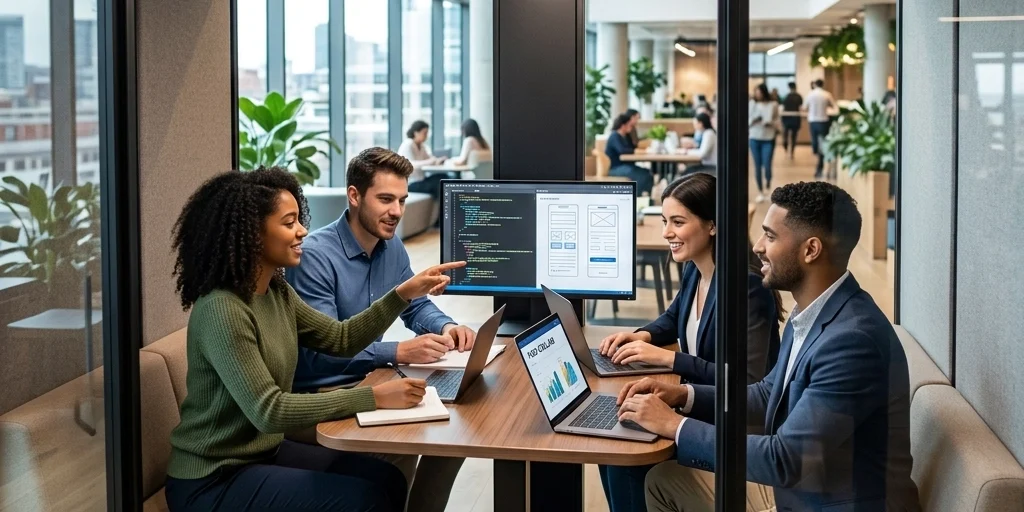
If you close your eyes and think of a "computer lab," what do you see? If you’re of a certain vintage, you probably see a windowless basement room filled with the hum of thirty identical beige towers, the faint smell of ozone, and rows of students staring forward like they’re in a low-budget sci-fi movie from 1997. It was the "factory model" of learning: everyone sits in a line, everyone does the same task, and nobody talks to each other because, well, the monitors were the size of small microwave ovens and blocked your view of the human being sitting three feet away.
Fast forward to May 2026, and that image belongs in a museum next to the floppy disk and the pager. The traditional computer lab isn't just dying; it’s been effectively replaced by something more agile, more social, and significantly more effective at actually getting people jobs.
Welcome to the era of the Pod.
The Slow Death of the Row-and-File Lab
Let’s be real: the traditional lab died because it couldn't keep up with our pockets. According to industry data, nearly 95% of students and young professionals now carry their own laptops or high-powered tablets. When everyone has a "lab" in their backpack, the institutional lab becomes a graveyard of outdated hardware that nobody wants to touch.
The COVID-19 pandemic acted as the final nail in the coffin. When the world went remote, we realized that cloud computing and SaaS (Software as a Service) meant we didn't need to be tethered to a specific physical desk to access high-end software.
But a funny thing happened on the way to total remote work. We realized that while we didn't need the hardware of the old labs, we desperately missed the collaborative energy of a shared space. You can’t launch a high-stakes career in cybersecurity or master complex logistics from your couch without eventually feeling like a hermit.
What Exactly is a "Pod"?
If the old computer lab was a factory, the Pod is a studio.
Physically, a Pod is a modular, high-tech infrastructure unit designed for small teams. Instead of rows of desks facing a chalkboard, Pods are usually circular or hexagonal. They feature shared monitors for screen-mirroring, "war room" style whiteboards, and integrated hardware that supports specific career pathways.
At USA Entertainment Ventures LLC, we see this shift as a fundamental change in how business consulting and workforce development operate. The Pod isn't just a place to sit; it’s an ecosystem designed to mimic the modern workplace.
Career Pathway #1: The Logistics Revolution
Logistics used to be about clipboards and shouting into CB radios. Today, it’s about massive data sets, real-time GPS tracking, and AI-driven supply chain optimization. You can't learn that effectively on a single 13-inch laptop screen.
The "Logistics Pod" is a high-speed command center. It allows a small team to visualize a global supply chain across multiple shared 4K displays. One person manages the fleet data, another monitors weather patterns, and a third optimizes fuel consumption.
This type of collaborative infrastructure is exactly what the trucking and distribution industries are screaming for in 2026. Companies are looking for "Pod-trained" professionals who know how to communicate in a high-pressure, tech-heavy environment. It’s about moving from "I know how to use this program" to "We know how to manage this system."

Career Pathway #2: Cybersecurity "War Rooms"
If you’re entering cybersecurity, the days of the "lone wolf" hacker in a hoodie are over. Modern security is a team sport.
Traditional labs are terrible for cybersecurity training because they are isolated. In a Pod-based environment, you have a "Red Team" Pod and a "Blue Team" Pod. The physical layout encourages the rapid-fire communication necessary to stop a simulated breach in real-time.
These Pods are equipped with isolated network switches and specialized hardware that allows students to break things without taking down the building’s Wi-Fi. It’s hands-on, it’s visceral, and it’s the only way to build the "muscle memory" required for a high-paying career in digital defense.
Career Pathway #3: Content Creation and the Media Engine
The creator economy has matured. In 2026, "Content Creation" isn't just about posting a selfie; it’s about high-end media production, 4K video editing, and immersive 3D rendering.
While a student might have a laptop that can handle basic tasks, they likely don't have the "rendering muscle" or the color-accurate monitors required for professional-grade work. The "Media Pod" provides a "studio-in-a-box" experience.
These Pods often feature:
- High-fidelity audio monitors.
- Professional lighting setups integrated into the pod structure.
- Dedicated servers for massive video files.
- Ergonomic designs that prevent the dreaded "editor’s slouch."
By working in a Media Pod, aspiring creators learn the workflow of a professional agency. They learn how to pass files back and forth, how to provide live feedback, and how to meet deadlines in a collaborative environment.

The ROI of Pods for Businesses and Schools
You might be wondering: "If everyone has a laptop, why spend money on physical Pods?"
The answer is simple: Retention and Results.
Data shows that students and employees are 40% more likely to complete a complex technical certification when they work in a collaborative, pod-based environment compared to working solo. Humans are social creatures. We thrive on the "vibe" of a productive room.
From a research perspective, Pods also offer better ROI for institutions. Instead of buying 50 mediocre PCs that will be obsolete in three years, institutions can invest in 5 high-powered Pods that use a "bring-your-own-brain" approach. The Pod provides the heavy-duty infrastructure: the screens, the servers, the high-speed connectivity: while the user provides the interface they are already comfortable with.

Implementing the Change
So, how do we move from the graveyard of the 90s lab to the Pods of the future? It starts with a shift in mindset. We have to stop thinking of computer spaces as "places to store computers" and start thinking of them as "places to facilitate work."
For businesses looking to upskill their workforce, this means creating "Internal Pods." Instead of sending your team to a boring seminar, you build a specialized Pod where they can tackle real-world problems in a simulated environment. Whether you're in manufacturing or government, the modular nature of Pods allows you to pivot quickly as technology changes.
The Bottom Line
The windowless computer lab is dead, and frankly, we shouldn't miss it. It was a product of its time: a time when hardware was scarce and expensive.
In 2026, the scarce resource isn't the computer; it’s the ability to work effectively within a team using high-level tools. Pods provide the physical infrastructure to bridge that gap. They turn the "individual contributor" into a "collaborative specialist," and that is the most valuable currency in the modern job market.
Whether you're looking to launch a career in trucking logistics or become the next big name in media consulting, the future is modular, it’s social, and it’s happening inside a Pod.
Are you ready to step out of the rows and into the circle? The future of your career might just depend on it. For more insights into how technology is reshaping the business landscape, check out our latest projects at USA Entertainment Ventures LLC.





