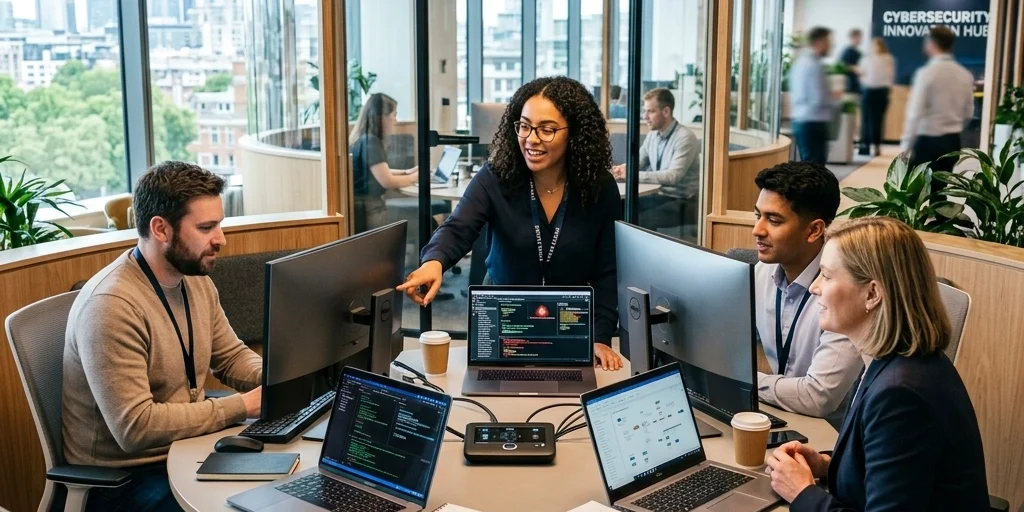
If you close your eyes and think of a "computer lab," what do you see? For most of us, it’s a windowless basement room filled with beige towers, monitors that hum like a disturbed beehive, and a faint smell of ozone and stale coffee. Maybe there’s a poster on the wall about "Cyber Safety" that looks like it was designed in Microsoft Paint circa 1998.
Well, I have some news that might hurt your nostalgic soul, but it’s going to save your business: those labs are effectively dead. They’re the rotary phones of the digital age: quaint to look at, but you wouldn’t want to rely on one to save your company from a ransomware attack.
At USA Entertainment Ventures LLC, we spend a lot of time looking at how physical infrastructure meets digital demand. What we’re seeing isn't just a slight upgrade; it’s a total reimagining of where and how technical training happens. The "Pod" has arrived, and it’s making the traditional lab look like a literal museum exhibit.
The 40% Problem: Why the Old Way Failed
Let’s talk numbers for a second, because data is the only thing that doesn’t lie (unlike your "waterproof" phone). Recent campus reports show that traditional computer labs are currently sitting at less than 40% capacity.
Why? Because of the "Bring Your Own Device" (BYOD) revolution. Roughly 95% of students and professionals are walking around with laptops that have more processing power than the entire lab used to have ten years ago. When everyone has their own rig, why walk down to a dusty basement to sit in a squeaky chair?
The problem is that while personal laptops are great for checking emails or writing a blog post, they aren't always enough for high-stakes cybersecurity training. You can't simulate a massive network breach on a MacBook Air while you're sitting in a crowded Starbucks. You need something more specialized, more secure, and: let’s be honest: cooler.

Enter the Pod: The Swiss Army Knife of Infrastructure
So, what exactly is a "Pod"? Think of it as a modular, tech-integrated, self-contained unit. It’s not just a fancy phone booth; it’s a hardware-optimized sanctuary.
Modern Pods are:
- Acoustically Treated: You can scream at a line of code without disturbing the person next to you.
- Climate Controlled: No more sweating through your shirt because 30 servers are running in a small room.
- Hardware Specialized: They come pre-loaded with the kind of high-performance gear that makes a gamer weep with joy.
- Modular: You can put them in a lobby, a warehouse, or a hallway. You don’t need to renovate an entire building; you just need a plug.
For businesses looking for consulting services, the ROI on Pods is a no-brainer. Instead of paying for HVAC and lighting for a 2,000-square-foot lab that sits empty 60% of the time, you invest in modular units that are used 100% of the time they are occupied.
Why Cybersecurity Training Needs a Physical "Home"
You might be thinking, "Dan, if we have the cloud, why do we need physical Pods at all?"
It’s a fair question. But cybersecurity isn't just about software; it’s about the environment. Training for a cyber-defense role requires intense focus. It’s a team sport. Whether it’s a "Duo Pod" for two-person tactical drills or a "Quad Pod" for a small response team, these units provide the physical "war room" feel that a Zoom call just can't replicate.
In a Pod, you can control the network. You can create a "sandbox" environment where you can safely unleash the nastiest malware known to man without worrying that it’s going to leak onto the building’s main Wi-Fi and shut down the HR department's payroll system. That level of physical isolation is the gold standard for high-level training.

Three Career Pathways: Logistics, Cyber, and Content
The shift to Pod-based infrastructure isn't just a win for the IT department. It’s opening up massive career pathways across three distinct sectors. If you’re looking at career opportunities, this is where the puck is heading.
1. The Cybersecurity Architect
This is the obvious one. As we move away from dusty labs, the demand for professionals who can operate in these high-tech environments is skyrocketing. We’re talking about people who don't just know how to code, but who understand how to manage secure physical nodes.
2. The Logistics Mastermind
Someone has to move these Pods. Someone has to maintain them, upgrade the hardware, and manage the fleet. The logistics of modular infrastructure is a booming business. It’s about taking high-tech solutions and making them "mobile." If you can figure out how to deploy 50 Cybersecurity Pods across a corporate campus in a weekend, you’re the most valuable person in the room.
3. The Content Creation Specialist
Here’s the wild card. These Pods aren't just for hackers. Because they are soundproof and tech-heavy, they are the perfect environments for content creators. Whether it’s recording a podcast, streaming a technical tutorial, or editing high-res video, the "Pod" is the new studio. At USA Entertainment Ventures LLC, we see this crossover every day. The line between "Technical Training" and "Entertainment Content" is blurring, and the Pod is the bridge.
The "Cool Factor" and Talent Retention
Let’s be real for a second: people want to work in places that look like they belong in the 21st century. If you’re trying to recruit a top-tier cybersecurity expert and you show them a basement lab with flickering fluorescent lights, they’re going to walk right back out the door.
If you show them a sleek, climate-controlled Pod with ergonomic seating and triple-monitor setups, you’ve just made a statement. You’re telling them that their work is important enough to warrant the best tools.
We’ve seen this in our showcase of various projects. The physical environment dictates the culture. A Pod-based culture is agile, modern, and focused. It says you value efficiency over tradition.
Practical Steps: How to Pivot
If you’re still holding onto that old lab, it’s time to start the transition. You don't have to gut the building tomorrow, but you should be looking at modularity.
- Assess Your Real Estate: How much of your current lab space is actually being used for "lab work" vs. just being a place where people sit because there are no other desks?
- Trial a Unit: Start with one or two Pods. Put them in high-traffic areas and watch how quickly they become the most popular spots in the building.
- Identify Your Goals: Are you training cyber warriors, or are you trying to give your logistics team a quiet place to coordinate? The beauty of Pods is that they can be whatever you need them to be.
If you’re not sure where to start, you can always contact us. We specialize in navigating these kinds of business transitions. We’re not just about entertainment; we’re about the ventures that make entertainment: and business: possible.

The Future is Modular
The "Dusty Lab" had a good run. It gave us the early internet, the first generation of hackers, and probably a lot of back pain. But as we look toward 2026 and beyond, we need infrastructure that can keep up with the speed of light.
Cybersecurity threats don't wait for you to book a room in the basement. They happen in real-time, and your training and response environments should be just as dynamic. Pods aren't just a trend; they are the logical conclusion of a world that demands mobility, security, and high performance.
So, pour one out for the beige towers and the squeaky chairs. The future is here, it’s modular, and it’s probably much more comfortable than that basement you remember.
Are you ready to step into the Pod? The door is open.
USA Entertainment Ventures LLC is a business consulting firm based in the US, focusing on the intersection of technology, infrastructure, and the entertainment industry. Led by CEO Dan Kost, we help businesses navigate the complexities of the modern digital landscape with simple, effective strategies.
For more information on what we do, visit our About Us page or check out our Q&A for common industry insights.