
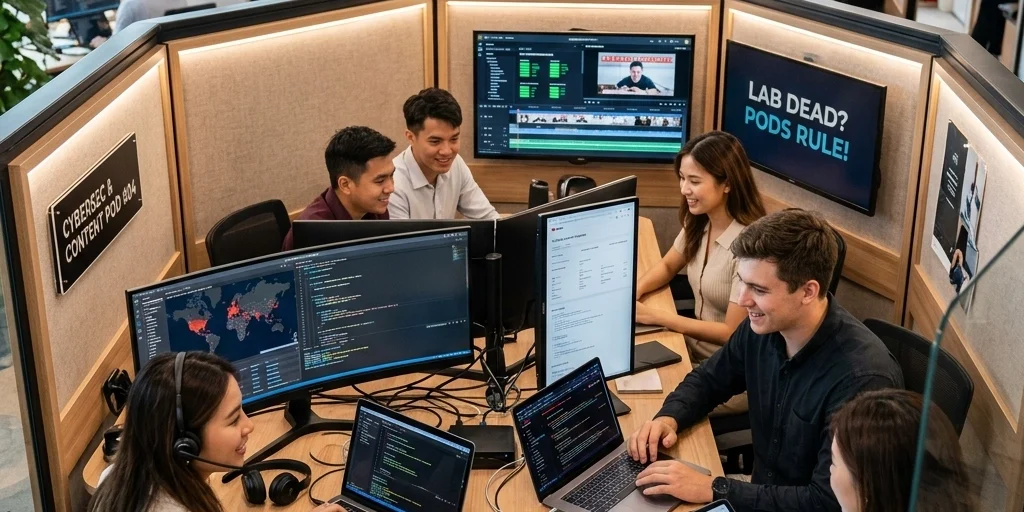
If you walk into a room filled with rows of beige desktop towers and fluorescent lights that buzz like a swarm of angry bees, you haven’t found a cutting-edge tech center: at least not in 2026. You’ve found a museum.
For decades, the "computer lab" was the crown jewel of schools and offices. It was the only place you could get high-speed internet or run software that didn’t make your personal laptop catch fire. But as we move further into the mid-2020s, the traditional lab is looking more like a rotary phone in a 5G world. It’s bulky, expensive to maintain, and about as flexible as a brick.
Enter the "Pod." Modular, specialized, and incredibly sleek, Pods are becoming the new physical infrastructure for the most high-demand careers of our era: cybersecurity, content creation, and logistics. At USA Entertainment Ventures LLC, we’re seeing a massive shift in how businesses and educational institutions approach their physical tech footprints.
The question isn't just "Are computer labs dead?" The real question is: "What’s taking their place, and why is it so much better for your career?"
The Ghost of Labs Past
Let’s be honest: the traditional computer lab was a logistics nightmare. You needed a massive room, industrial-grade HVAC to keep the servers from melting, and a dedicated IT team to untangle the "spaghetti" of wires behind every desk. If you wanted to upgrade one machine, you usually had to upgrade all fifty to keep things uniform. It was a "one-size-fits-none" approach.
Research shows that these labs face a steep decline because of their high capital investment and the rapid rate of hardware obsolescence. In 2026, tech moves too fast for a five-year procurement cycle. By the time the budget is approved, the graphics cards are already ancient history.
The Rise of the Pod: Modular, Not Miserable
A "Pod" isn't just a fancy desk. It’s a self-contained, modular environment designed for specific workflows. Think of it as a professional-grade "plug-and-play" workstation that provides the isolation, power, and connectivity required for specialized tasks without needing a dedicated 2,000-square-foot room.

Why Pods are Winning:
- Scalability: Need five more workstations? You don’t need to knock down a wall; you just drop in five more Pods.
- Specialization: You can have a "Cyber Pod" right next to a "Content Pod." They don’t need the same hardware, lighting, or security protocols.
- Privacy and Focus: In the age of open offices, Pods provide the physical and acoustic isolation needed for deep work.
- Mobility: Many Pod designs are semi-portable. If your office moves, your infrastructure moves with you.
Cybersecurity: The Digital Bunker
If there is one field where the traditional lab has failed most spectacularly, it’s cybersecurity. You can’t train the next generation of "white hat" hackers in an open room where everyone can see each other's screens.
Cybersecurity requires a "bunker" mentality. A Cybersecurity Pod acts as a hardened physical node. It’s equipped with air-gapped networking capabilities, multi-monitor setups for threat monitoring, and specialized hardware that can handle the intense processing required for encryption and penetration testing.
For those looking into career pathways, the "Cyber Pod" represents the front line. As global threats become more sophisticated, the physical environment where security analysts work must be as secure as the code they write. This isn't just about software anymore; it's about creating a controlled physical space where data integrity is the top priority.
Content Creation: From "Influencer" to "Industry"
Content creation has evolved from a hobby into a multi-billion-dollar economic engine. But you can't record high-quality podcasts or edit 8K VR video in a traditional computer lab. The acoustics are terrible, the lighting is "office-drab," and the hardware usually lacks the GPU "oomph" needed for modern rendering.
Content Creation Pods are the new studios. These units come pre-equipped with:
- Acoustic Treatment: No more "hallway echo" in your audio.
- Integrated Lighting: Professional-grade key lights built into the frame.
- High-End I/O: Easy access to XLR inputs, SDI ports, and high-speed storage bays.
This shift is creating a massive career bridge. We are seeing a surge in demand for "Content Technicians": people who know how to manage the hardware and physical infrastructure of these Pods to ensure a seamless output. Whether you’re looking at 360 Sports Media or independent production, the Pod is the HQ for the modern creator.

Logistics: The Hidden Hero of the Pod Revolution
You might be wondering: "If we're moving all this hardware into individual Pods, who manages the deployment?"
This is where the new career pathway in Tech Logistics comes in. Moving a thousand-pound "Pod" across a campus or a city and integrating it into a mesh network is a complex logistical dance. It requires expertise in both physical supply chain management and technical integration.
Logistics professionals are now focusing on "Modular Infrastructure Deployment." It’s no longer about just shipping boxes; it’s about maintaining a fleet of mobile, high-tech environments. Companies like Mobile Hwy Ads understand the power of moving high-impact tech to where it’s needed most. The logistics of the future isn't just about getting a package from point A to point B: it’s about ensuring the "command center" arrives ready to work.
The Business Case: Why Pods Make Sense for the Bottom Line
From a business consulting perspective at USA Entertainment Ventures LLC, we look at the ROI. Traditional labs are "sunk costs." You spend $200k on a room that is obsolete in three years.
Pods, however, are assets. They can be leased, moved, or resold. They reduce the need for massive real estate footprints. If your team shrinks, you don't have an empty, expensive room; you have Pods you can repurpose or relocate.
Key Takeaways for Businesses:
- Stop Investing in Fixed Infrastructure: If it’s bolted to the floor, it’s probably a bad investment in 2026.
- Focus on Specialization: Your HR team doesn't need the same setup as your video editors. Pods allow for "Right-Sized" tech.
- Prioritize Employee Experience: People want to work in spaces that feel intentional. A Pod feels like a premium tool; a row of desks in a lab feels like a classroom.
Looking Ahead: 2026 and Beyond
As we navigate through 2026, the trend is clear: the "Computer Lab" is being decentralized. We are moving toward a hybrid model where virtual, cloud-based labs handle the "brain work," and physical Pods handle the "heavy lifting" and specialized environments.
Whether you are a student looking for a career in cybersecurity or a business owner trying to figure out how to house your new media team, the Pod is the answer. It’s the HQ of the future: modular, efficient, and ready for whatever the next tech wave throws at us.

Ready to rethink your physical infrastructure? At USA Entertainment Ventures LLC, we specialize in helping businesses navigate the intersection of entertainment, technology, and logistics. Don't get stuck in the "beige box" era. Let’s talk about how Pods can transform your workflow and your bottom line.
The traditional computer lab might be dead, but the future of specialized, modular workspaces has never looked more alive. Are you ready to step into the Pod?





