When most executives hear the word "esports," they envision teenagers hunched over keyboards, battling virtual opponents for glory and prize money. This perception, while not entirely inaccurate, misses the strategic opportunity hiding in plain sight.
Esports is not simply entertainment. It is a permission slip: a culturally relevant entry point into educational institutions that allows forward-thinking corporations to deploy sophisticated workforce development infrastructure under a banner that students and administrators actually welcome.
The competitive gaming wrapper is merely the surface. Beneath it lies a comprehensive delivery system for cloud computing curriculum, artificial intelligence literacy, data analytics training, cybersecurity fundamentals, logistics simulation, and content creation skills. For Fortune 100 companies seeking to build tomorrow's talent pipeline while strengthening brand trust, esports represents an unparalleled opportunity to become synonymous with "future-ready" education.
The Permission Problem in Education
Corporate engagement with K-12 education has long faced a fundamental challenge: schools are inherently cautious about outside influence. Administrators worry about commercialization. Parents question motives. Teachers resist disruption to established curricula.
Traditional workforce development programs often struggle to gain traction because they feel imposed rather than invited. They arrive packaged in corporate language that feels foreign to educational environments.
Esports solves this problem elegantly.

Research consistently shows that esports programs successfully integrate STEM and Career Technical Education (CTE) frameworks while maintaining high student engagement. Programs emphasizing data analysis, performance metrics, and real-world skill application have demonstrated measurable success in teaching teamwork, critical thinking, and problem-solving: skills that transfer directly to professional environments.
Students want to participate. Parents see value in structured competitive activities. Administrators recognize esports as a legitimate pathway to career readiness. The door opens willingly.
Once inside, the real education begins.
The Infrastructure Layer: Physical Pods as Distribution Systems
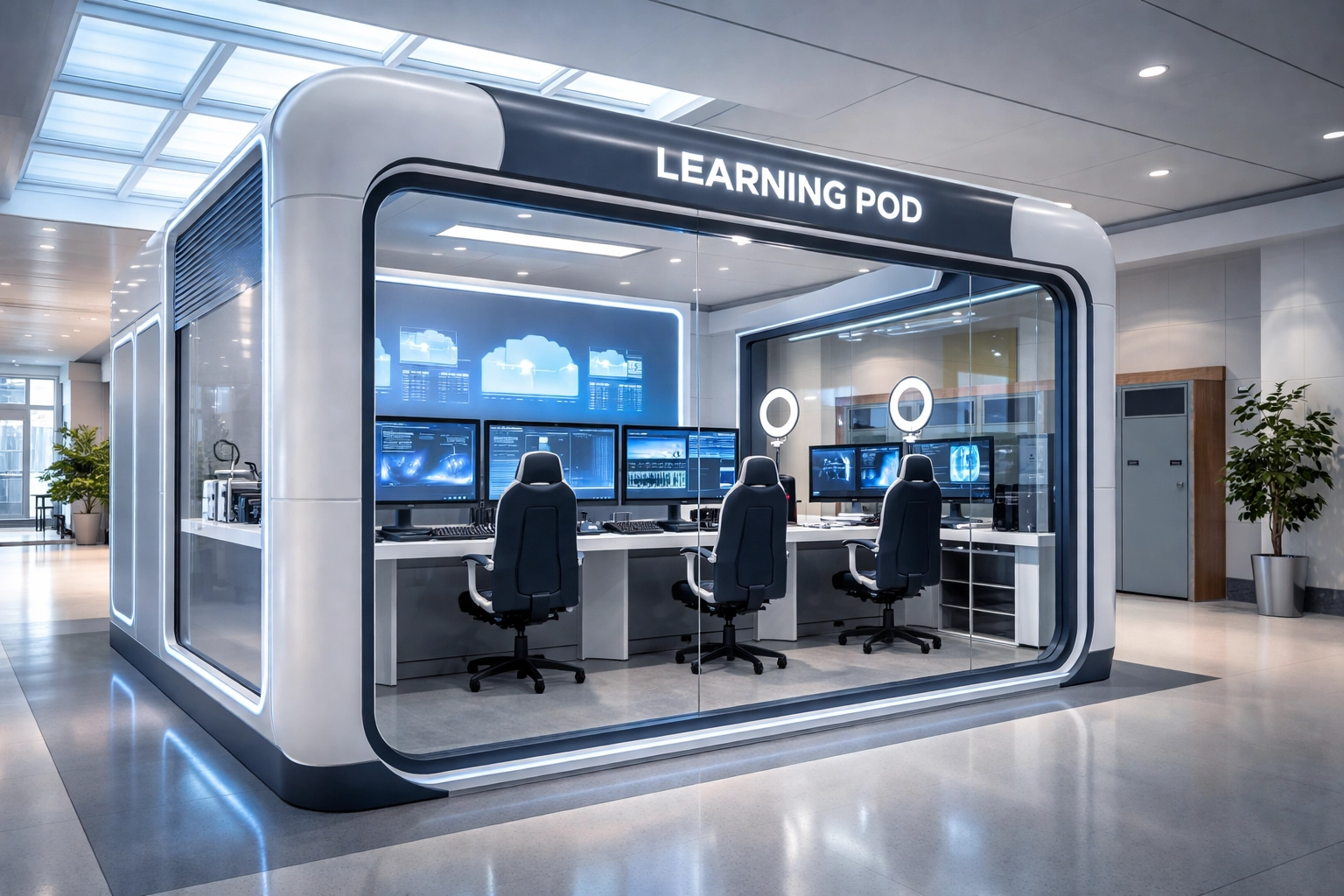
The strategic value of esports in education extends far beyond software and curriculum. Physical infrastructure: specifically, purpose-built learning pods: creates a permanent, branded presence within schools that no digital-only initiative can match.
These pods function as multi-use platforms rather than single-purpose gaming stations. Each installation can include:
- Competitive esports stations for team-based learning and tournaments
- Cloud computing curriculum access with pathways to industry certifications
- Streaming studio capabilities for content creation and media literacy
- Data analytics dashboards for real-time performance measurement
- Career pathway programming spanning multiple high-demand industries
The pod becomes the new computer lab: a centralized hub where cutting-edge technology meets hands-on learning. Unlike traditional computer labs that age into obsolescence, these installations are designed for continuous curriculum updates and evolving industry partnerships.
For corporations, the physical presence matters enormously. A logo on a website fades from memory. A branded learning environment where students spend hours each week creates lasting associations between the company and opportunity, innovation, and support.
Cloud Computing: The Hidden Curriculum
Every esports match generates data. Server connections, latency measurements, network traffic, storage requirements: the backend infrastructure required to run competitive gaming mirrors the systems that power modern enterprise operations.
This creates a natural teaching environment for cloud computing fundamentals.
Students learning to optimize their gaming performance inevitably encounter questions about server architecture. Why does latency matter? How do networks route information? What makes some cloud providers faster than others? These questions open doors to curriculum that might otherwise feel abstract or inaccessible.
Cloud certification pathways become tangible when students can connect theoretical concepts to systems they interact with daily. The progression from casual user to informed operator to certified professional becomes visible and achievable.
For corporations with cloud services divisions, this represents a long-term talent funnel. Students who learn cloud fundamentals through esports-integrated curriculum are more likely to pursue related certifications, consider related careers, and remember which company made that pathway possible.
Artificial Intelligence: From Player to Practitioner
Artificial intelligence has become unavoidable in competitive gaming. AI-powered analytics tools evaluate player performance, predict opponent strategies, and optimize training regimens. Game developers increasingly incorporate machine learning into gameplay mechanics themselves.
Students engaged in serious esports competition naturally encounter AI as users. The educational opportunity lies in transitioning them from consumers of AI tools to practitioners who understand underlying principles.
AI literacy curriculum integrated into esports programs can address:
- Machine learning fundamentals through game strategy optimization
- Data pattern recognition using match performance analytics
- Algorithm basics via custom bot development and automation
- Ethical AI considerations through discussions of fairness in competitive environments
This grounding in AI concepts prepares students for a workforce where artificial intelligence will be omnipresent across industries. The competitive gaming context makes abstract concepts concrete and immediately applicable.
Data Analytics: Every Match Tells a Story
Modern esports operates on data. Professional teams employ analysts who dissect match footage, compile performance metrics, and identify statistical patterns that inform strategy. This same analytical framework can be taught at the high school level.

Data analytics dashboards built into learning pod installations allow students to:
- Track individual and team performance over time
- Identify statistical trends and correlations
- Create visualizations that communicate findings effectively
- Make data-informed decisions about strategy and improvement
These skills transfer directly to careers in business intelligence, market research, financial analysis, and countless other fields where data literacy is essential. The esports context provides motivation and relevance that generic data curriculum often lacks.
Students who learn to analyze gaming data develop analytical thinking patterns that serve them throughout their professional lives. They become comfortable with spreadsheets, dashboards, and statistical reasoning: competencies that employers consistently rank among the most valuable.
Content Creation and Media Literacy
Esports culture is inseparable from content creation. Streaming platforms, video production, social media management, and personal branding are integral to the ecosystem. Students engaged in competitive gaming often maintain parallel interests in broadcasting, editing, and digital marketing.
Learning pods equipped with streaming studio capabilities transform this interest into structured education. Students learn:
- Video production fundamentals including lighting, audio, and editing
- Live broadcasting skills including presentation, improvisation, and audience engagement
- Social media strategy including platform optimization and community building
- Personal brand development including Name, Image, and Likeness (NIL) considerations
These competencies serve students regardless of whether they pursue gaming professionally. Marketing departments, corporate communications teams, and media companies all seek employees with practical content creation experience.
Logistics and Operations: Running the Machine
Esports tournaments require logistics. Equipment must be maintained, scheduled, and transported. Events require coordination across multiple stakeholders. Teams need management structures that handle communications, scheduling, and resource allocation.

This operational complexity creates teaching opportunities for logistics simulation and supply chain fundamentals. Students who help organize esports events learn principles that apply to warehouse management, distribution networks, and enterprise operations.
The skills are transferable because the underlying challenges are universal: How do you move resources efficiently? How do you coordinate multiple parties toward a common goal? How do you anticipate problems before they occur?
Corporations with significant logistics operations gain access to students who have practiced these skills in contexts they find genuinely engaging. The learning sticks because the motivation is intrinsic.
Cybersecurity: Defending the Digital Arena
Competitive gaming environments present constant cybersecurity challenges. DDoS attacks target tournaments. Account security matters enormously to players who have invested thousands of hours building their profiles. Network vulnerabilities can compromise competitive integrity.
These real-world stakes make cybersecurity education meaningful rather than theoretical. Students learn:
- Network security fundamentals through practical application
- Authentication and access control principles
- Threat identification and response procedures
- Privacy protection practices
The cybersecurity talent shortage is well-documented across industries. Programs that introduce students to security concepts through engaging, relevant contexts help build the pipeline of professionals that enterprises desperately need.
The Strategic Opportunity for Fortune 100 Companies
Esports-integrated learning infrastructure offers something rare in corporate education partnerships: a delivery mechanism that students welcome, schools embrace, and companies can scale nationally.
The competitive gaming wrapper provides cultural permission. The physical pod infrastructure ensures lasting presence. The curriculum stack: spanning cloud, AI, data analytics, content creation, logistics, and cybersecurity: builds genuine workforce capabilities.
Companies that anchor these programs become synonymous with future-ready education. Their brands attach to opportunity and innovation in the minds of students, parents, educators, and communities.
This is not sponsorship in the traditional sense. This is infrastructure investment that generates talent pipeline, brand trust, and workforce development outcomes simultaneously.
The question is not whether esports will become a standard feature in American education. The question is which corporations will recognize the opportunity and position themselves as anchors in this emerging ecosystem.
For Fortune 100 companies serious about workforce development, the strategic path forward is clear: look beyond the game and see the infrastructure opportunity waiting to be built.
USA Entertainment Ventures LLC specializes in deploying workforce development infrastructure through innovative partnerships. Learn more about our programs.