
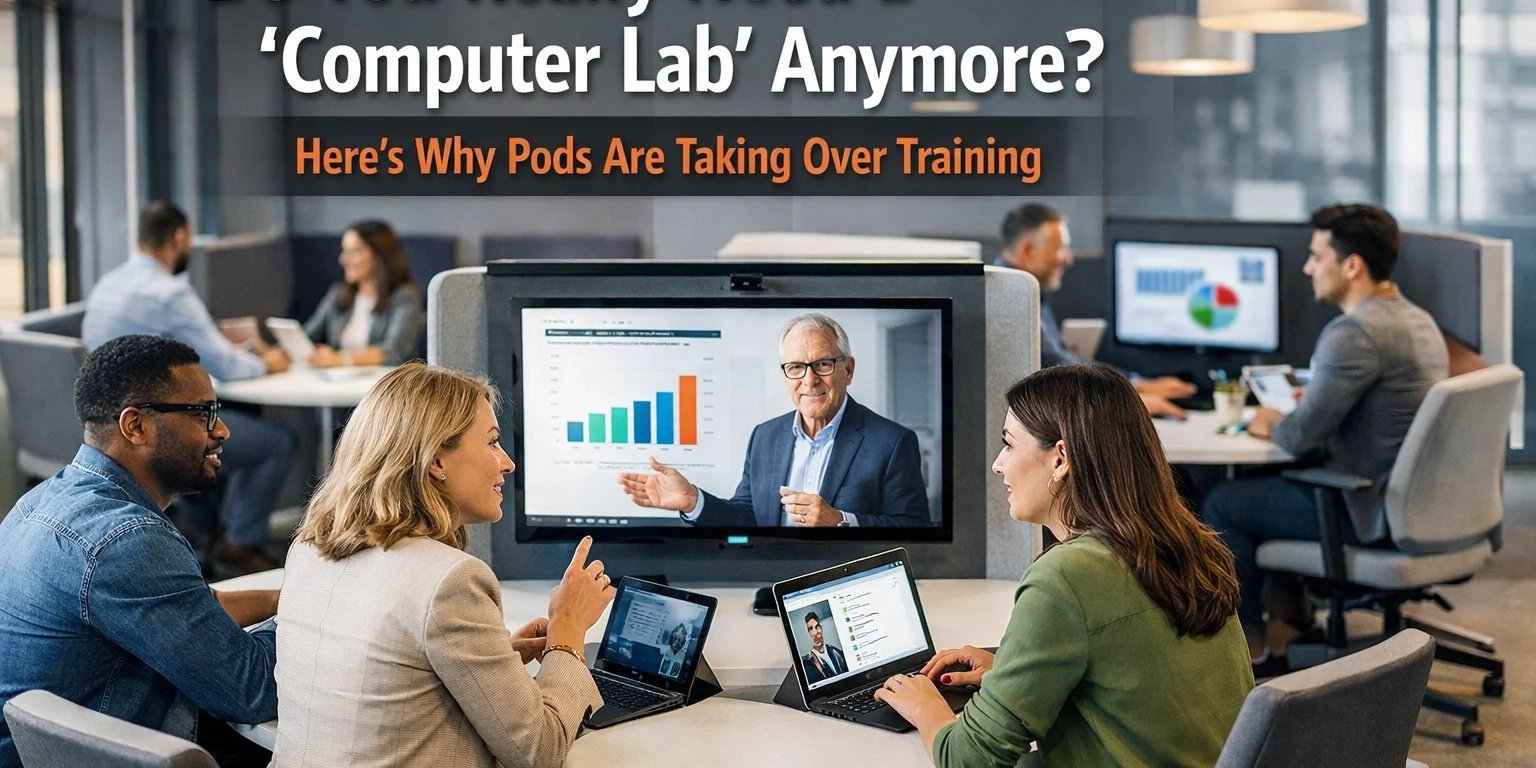
If you close your eyes and think of a “computer lab,” what do you see? Probably a sterile room filled with rows of beige (or maybe slate grey) towers, flickering fluorescent lights, and that faint, unmistakable smell of ozone and forbidden snacks. It was the place where you learned how to type "The quick brown fox" and maybe, if the teacher wasn't looking, played a sneaky game of Oregon Trail.
But it’s 2026. We’ve got AI writing our emails, cars that (mostly) drive themselves, and a workforce that needs to be ready for the "real world" before they even step foot in an office. So why are we still training people in environments that look like a 1998 call center?
At USA Entertainment Ventures LLC, we’ve been watching the shift closely. The "Computer Lab" is officially on life support, and the "Training Pod" is the one holding the scalpel. Here is why the physical infrastructure of learning is undergoing a massive facelift, and why your business, or your career, needs to catch up.
The Death of the Row: Why Labs Failed the Vibe Check
Traditional computer labs were built for one thing: uniformity. Everyone has the same mouse, the same monitor, and the same boredom. They work fine for teaching isolated technical skills, like how to use a spreadsheet, but they fail miserably at preparing workers for the messy, collaborative, and fast-paced nature of modern industry.
Think about it. When was the last time you worked in a perfectly silent row of 30 people all doing the same task? Probably never. Modern work is about communication, adaptability, and using specific tools in specific contexts.
The traditional lab model also has a massive financial flaw: it’s an anchor. If you build a 30-station lab and only 10 people need to learn cybersecurity this month, 20 high-end machines sit there gathering dust and depreciating faster than a new car driven off the lot. It’s inefficient, and quite frankly, it’s a waste of space.
Enter the Pod: The Boutique Gym of Training
If a computer lab is a massive, old-school bodybuilding gym, a Pod is a specialized CrossFit box. It’s smaller, more intense, and built for a specific purpose.
A "Pod" is a purpose-built learning environment configured around specific career pathways. Instead of a sea of desks, you have specialized clusters of technology that mirror a real-world workplace. If you’re training for logistics, the Pod looks like a logistics hub. If you’re training for cybersecurity, it feels like a Security Operations Center (SOC).
Research shows that pods deliver a staggering 50-75 percent cost reduction compared to traditional labs. Why? Because you aren't over-building. You are scaling resources to actual demand. You can learn more about how this fits into the broader national strategy on our National Workforce Infrastructure Rollout page.

Career Pathway #1: Cybersecurity (The Matrix, But With Better Chairs)
Let’s talk about cybersecurity. You can’t learn to defend a network by sitting in a row and reading a PDF. You need to be in the "thick of it."
A cybersecurity training pod isn't just a desk with a laptop. It’s an environment featuring network simulation equipment, penetration testing tools, and workstations arranged for team-based incident response. It’s designed to facilitate high-pressure simulations where one group attacks and the other defends.
This layout fosters "muscle memory." When a trainee eventually lands a job in a real SOC, they don’t have that "deer in the headlights" moment. They’ve seen the screens, they’ve worked the comms, and they’ve operated the hardware in a pod that looks exactly like their new office.
Career Pathway #2: Logistics (Moving the World)
Logistics used to be about clipboards and heavy lifting. Now? It’s about data, RFID, and complex supply chain software.
A logistics pod might incorporate actual RFID scanners, warehouse management software (WMS) terminals, and even small-scale sorting simulations. Trainees aren't just clicking buttons; they are understanding the physical flow of goods through a digital lens.
In these pods, learners tackle real-world scenarios: "A shipment is delayed in Singapore, the RFID tag on pallet B is malfunctioning, and the client needs an update in five minutes. Go." You can't simulate that kind of pressure in a traditional computer lab where everyone is just staring at a PowerPoint.

Career Pathway #3: Content Creation (The New Office)
The "creator economy" isn't a hobby anymore; it’s a multi-billion dollar industry that requires a serious workforce. From corporate video production to high-end podcasting and social media management, the demand for content creators is skyrocketing.
A content creation pod is a far cry from a computer lab. It features sound-treated walls, professional lighting rigs, 4K cameras, and high-end editing suites. It’s a space where a trainee can go from "I have an idea" to "I have a finished product" in one afternoon.
The beauty of the pod model here is modularity. If the trend shifts from long-form video to short-form vertical content, you don’t need to renovate the entire building. You just swap out a few peripherals, update the software, and your pod is ready for the next wave.
The Financial "Cheat Code": Why Your CFO Will Love Pods
Let’s get down to brass tacks. At USA Entertainment Ventures LLC, we know that at the end of the day, the numbers have to make sense.
- Reduced Waste: Traditional labs require massive footprints and expensive HVAC to keep 50 machines cool. Pods are compact and can be tucked into existing office footprints.
- Scalability: You can start with one pod and add more as your training needs grow. It’s the "plug and play" of physical infrastructure.
- Depreciation Management: When you buy 100 identical computers, they all become obsolete at the same time. With pods, you can cycle your hardware upgrades based on which industry (cyber vs. logistics vs. content) is evolving fastest.
If you’re wondering how this fits into your specific business model, checking out our services page might give you some ideas on how we consult on these transitions.

But Is the Computer Lab Dead Dead?
Look, we aren't suggesting you take a sledgehammer to every row of desks in your building just yet. There is still a place for traditional labs, mostly for foundational, "101-level" technical skills. If you need to teach 50 people how to log into a basic portal, a lab is fine.
But for career readiness, the lab is a dinosaur. The future is hybrid. Organizations that are winning the talent war are using labs for the basics and Pods for mastery. It’s the difference between reading a book about swimming and actually jumping into the pool.
Why This Matters for 2026 and Beyond
The workforce is changing faster than our education systems can keep up. By moving to a pod-based infrastructure, companies and training centers can stay agile.
Imagine a world where a training center can pivot its entire focus in a weekend. Saturday it’s a cybersecurity hub; Monday it’s a logistics training center. That’s the power of modular pods. It’s not just about the tech; it’s about the flexibility to meet the market where it’s going, not where it’s been.
As Dan Kost, our CEO, often says, "If you're still doing things the way you did them three years ago, you're already behind." (Okay, maybe he didn't say it exactly like that, but the sentiment stands!)
How to Get Started
If you are an executive looking at your training budget and wondering why you aren't seeing the ROI you expected, it might be time to look at your floor plan. Are you building a museum of technology, or a launchpad for careers?
The shift toward Pods is more than a design trend; it’s a fundamental rethinking of how humans acquire professional skills. It’s about creating an environment that respects the learner’s time and the organization’s bottom line.
If you want to chat more about how we see the future of workforce infrastructure, or if you just want to see some cool examples of what we’ve done, feel free to contact us. We’re always up for a conversation about how to make things better, faster, and: let's be honest: a whole lot cooler.

The Bottom Line
The "Computer Lab" was a great tool for the 20th century. It helped us bridge the gap between paper and digital. But the gap has been bridged. Now, we need to build the structures that actually help people work in that digital world.
Pods are taking over because they are smarter, cheaper, and infinitely more effective. So, do you really need a computer lab anymore? Probably not. You need a Pod. And you probably needed it yesterday.
Check out our about us page to see the team behind these insights, and let’s get to work building the future, one pod at a time.





